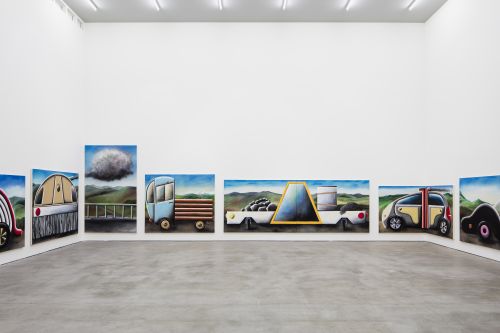
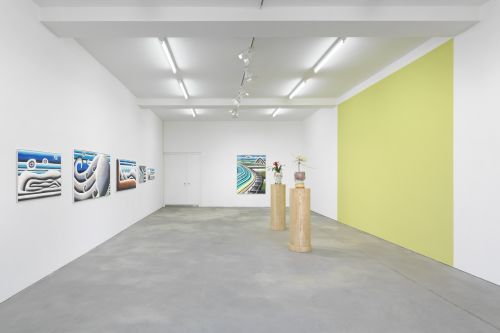
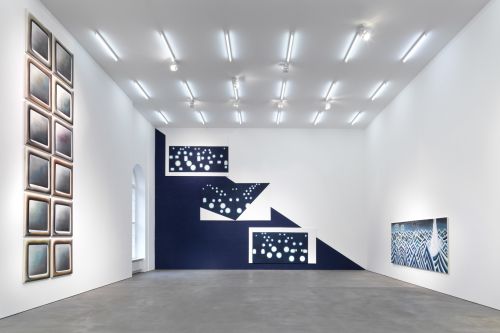
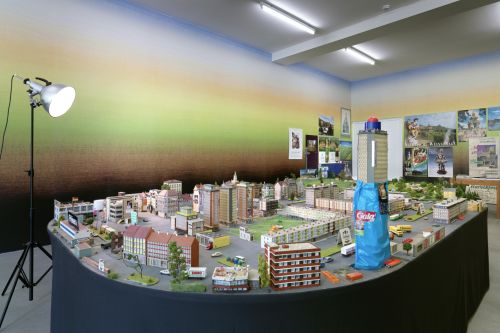
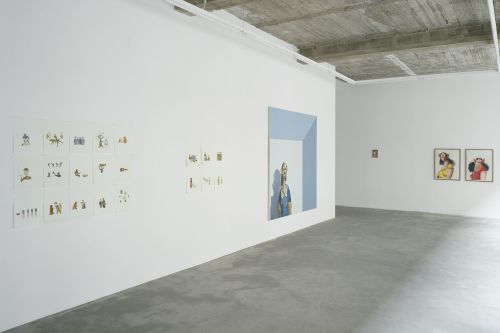
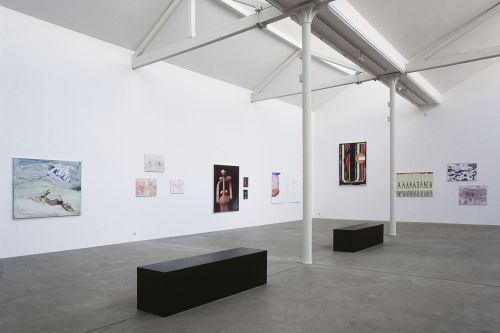
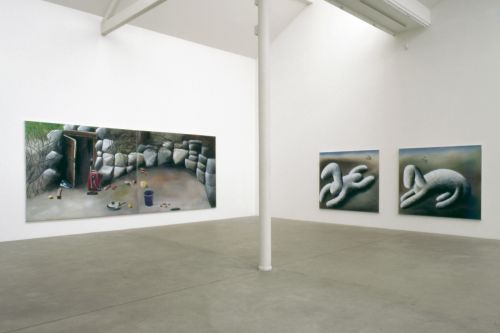
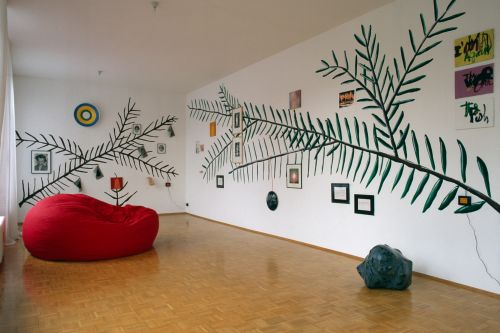
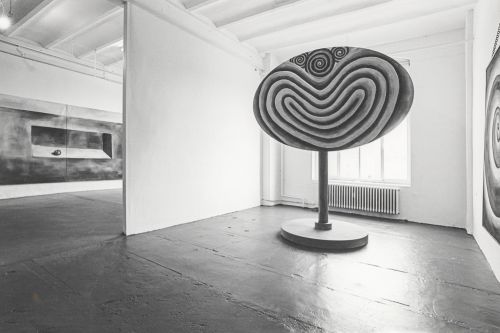
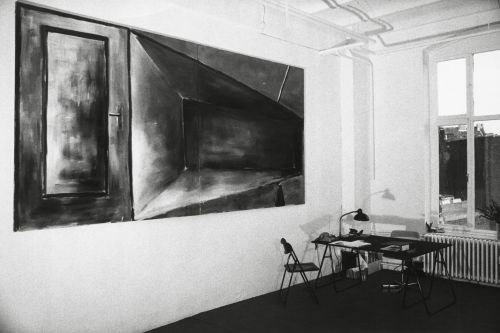
Andreas Schulze (*1955) is one of the great individualists of German painting. The artist’s unique painting style defamiliarizes basic design and architectural forms, with a cryptic pictorial repertoire that oscillates between gentle irony and friendly affirmation, menace and comfort. It exposes the blind spots of middle-class life and ironizes the pretensions of contemporary art. The Cologne-based artist has been associated with the gallery since 1983.
Read more
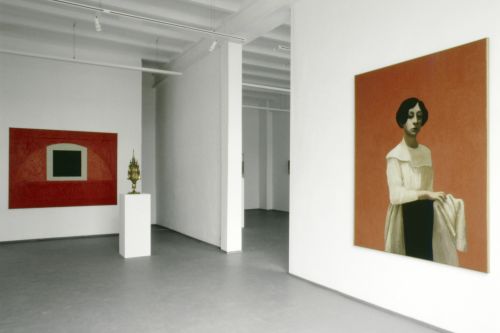
Since the beginning of his career on the Cologne scene in the 1980s, Schulze’s work deliberately situates itself outside of common painterly trends, attitudes and affiliations. Despite contacts to the Neue Wilde (New Fauves) of the Mülheimer Freiheit group and other Cologne artists, the painter developed his own distinctive way of painting that combines the representational with the absurd.
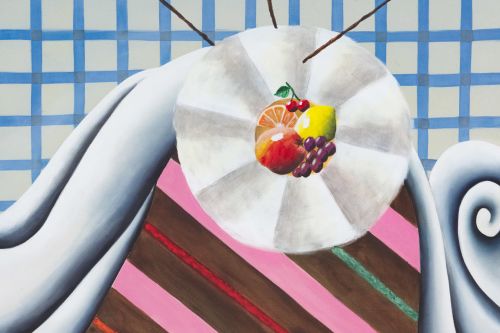
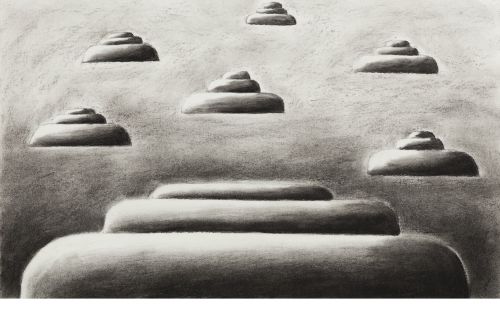
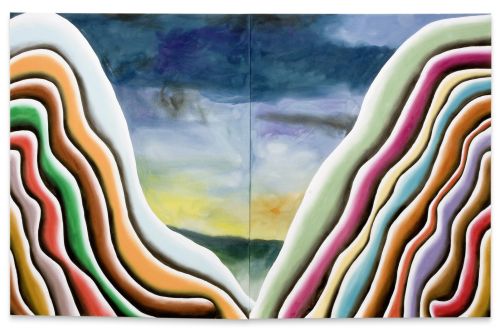
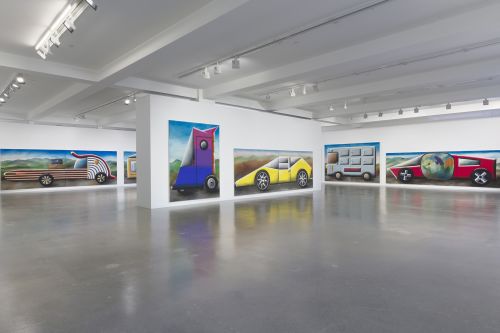
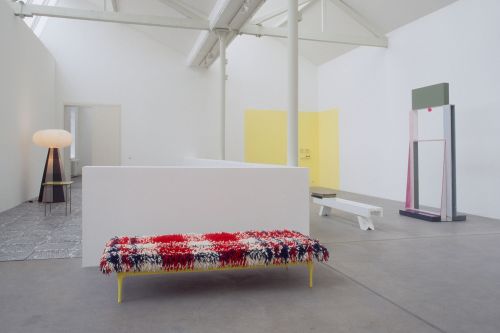
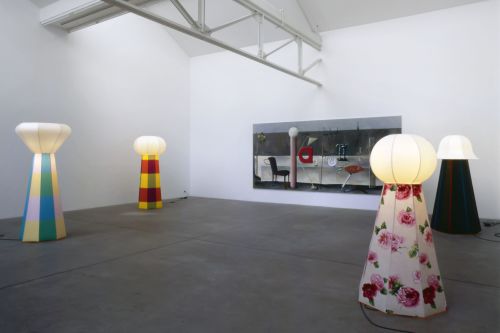
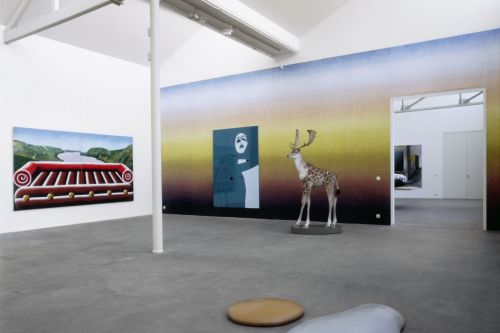
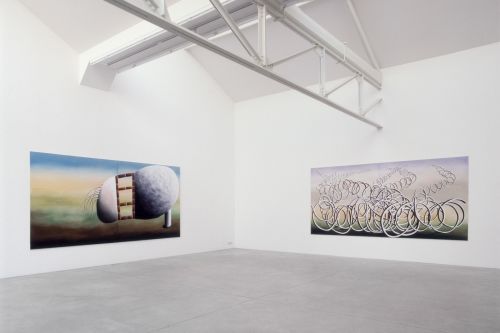
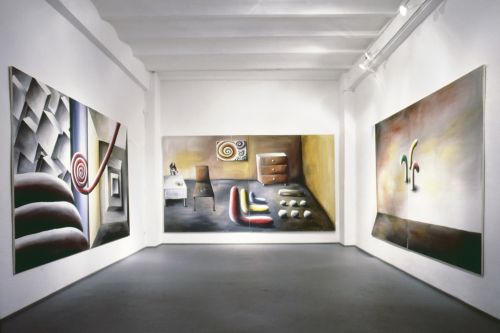
His repertoire of middle-class emblems thrives on the almost brazen simplicity of their pictorial settings. The “subjects” of these renderings include such commonplace things as peas, geraniums, fruit or porcelain dishes. Everyday objects such as sofas, cars, windows, rocks or Mars bars are arranged in humorous tableaux. Shaded geometric and biomorphic sausage-like shapes are contrasted with spherical color gradients in the background. Built-in kitchen cabinets, absurd pipe constructions or the kind of fringed roller found in a car wash are interspersed with abstracted household objects and the occasional indoor plant. Interiors and landscapes merge. Prefabricated houses are captured in an oblique bird’s eye view. In series that he revisits again and again, Schulze paints pictures of spheres and windows. His car paintings resemble assemblages of car doors, bumpers, and windshields, masterfully-painted yet quite possibly cobbled together by a mischievous child. Although primarily active as a painter, Schulze has repeatedly expanded his artistic universe to include sculptures and installations. He has also designed lamps and carpets himself and staged living room interiors on floor paintings that can resemble a lawn or a street intersection.
For all his independence, Schulze brings a multitude of art historical references to the fore: from Oskar Schlemmer’s Triadisches Ballett (Triadic Ballet) to Pop, surrealism and naïve painting. Yet he also defies the avant-garde propensity for assuming a superior stance of profundity. Balancing on the fine line between representation and abstraction, he carves out our collective pictorial understandings of miscellaneous everyday objects while simultaneously subjecting them to a kind of humorous destabilization. The objects are recognizable as such, and yet they also resemble patterns, designs or ornaments. They always exude something almost surreal; infused with an intrinsic logic of painterly comedy, they often have the look of something puffed-up and soft, if not inflated.
In radically simplifying his everyday subjects and thereby depriving them of their already rather banal meaning, Schulze forces viewers to question their fundamental nature. His work alternates between familiarity and strangeness and seems to express a fear of our increasingly complex society. It is an oeuvre that seems to make fun of middle-class trappings and their fetishization while also showing great sympathy and understanding about the need for such fetishes.
Shadow and Light Richard Artschwager, John Baldessari, Matthew Barney, George Condo, Walter Dahn, Olafur Eliasson, Martin Fengel, Peter Fischli David Weiss, Dan Flavin, Sylvie Fleury, Gilbert & George, Dan Graham, Thomas Grünfeld, Andreas Gursky, Stefan Hirsig, Jenny Holzer, Axel Kasseböhmer, Stefan Kern, Karen Kilimnik, Astrid Klein, Louise Lawler, Anne Loch, Paul Morrison, Jean-Luc Mylayne, Bruce Nauman, Manuel Ocampo, Nam June Paik, Hirsch Perlman, Lari Pittman, Barbara Probst, Gerhard Richter, Ed Ruscha, Robert Ryman, Frances Scholz, Andreas Schulze, Cindy Sherman, Paul Sietsema, Rosemarie Trockel, Kara Walker, Andy Warhol, Christopher Wool, Martin Wöhrl, Philip-Lorca diCorcia July 26–August 31, 2003 Salzburg
Monika Sprüth and Philomene Magers will open a temporary space in Salzburg together with their London partner Simon Lee for the duration of the Salzburg Festival. One of the main reasons for this was the fact that the galleries are traditionally closed in August and that exhibition operations are shut down, but at the same time cultural life is at its peak in Salzburg, not far from our Munich location. It makes sense to contribute something to the cultural climate with a precisely formulated group exhibition and at the same time to reach a sophisticated international audience.
20th Anniversary Show John Baldessari, Alighiero Boetti, George Condo, Walter Dahn, Thomas Demand, Thea Djordjadze, Peter Fischli David Weiss, Sylvie Fleury, Andreas Gursky, Jenny Holzer, Gary Hume, Axel Kasseböhmer, Karen Kilimnik, Astrid Klein, Barbara Kruger, Louise Lawler, Jean-Luc Mylayne, Nina Pohl, Richard Prince, Ed Ruscha, Frances Scholz, Andreas Schulze, Cindy Sherman, Rosemarie Trockel, Andrea Zittel, Philip-Lorca diCorcia April 25–October 18, 2003 Cologne
In 1983, Monika Sprüth opened her Cologne based gallery with a solo show by Andreas Schulze. Starting from the idea to establish a forum for young and unknown artists, the central focus of the gallery concept was developed in the discourse of the 80s. The gallery program was completed by recourses to artistic attitudes of the last 40 years. This research, motivated by reflection on contemporary art history, was more and more realized in cooperation with Philomene Magers who directed her Bonn gallery since 1992. After a few years of loose cooperation, Monika Sprüth Gallery and Philomene Magers Gallery aligned with each other after, and together the Monika Sprüth / Philomene Magers Gallery opened up in Munich in 1999.
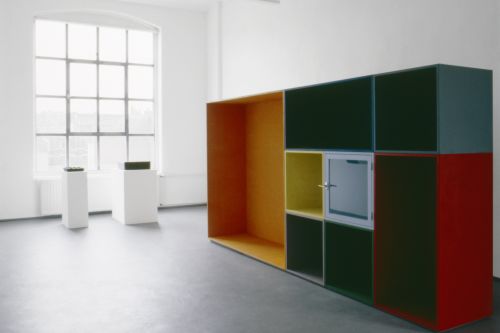
Reflexions Carl André, John Armleder, John Baldessari, Sylvie Fleury, Isa Genzken, Thomas Grünfeld, Stephan Jung, Karen Kilimnik, Jeff Koons, Louise Lawler, Robert Morris, Paul Morrison, Andreas Schulze, Andy Warhol, Franz West, Heimo Zobernig January 24–March 1, 2002 Munich
Künstler der Galerie Peter Fischli David Weiss, Rosemarie Trockel, George Condo, Axel Kasseböhmer, Cindy Sherman, Jenny Holzer, Barbara Kruger, Anne Loch, Andreas Schulze, Thomas Wachweger, Milan Kunc, Ina Barfuss June 13–July 15, 1987 Cologne
Andreas Schulze (*1955, Hanover) lives in Cologne. Special, a major solo exhibition of Schulze’s work is currently on view at ICA Miami (through April 19, 2026). Selected solo exhibitions include Le Consortium, Dijon (2025), Kunsthalle Nürnberg, which traveled to The Perimeter, London (2022–23), Fuhrwerkswaage, Cologne (2021), Kunsthalle Bielefeld (2018), Villa Merkel, Esslingen, which traveled to Kunstmuseum St. Gallen and Kunstmuseum Bonn (2014–15), Schirn Kunsthalle Frankfurt (2014), Falckenberg Collection, Hamburg and Leopold-Hoesch-Museum, Dueren (both 2010), Sprengel Museum, Hannover (1997) and Monika Sprüth Galerie, Cologne (1983). Group exhibitions include Centre d’art contemporain, Meymac (2020), Aishti Foundation, Beirut (2018), Groninger Museum, Groningen (2016), Städel Museum, Frankfurt (2015), Deichtorhallen Hamburg (2000), Triennale di Milano (1997), Solomon R. Guggenheim Museum, New York (1988), Museum of Modern Art, New York (1984), and The Tate Gallery, London (1983).
Be the first to know!
Subscribe to receive newsletters on our artists, exhibitions, fairs, events, and more.
I am interested in:
You can withdraw your consent at any time by clicking the unsubscribe link in the newsletter. The newsletter is sent in accordance with our Privacy Policy, which outlines how we process your data.
Manage Cookie Consent
This site uses cookies to improve user experience. By clicking “Accept” you consent to our use of cookies. Further information can be found in our Cookie Policy.
Functional
Always active
The technical storage or access is strictly necessary for the legitimate purpose of enabling the use of a specific service explicitly requested by the subscriber or user, or for the sole purpose of carrying out the transmission of a communication over an electronic communications network.
Preferences
The technical storage or access is necessary for the legitimate purpose of storing preferences that are not requested by the subscriber or user.
Statistics
The technical storage or access that is used exclusively for statistical purposes.The technical storage or access that is used exclusively for anonymous statistical purposes. Without a subpoena, voluntary compliance on the part of your Internet Service Provider, or additional records from a third party, information stored or retrieved for this purpose alone cannot usually be used to identify you.
Marketing
The technical storage or access is required to create user profiles to send advertising, or to track the user on a website or across several websites for similar marketing purposes.
To provide the best experiences, we use technologies like cookies to store and/or access device information. Consenting to these technologies will allow us to process data such as browsing behavior or unique IDs on this site. Not consenting or withdrawing consent, may adversely affect certain features and functions.
Functional
Always active
The technical storage or access is strictly necessary for the legitimate purpose of enabling the use of a specific service explicitly requested by the subscriber or user, or for the sole purpose of carrying out the transmission of a communication over an electronic communications network.
Preferences
The technical storage or access is necessary for the legitimate purpose of storing preferences that are not requested by the subscriber or user.
Statistics
The technical storage or access that is used exclusively for statistical purposes.The technical storage or access that is used exclusively for anonymous statistical purposes. Without a subpoena, voluntary compliance on the part of your Internet Service Provider, or additional records from a third party, information stored or retrieved for this purpose alone cannot usually be used to identify you.
Marketing
The technical storage or access is required to create user profiles to send advertising, or to track the user on a website or across several websites for similar marketing purposes.