
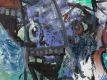
George Condo is an icon of contemporary American painting. His unique pictorial language reimagines the imagery and practices of Western art history, most especially Modernism, with vitality and dynamism. Composition in Green (2024) demonstrates the artist’s all-over approach to the painted surface. Frantic black linework cuts obliquely across the green canvas, forming a sequence of semi-descipherable vignettes that together descend into abstraction. The painting’s energetic geometry is reminiscent of Cubism, specifically Marcel Duchamp’s Nude Descending a Staircase (No. 2) (1912), which shares a jazz-like rhythm in its strict diagonal composition. Bold and bright, Condo’s Composition in Green reflects Condo’s engagement with the art historical canon while showcasing his undeniable contemporaneity.



























George Condo (*1957, Concord, NH) lives in New York. Selected solo exhibitions include Musée d’Art Moderne de Paris (2025), DESTE Foundation for Contemporary Art, Hydra (2024), Nouveau Musée National de Monaco – Villa Paloma (2023), The Morgan Library & Museum, New York (2023), Long Museum, Shanghai (2021), Cycladic Art Museum, Athens and Maritime Museum, Hong Kong (both 2018), Phillips Collection, Washington, DC (2017, traveled to Louisiana Museum of Modern Art, Humlebæk, Denmark), Staatliche Museen zu Berlin – Museum Berggruen, Berlin (2016), New Museum, New York (2010), traveled to Hayward Gallery, London (2011), Boijmans Van Beuningen, Rotterdam (2011), Schirn Kunsthalle, Frankfurt (2012) and Kunstmuseum Luzern (2008). Selected group exhibitions include Venice Biennale (2019, 2013), 13th Biennale de Lyon (2015), 10th Gwangju Biennale (2014), Whitney Biennial (2010, 1987) and the 48th Corcoran Biennial, Washington, DC (2005).

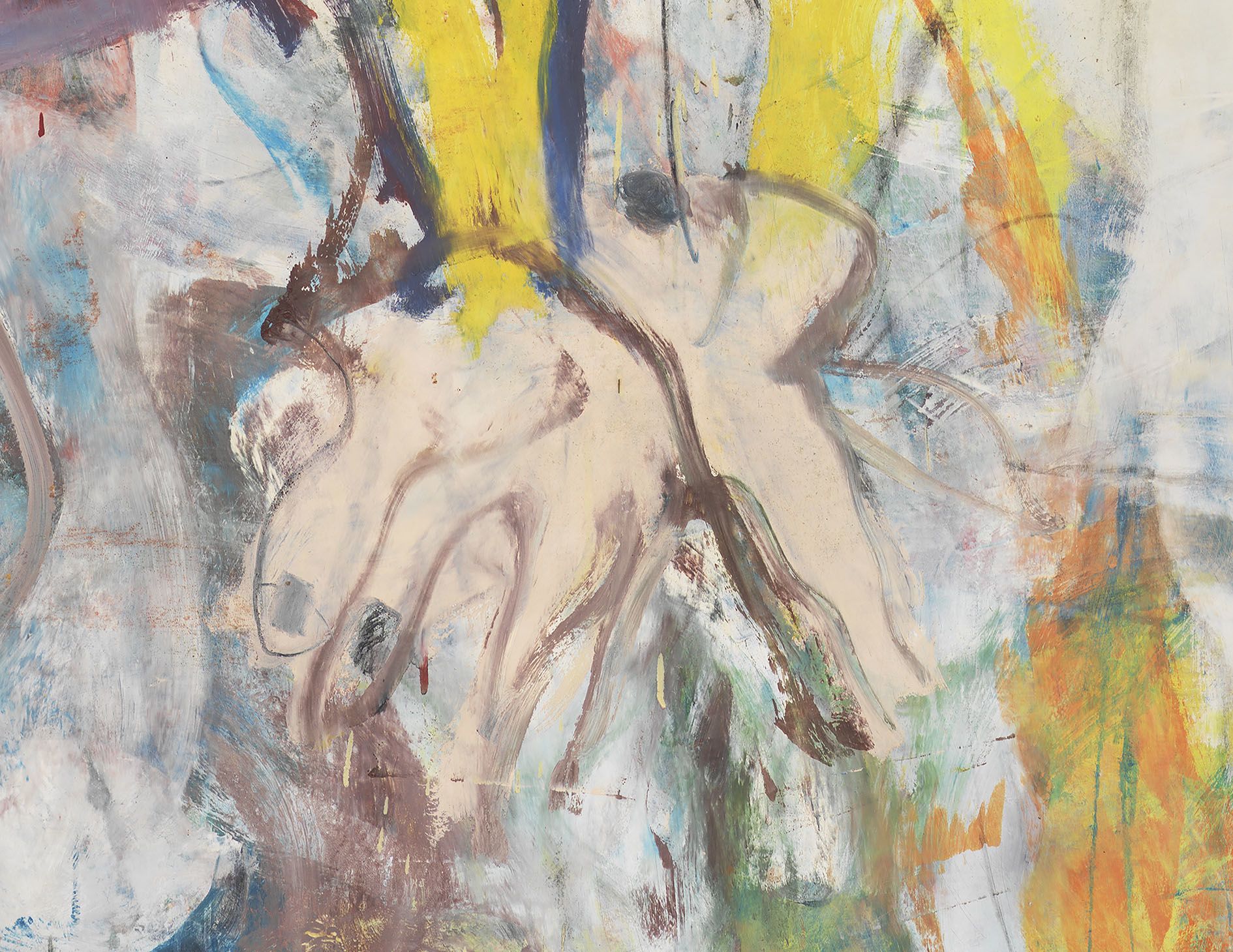


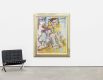
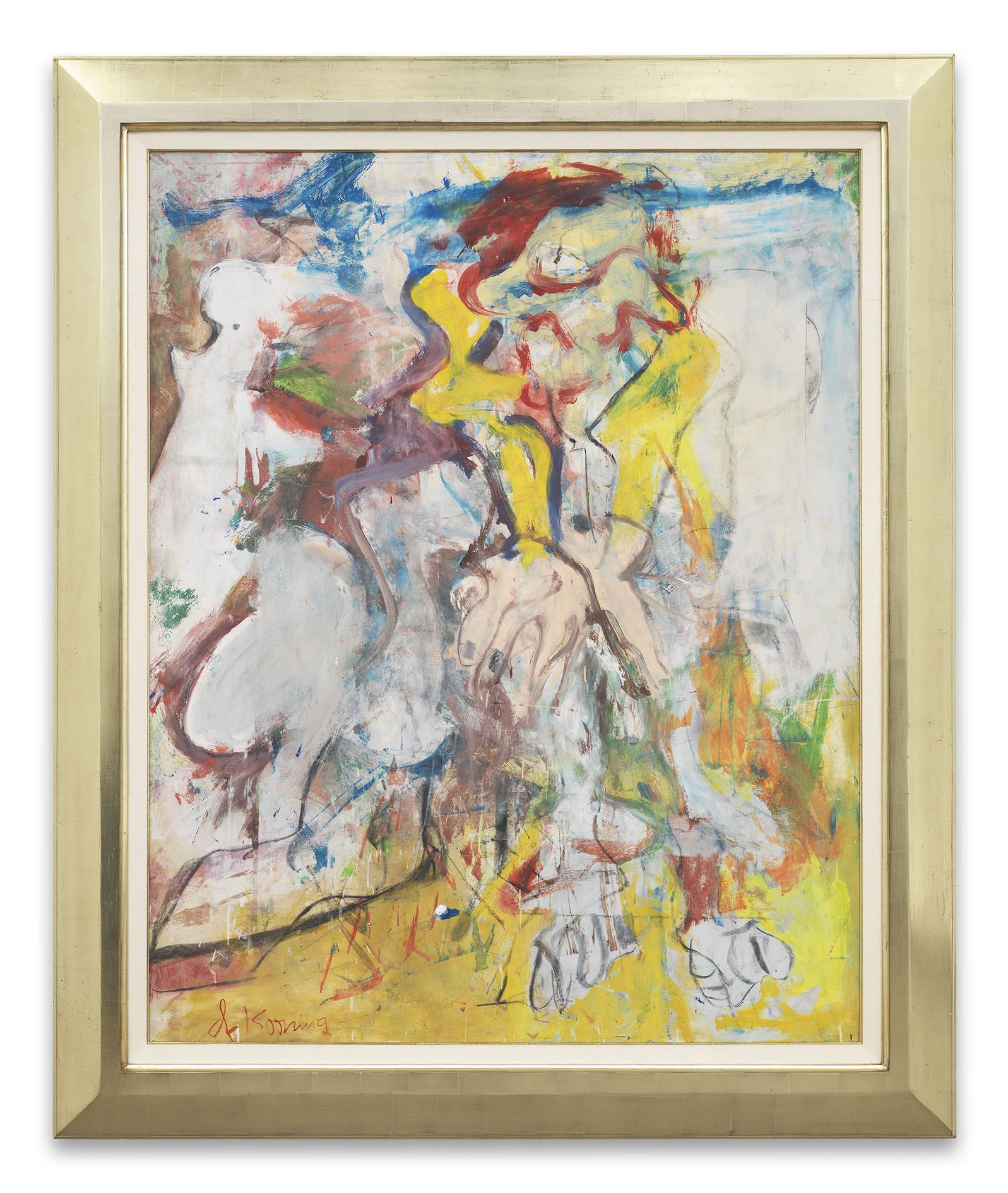
By the time Abstract Expressionism was remaking the possibilities of painting in postwar New York, Willem de Kooning, who had arrived as a stowaway from Rotterdam in 1926, stood apart from his peers in his refusal to abandon the figure, holding figuration and abstraction in permanent, productive tension and making that irresolution the very subject of his work. The 1960s and 1970s deepened this commitment, as the figure grew more diffuse and more openly equivocal, resisting resolution into either pure form or pure gesture, a quality Man with a Red Face (1968–70) embodies with particular clarity. As so often in his work, a figure surfaces from the energetic brushwork: areas of yellow and pallid skin tone coalesce into a jacketed man, guiding the eye toward a red gestural line that sweeps upward into a pompadour before winding down through tear trough, cheek and chin, simultaneously defining and dissolving the facial structure. The fleshy pinks, yellows and blues are characteristic of this moment in his œuvre, hovering ambiguously between body and landscape.
The same ambiguity is embedded in the palette itself, where each tone refuses a single identity—sand or clothing, sky or shadow—colors drawn from de Kooning’s years on the Long Island coast, among its dunes, bleached light and open sea.
Willem de Kooning (1904–97) lived and worked in New York City and East Hampton, New York. Selected solo exhibitions include The Museum of Modern Art, New York (2012, 1997), Whitney Museum of American Art, New York, Akademie der Künste, Berlin, Centre Georges Pompidou, Paris (1983–84), Walker Art Center, Minneapolis (1974), Stedelijk Museum, Amsterdam (1968). De Kooning was awarded many honors in his lifetime, including The Presidential Medal of Freedom in 1964. His work is held in major museum collections, including Stedelijk Museum, Amsterdam, Tate Modern, London, National Gallery of Australia, Canberra, The Museum of Modern Art, New York, The Metropolitan Museum of Art, New York, Art Institute of Chicago, Smithsonian Institution’s Hirshhorn Museum & Sculpture Garden, Washington, DC, and National Gallery of Art, Washington, DC. He also participated in Documenta 3 (1964) and Documenta 6 (1977), Kassel, and in La Biennale di Venezia in 1950, 1954, 1956, 1978, 1986 and 1988.

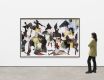
Kara Walker’s work operates at the intersection of beauty and brutality, appropriating historical visual forms to expose the violence embedded within America’s cultural and racial foundations. Tituba’s Handmaidens (2025) is part of a suite of new cutout collages in vibrant ink and watercolor, presented on a grand scale akin to history paintings. These works build upon Walker’s signature monochromatic silhouettes by engaging formal composition, texture and color. She commandeers art history and cultural memory—drawing on the portraiture of Diego Velázquez and John Singer Sargent alongside the Salem witch trials—and transforms these references into incisive commentary that critiques prevailing narratives and entrenched mythologies. By invoking Tituba, the enslaved woman whose coerced testimony helped ignite the trials, Walker positions her as a presence that haunts the anonymous, ambiguous figures that populate the scene.
Kara Walker (*1969, Stockton, CA) lives and works in New York. Walker recently presented a major site-specific commission at the San Francisco Museum of Modern Art. Selected solo exhibitions include Fundación PROA, Buenos Aires (2025), National Gallery of Australia, Canberra (2023), De Pont Museum, Tilburg, The Netherlands (2022), Schirn Kunsthalle, Frankfurt, Kunstmuseum Basel (both 2021), Turbine Hall, Tate Modern, London (2019), Domino Sugar Refinery, New York (2014), Camden Arts Centre, London, Art Institute of Chicago (both 2013), Center for Contemporary Art Ujazdowski Castle, Warsaw (2011), Hammer Museum, Los Angeles and Modern Art Museum Fort Worth (both 2008), Walker Art Center, Minneapolis, Whitney Museum, New York (both 2007) and The Metropolitan Museum of Art, New York (2006).
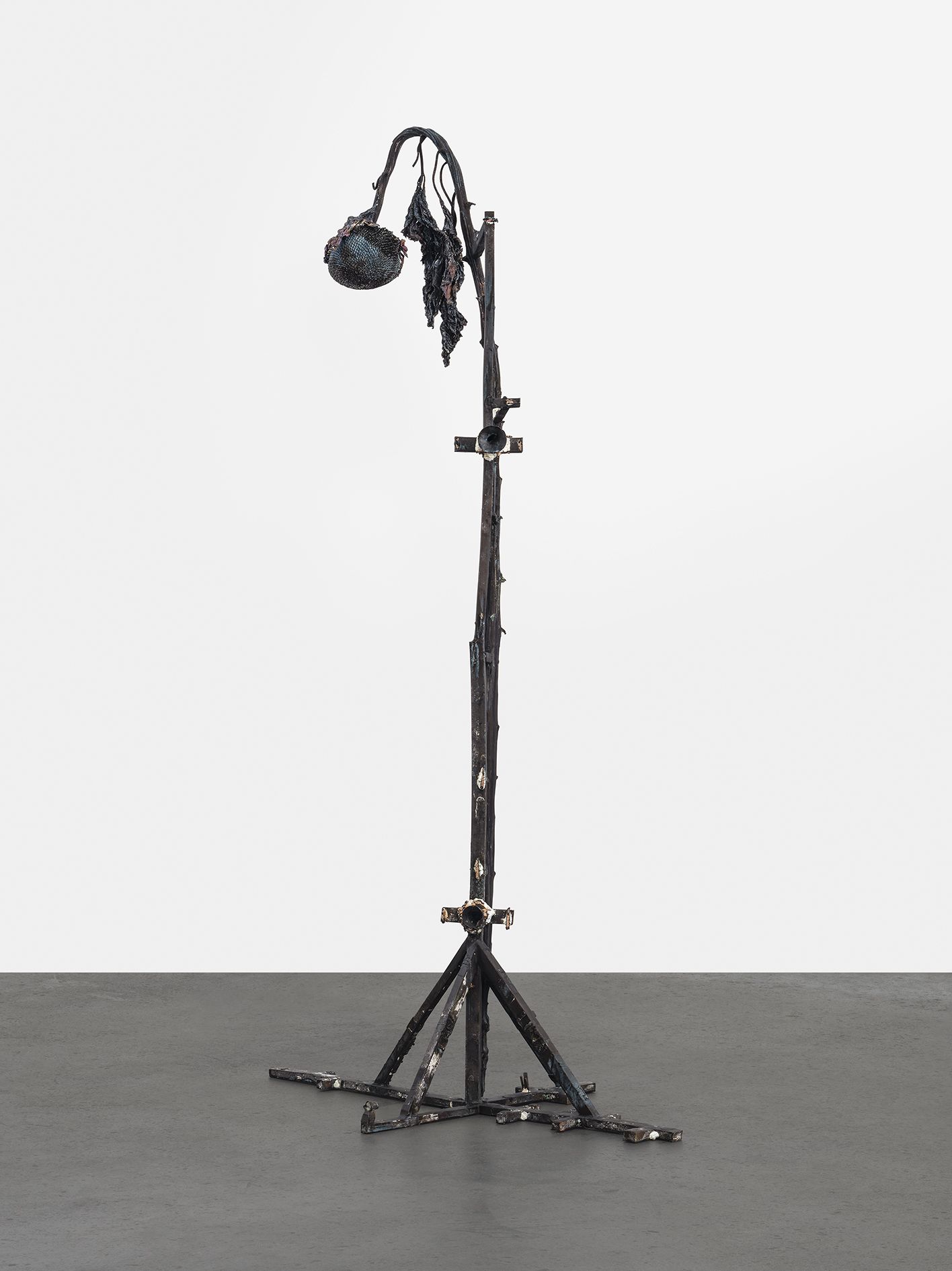
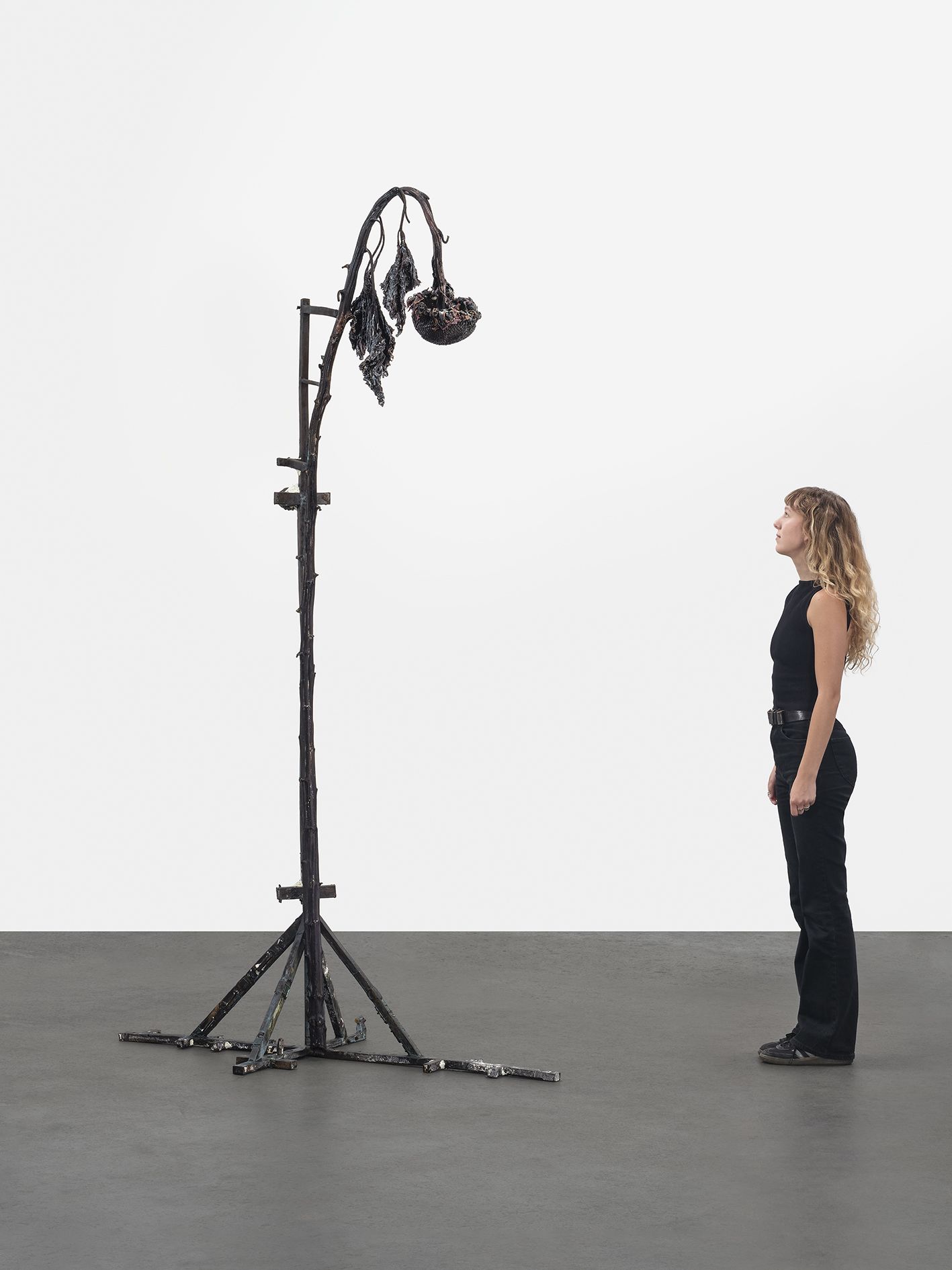
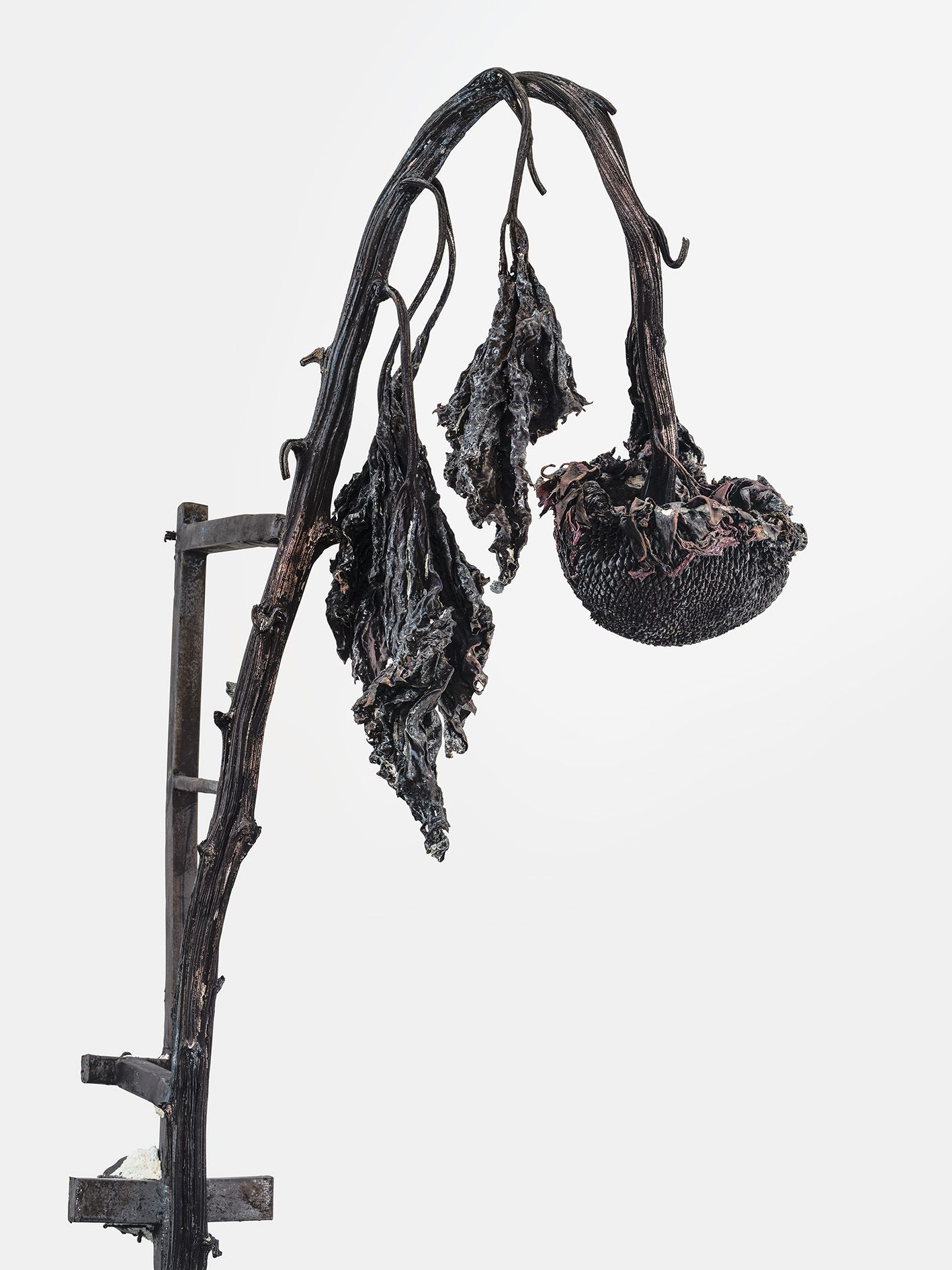


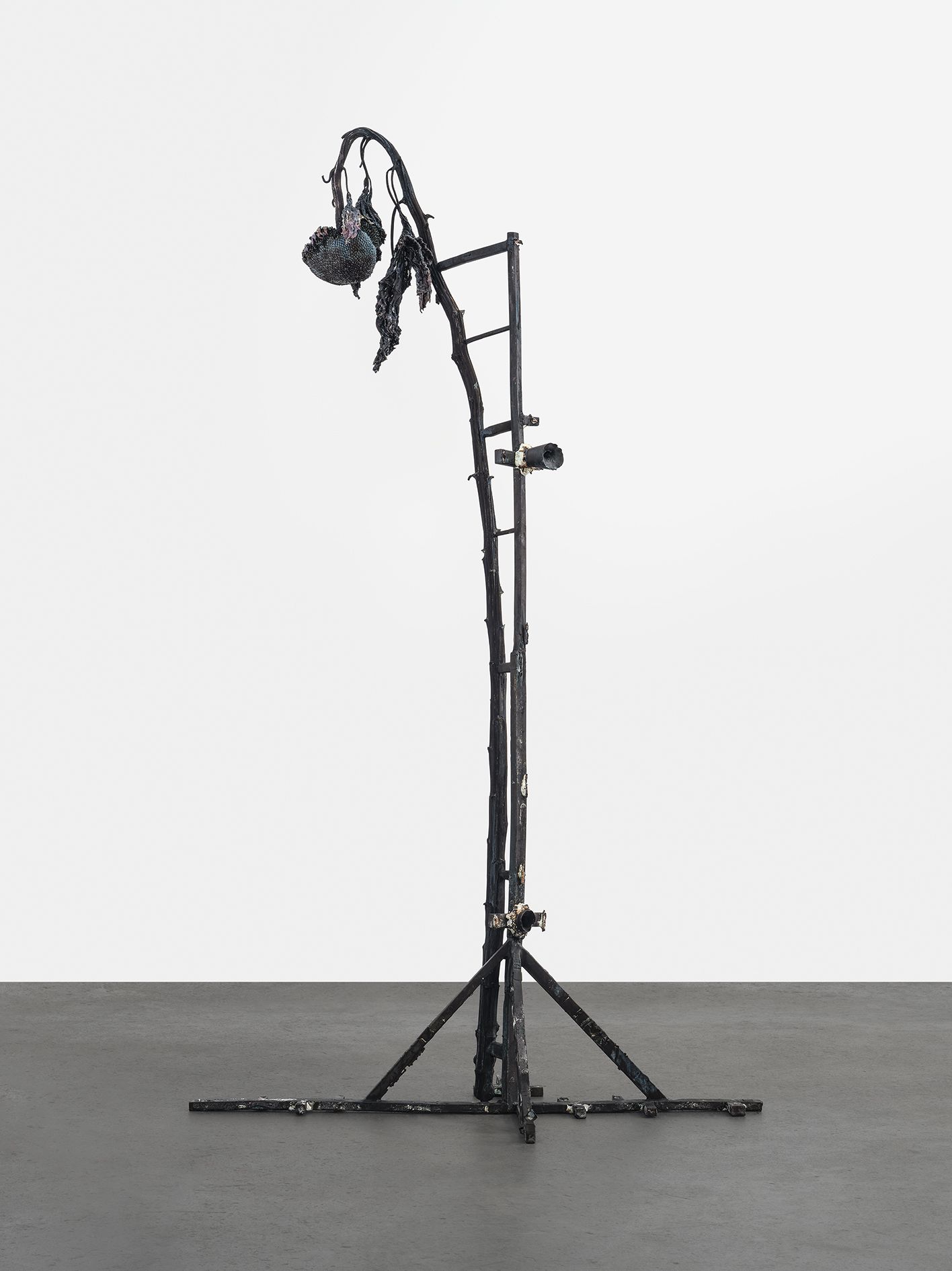
Sterling Ruby’s œuvre visually interrogates our troubled contemporary landscape, understanding its violence and traumas through a post-humanist lens across artistic media. As in Vincent van Gogh and Anselm Kiefer’s work, the sunflower is an important recurring motif in Ruby’s practice; its germination, growth, and decay are natural symbols for cycles of life. Bound Flower. Altadena. (9115) (2026) originated as a specimen cultivated in Ruby’s studio garden. The sunflower was cut, dried, and directly cast, incinerating the blossom to produce a bronze phantom with its likeness. Named after a region devastated by the recent Eaton Fire, the Los Angeles-based artist imbues the sculpture with a haunting sense of loss. Alongside immortalizing each detail of the sunflower, the work retains the utilitarian infrastructure of its fabrication: gates and sprues through which molten metal flowed, functioning as constraints that bind the flora in a state of suspended time.
Sterling Ruby (*1972, Bitburg, Germany) lives and works in Los Angeles. Solo exhibitions include MAMO – Centre d’art de la Cité Radieuse, Marseille (2025), Sogetsu Foundation, Tokyo (2023), Museum of Cycladic Art, Athens (2021), Institute of Contemporary Art, Boston (2020), Institute of Contemporary Art, Miami (2019), Nasher Sculpture Center, Dallas (2019), Museum of Art and Design, New York (2018), Des Moines Art Museum (2018), Museum of Contemporary Art, Los Angeles (2017), Winterpalais, and Belvedere Museum, Vienna (2016). Selected recent group exhibitions include those at Palazzo Diedo – Berggruen Arts & Culture, Venice (2024), The Metropolitan Museum of Art (2021–22), 21st Century Museum of Contemporary Art, Kanazawa, Japan (2020), Desert X Biennial (2019) and others at The Warehouse Dallas (2024), Whitney Museum of American Art, New York (2019), National Museum of Modern Art, Osaka (2019), Museum of Contemporary Art, Chicago (2018), Berkeley Art Museum and Pacific Film Archive (2018), Musée des Arts Décoratifs, Tel Aviv Museum of Art (2017), Los Angeles County Museum of Art (2016), and Hammer Museum, Los Angeles (2016).

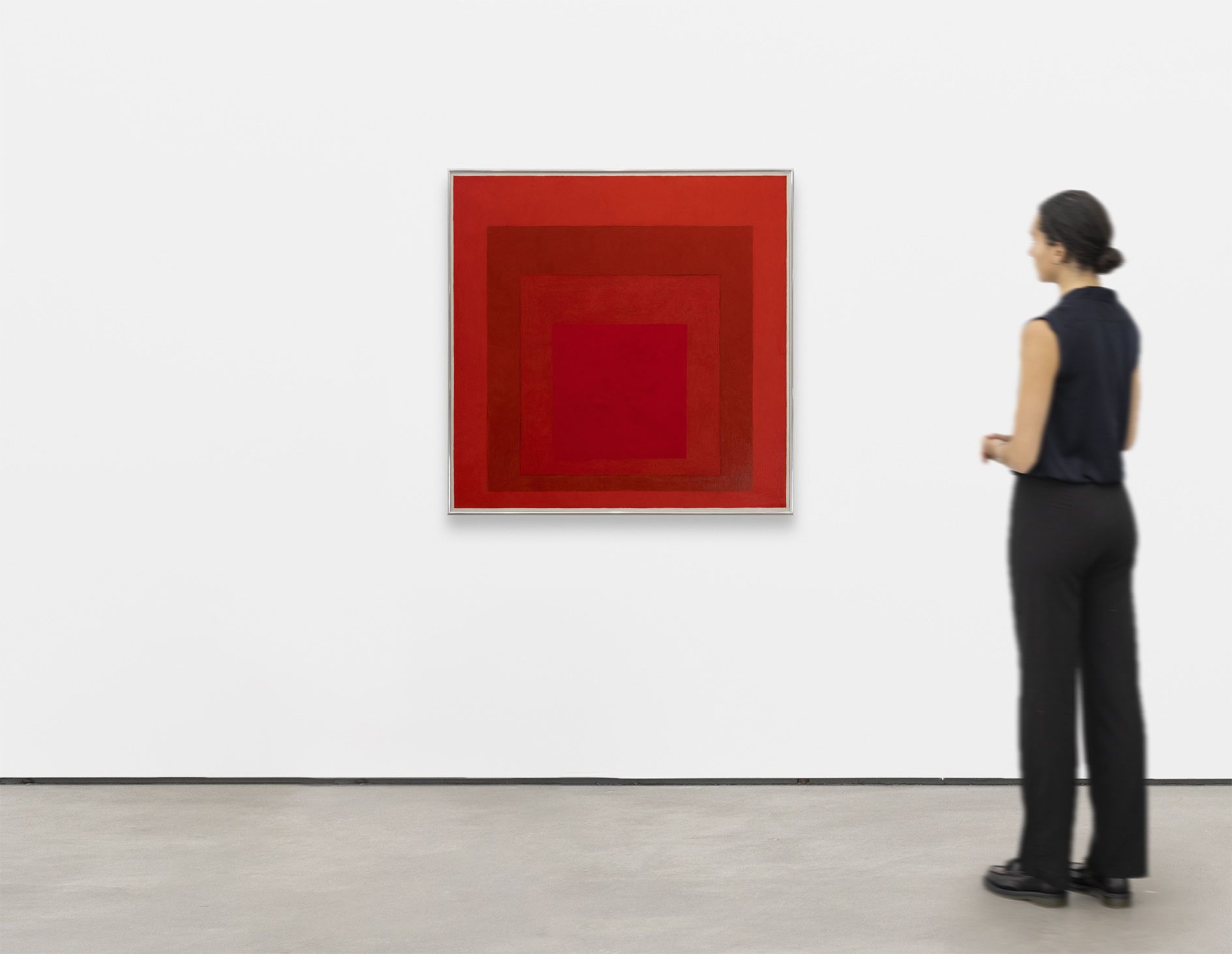

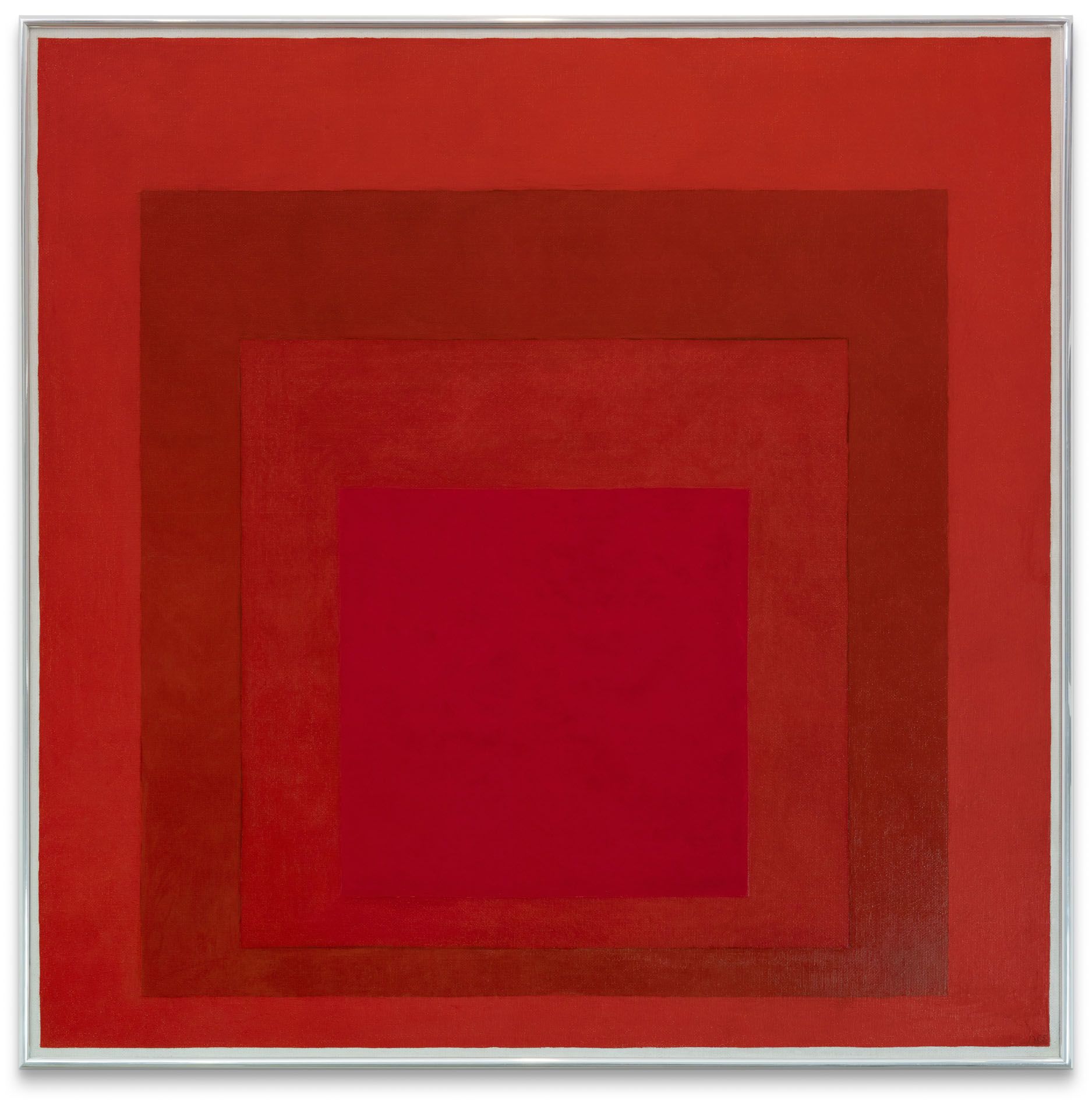
Josef Albers is one of the most influential abstract painters and art teachers of the twentieth century, bridging the gap between European and American Modernism. Color theory sat at the heart of his life’s work, threading through every stage of his career—from his formative years at Germany’s Bauhaus to his time at Black Mountain College in North Carolina, where he counted Robert Rauschenberg and Cy Twombly among his students, and ultimately to Yale, where he served as Head of the Department of Design. His most recognizable and celebrated body of work, Homage to the Square (1950–76), explores the relationships between interacting color fields, as composed in clean geometries of nested squares. The chromatic juxtaposition of varied reds in Homage to the Square: Between 2 Scarlets (1962) reveals how two closely related hues of crimson can appear strikingly different from one another, demonstrating the fundamental relativity of color, an idea expressed in Albers’ acclaimed book on color theory, Interaction of Color, first published a year after this painting was made.
One of only eight red paintings produced in this scale, Homage to the Square: Between 2 Scarlets is an art-historically important work that directly investigates the visual perception of color and its complexities.
Josef Albers (1888–1976) lived and worked in New Haven. Selected solo exhibitions include Kawamura Memorial DIC Museum of Art, Sakura, Japan (2023), Musée d’Art Moderne de Paris and Instituto Valenciano de Arte Moderno (with Anni Albers, 2021–22), Peggy Guggenheim Collection, Venice (2018), Solomon R. Guggenheim Museum, New York (2017), and Museum of Modern Art, New York (2016–17). His work is in the permanent collections of the Art Institute of Chicago, British Museum, London, Brooklyn Museum, New York, Hamburger Kunsthalle, Hamburg, Hirshhorn Museum and Sculpture Garden, Washington, DC, Kunstmuseum Basel, Los Angeles County Museum of Art, The Metropolitan Museum of Art, New York, Museum of Modern Art, New York, Philadelphia Museum of Art, and Victoria and Albert Museum, London.




Donald Judd is a landmark figure in twentieth-century American art. Despite a lifelong antipathy to the term Minimalism, he is considered a pioneer, theorist and key representative of the movement. Untitled (1989) is one of Judd’s celebrated multicolored enameled aluminum works conceived during his mature career, in which he returns to the color of his earlier painterly practice. Working within the 163-shade RAL code, he explored chromatic relationships across the spectrum of the chart, then enlisted Swiss manufacturers to realize each piece, with every section of aluminum folded, not welded, into its hollow form. The units of varying sizes in white, black, yellow and red are arranged horizontally across the wall in a unified rectangular configuration, their visible screws registering the logic of assembly. The work emphasizes the interplay of color, material and spatial arrangement, deploying color as an integral component of the object and allowing its relationships to unfold without hierarchy or focal point.
Donald Judd (1928–94) lived and worked in New York and Marfa, TX, until his death in New York. His works were exhibited throughout the world in major solo exhibitions at institutions such as Tate Modern (2004), Walker Art Center, Minneapolis (2001), Saint Louis Art Museum (1991), Stedelijk Van Abbemuseum, Eindhoven (1987), National Gallery of Canada, Ottawa (1975), and at Whitney Museum of American Art, New York (1988, 1968). A major retrospective was held at The Museum of Modern Art, New York, in 2020.

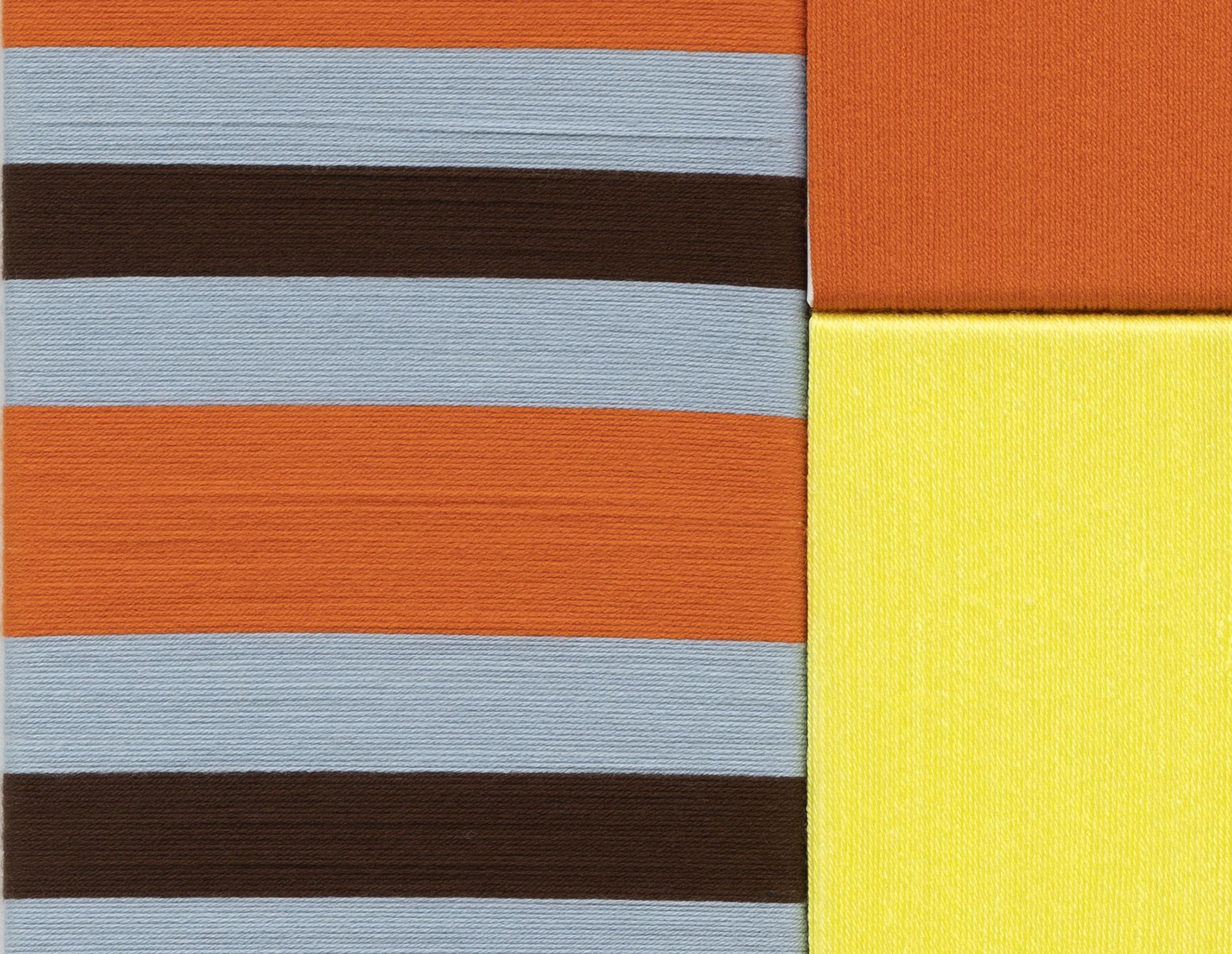


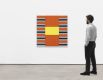
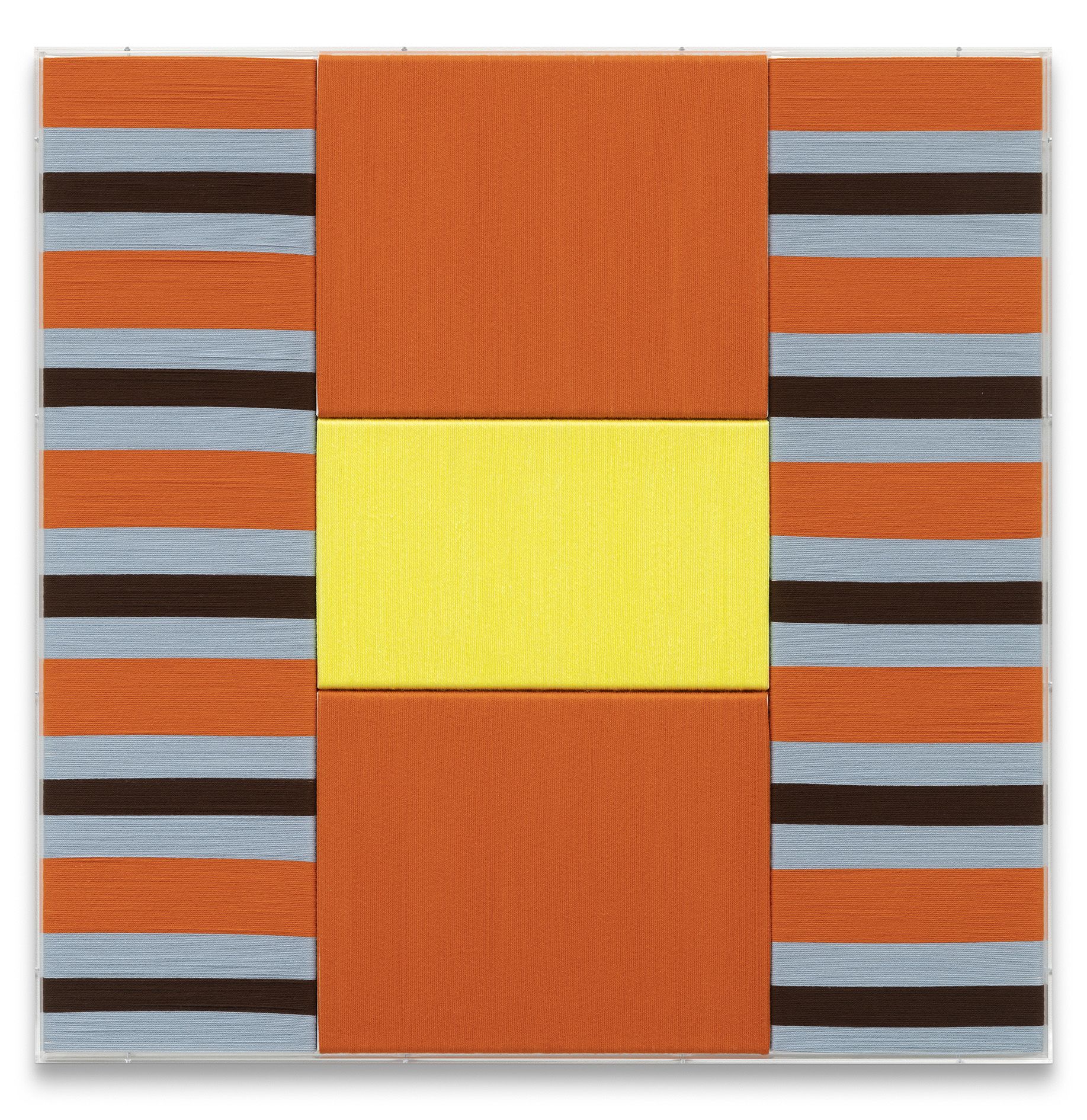
Rosemarie Trockel is one of the most influential conceptual artists of our time. The first female artist to represent Germany at the Venice Biennial, Trockel continues to challenge traditional notions of femininity, culture and artistic production. Her celebrated Strickbilder (knitting paintings) represent an important part of her varied œuvre, which also includes sculptures, drawings and mixed-media installations. Entanglement (2023) consists of multiple wool-wrapped canvas panels: a central column of three—a bright yellow panel sandwiched between two larger orange ones—set against flanking side panels of horizontal stripes in orange, light blue and dark brown. The color relationships invoke the language of color field painting, yet the subversion lies in the material itself: wool, coded as domestic, feminine and craft-based. The title makes this tension explicit. Yarn, by definition, entangles, but “entanglement” also describes the logic of the work, in which the macho tradition of abstract painting and the feminized craft of knitting become inseparable.
Rosemarie Trockel (*1952, Schwerte, Germany) lives and works in Berlin. Solo exhibitions include Sungkok Art Museum, Seoul (2024), Museum MMK für Moderne Kunst, Frankfurt (2022–23), Moderna Museet Malmö (2018–19), Pinacoteca Agnelli, Turin (2016), Kunsthaus Bregenz (2015), traveling exhibition at Museo Nacional Centro de Arte Reina Sofía, Madrid, New Museum, New York and Serpentine Galleries, London (2012–13) and WIELS, Brussels, Culturegest, Lisbon and Museion Bozen, Bolzano (2012–13). In 2005, a major retrospective of her work opened at Museum Ludwig, Cologne and traveled to MAXXI, Rome. In 1999, Trockel became the first woman artist to represent Germany at La Biennale di Venezia. Her work was also included in Documenta 10 (1997) and Documenta 13, Kassel (2012), as well as La Biennale di Venezia (2022).


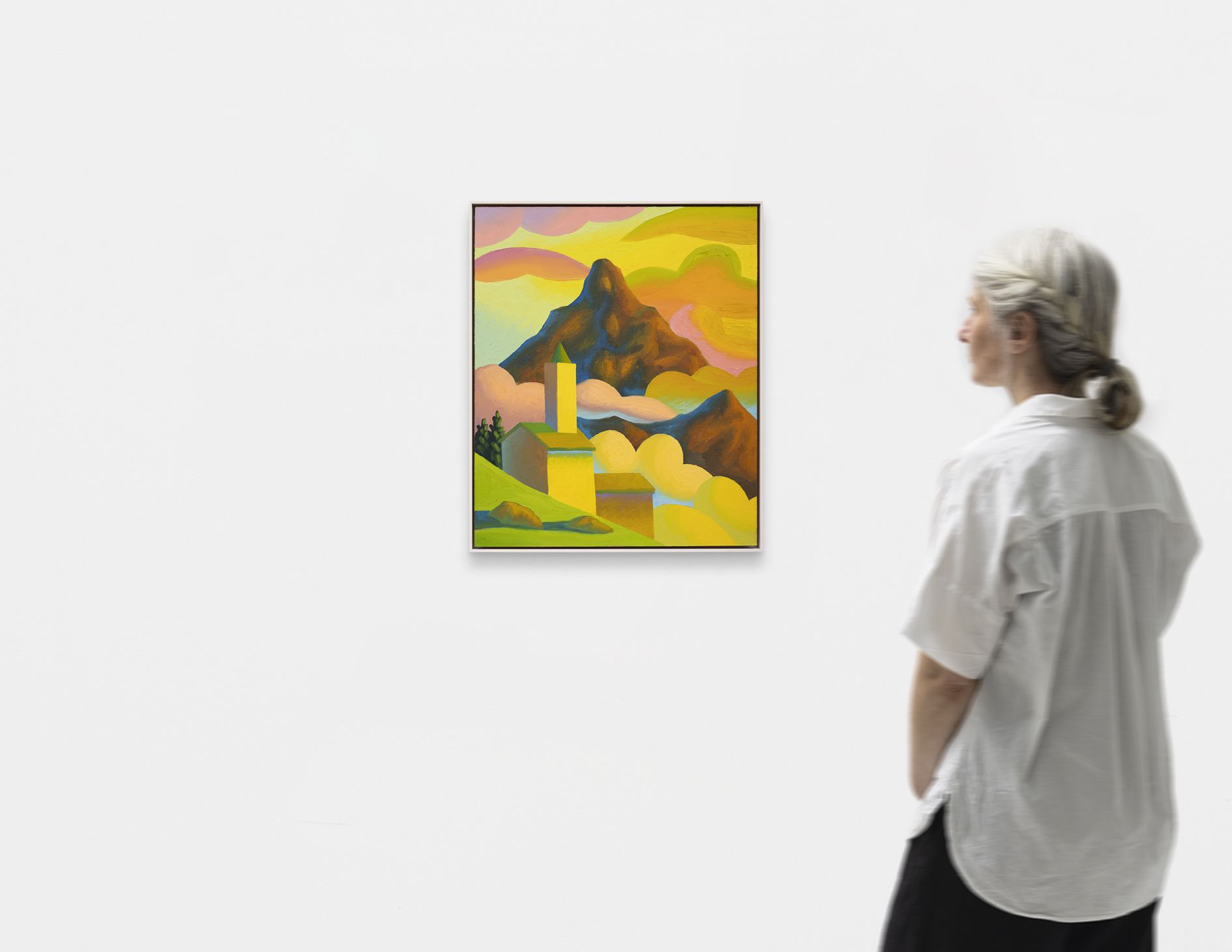


Salvo was an Italian Conceptual artist in dialogue with the burgeoning Arte Povera movement before his practice dramatically shifted in 1973, when the artist turned decisively to figurative painting. His oil paintings embrace the aesthetics of traditional art histories, from Giotto and Botticelli to Italian Futurism and Surrealism, employing flat geometric forms and rich colors that draw attention to the painting’s artifice. In L’alpe (2005), a rocky Alpine mountain, its twisted shadows a deep blue, is framed by billowing pink, orange, and yellow clouds, foregrounded by the slope of a verdant green hill with a simple honey-colored building atop, whose pointed spire mirrors the mountain’s peak. L’alpe and its sublime yellow-hued brightness is characteristic of Salvo’s renowned sumptuous light effects, which generate serene, dreamlike scenes.
Salvo (1947–2015) lived and worked in Turin. Solo exhibitions include Pinacoteca Agnelli, Turin (2024), Museum of Contemporary Art, Rome (2021), Museo d’Arte della Svizzera Italiana, Lugano (2017, with Alighiero Boetti), Museo d’Arte Contemporanea, Lissone (2015), Galleria d’Arte Moderna e Contemporanea, Turin (2007), Galleria d’Arte Moderna e Contemporanea, Bergamo (2002), Musée d’Art Contemporain, Nîmes and Museum Boijmans van Beuningen, Rotterdam (both 1988), Kunstmuseum Lucerne (1983), Mannheimer Kunstverein and Museum Folkwang, Essen (both 1977). In addition to participating in Documenta 5 (1972) and the 1984 and 1976 editions of La Biennale di Venezia, recent group exhibitions include Kröller-Müller Museum, Otterlo, The Netherlands (2023), Kunsthaus Glarus, Switzerland (2022), Castello di Rivoli, Turin (2021) and Menil Drawing Institute, Houston (2020).
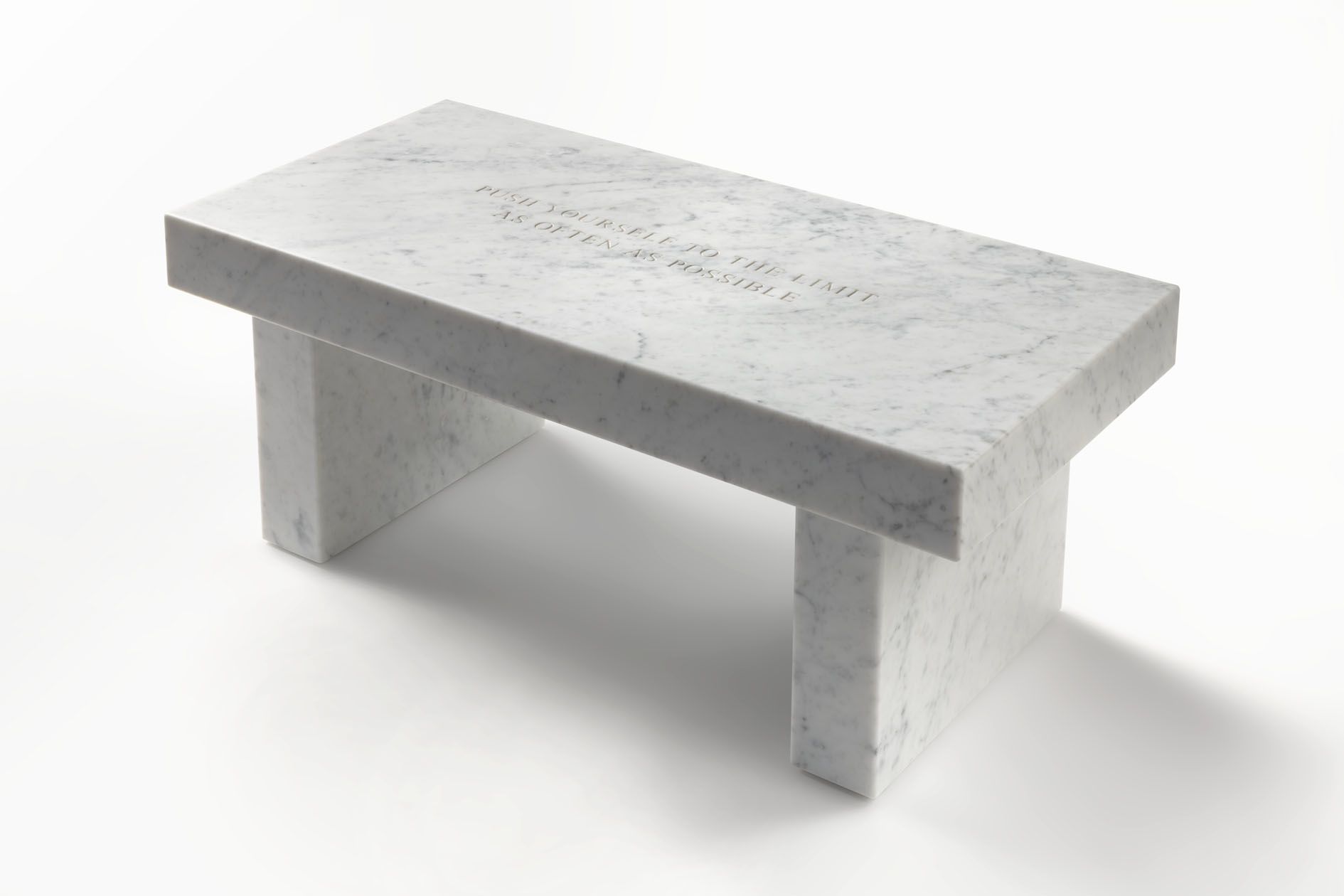
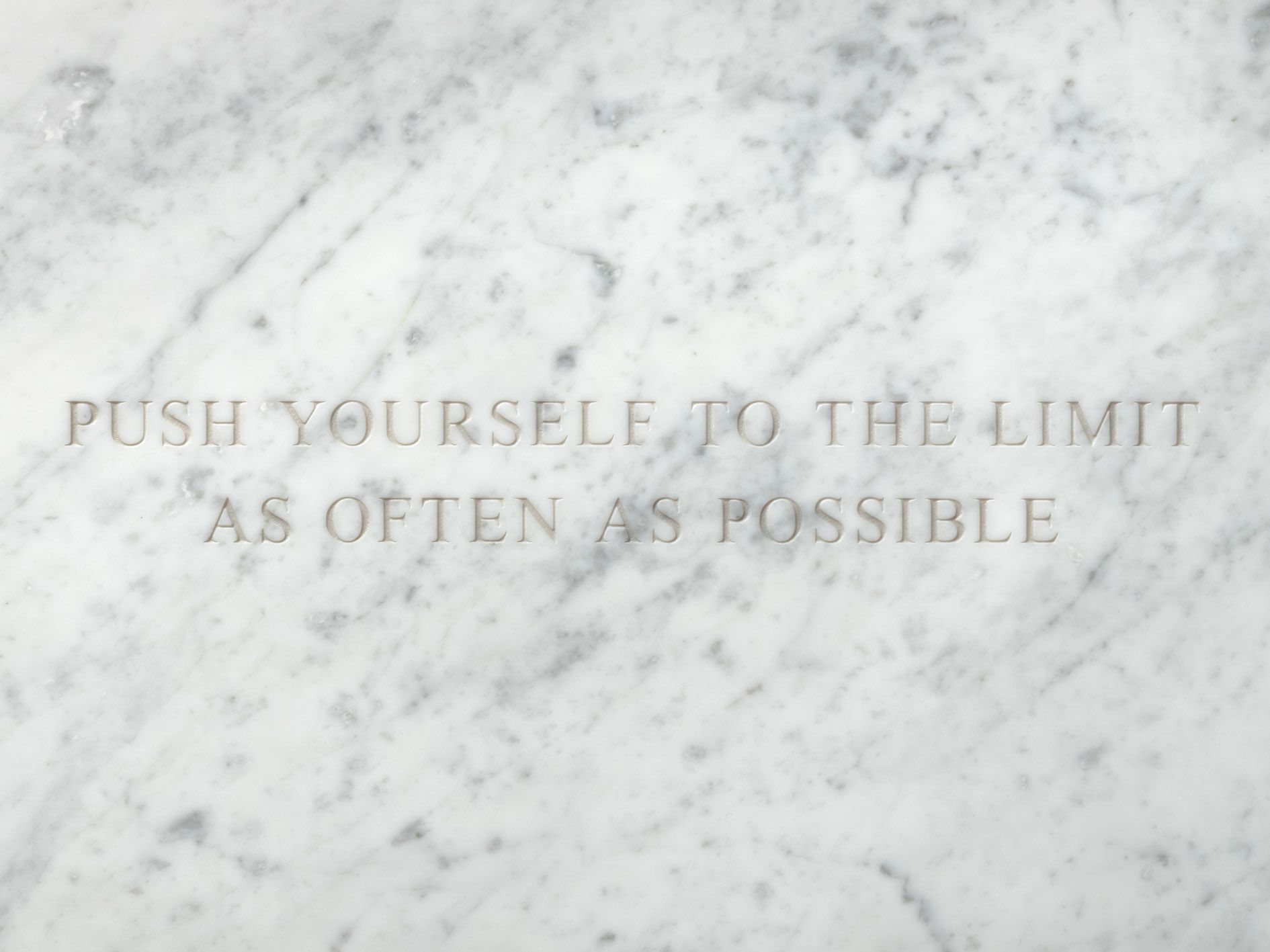


Jenny Holzer is a conceptual artist whose text-based practice is an ongoing artistic investigation of language and the constructions of political meaning. From the late 1980s onwards, benches and footstools have become a crucial medium for such discourse. As is the case with Truisms: Push yourself to the limit… (2019), a white marble bench with the titular inscription centrally engraved. The inscription and title stem from her first major series, Truisms, a collection of terse one-liners written between 1977 and 1979 that compile aphorisms on power, politics, violence, and social structures. In this work, Holzer’s declarative and confrontational speech is exhibited in a mode that promotes contemplative and reflective terms of engagement, requiring viewers to slow down, sit, and consider their own positions on the statement.
In June of this year, the Serralves Museum will present Jenny Holzer’s first solo exhibition in Portugal.
Jenny Holzer (*1950, Gallipolis, OH) lives and works in New York. Major surveys of her work were recently on view at Glenstone Museum, Potomac (2025), the Guggenheim Museum, New York (2024) and Kunstsammlung Nordrhein-Westfalen, Düsseldorf (2023), and in 2022 she curated an exhibition on Louise Bourgeois’ work at Kunsthalle Basel. Other selected solo shows include Guggenheim Museum, Bilbao (2019), Tate Modern, London (2019), Massachusetts Museum of Contemporary Art, North Adams (2017– present), Blenheim Art Foundation, Woodstock (2017), Museo Correr, Venice (2015), Neue Nationalgalerie, Berlin (2011, 2001), DHC/ART Foundation for Contemporary Art, Montreal and The Baltic, Gateshead (both 2010), Fondation Beyeler, Riehen/Basel and Whitney Museum of American Art, New York (both 2009), Walker Art Center, Minneapolis (1991), Hamburger Kunsthalle, Hamburg (2000), as well as Dia Art Foundation, New York and Guggenheim Museum, New York (both 1989).
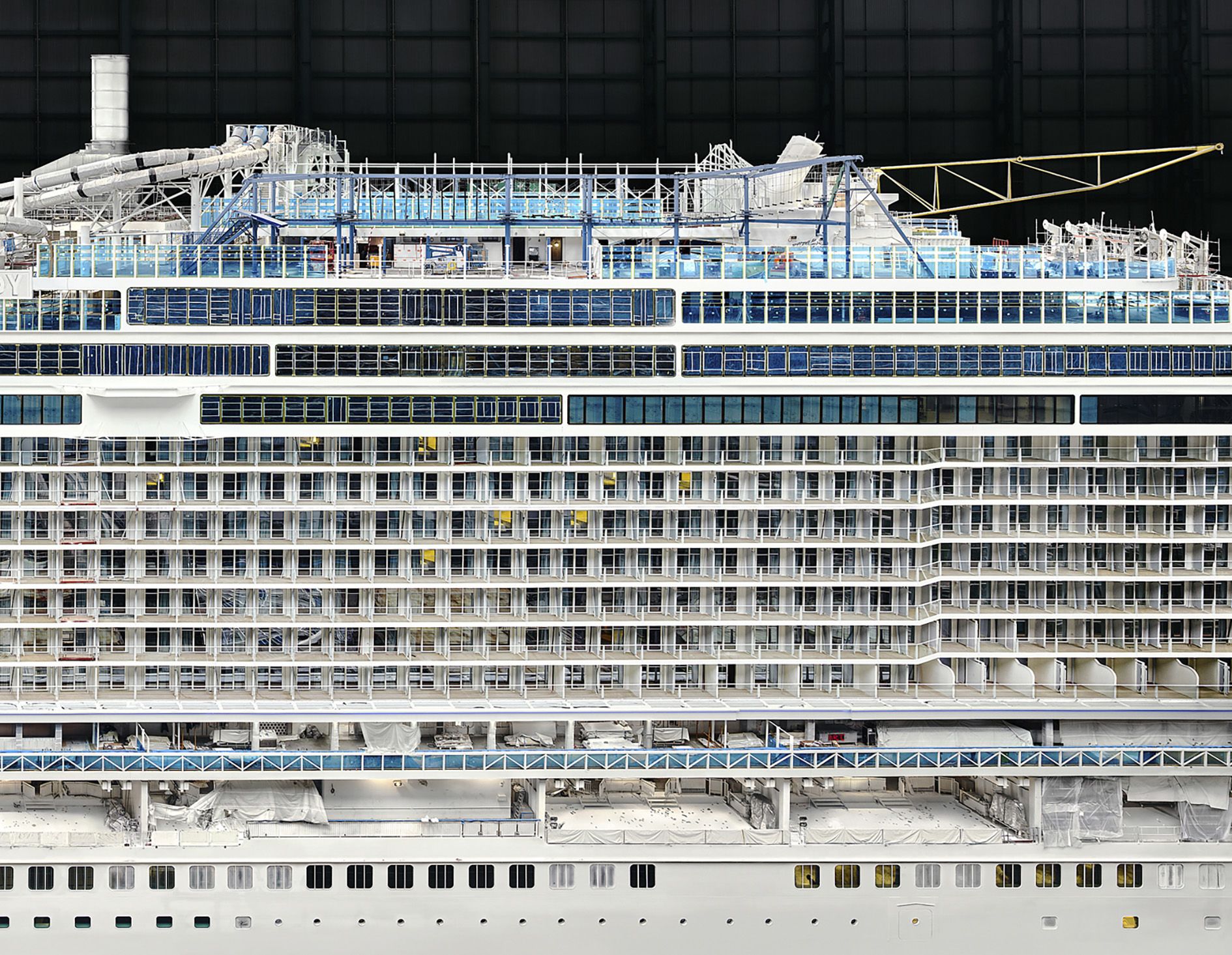
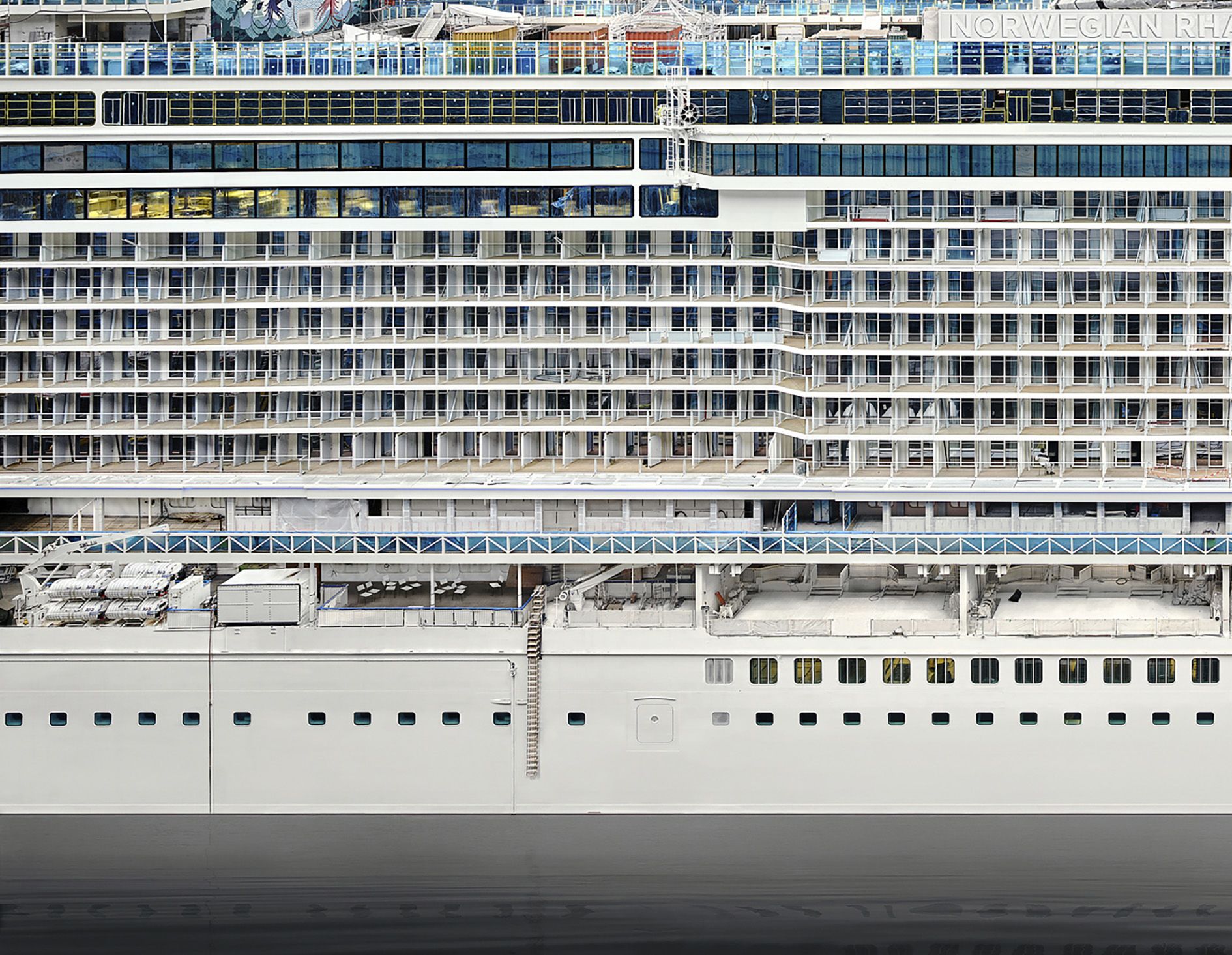


Andreas Gursky ranks among the most important photographers of his generation, his monumentally scaled works distilling contemporary life into visual statements of an ambition that has stretched the boundaries of photography. Kreuzfahrt (Cruise) (2020) confronts the viewer with an image of almost hallucinatory scale—a floating city caught mid-construction, tarps draped across unfinished interiors, a lone worker dwarfed by the surrounding immensity. Begun well before the first of what would become a series of crises involving these vessels, the work holds the cruise liner in a state of suspension that would prove unexpectedly prescient. An emblem of late-capitalist appetite, it is a place where leisure, consumption and ecological cost meet in one overwhelming form. Its rows of identical balconies, each a private space made anonymous by repetition, find a formal echo in Paris, Montparnasse (1993), Gursky’s earlier portrait of one of France’s largest social housing blocks. Separated by three decades and at opposite ends of the economic spectrum, necessity at one extreme, excess at the other, Gursky’s gaze makes no distinction.
Andreas Gursky (*1955, Leipzig) lives and works in Düsseldorf. Solo exhibitions include Fondazione MAST, Bologna (2023), Amorepacific Museum of Art, Seoul (2022), Museum Küppersmühle, Duisburg (2021), MdbK Leipzig (2021), Hayward Gallery, London (2018), National Museum of Art, Osaka (2014), National Art Center, Tokyo (2013), Stiftung Museum Kunstpalast, Düsseldorf (2013) and Louisiana Museum of Modern Art, Copenhagen (2012). A solo exhibition organized by The Museum of Modern Art, New York (2001), toured to Centro de Arte Reina Sofía, Madrid, Centre Georges Pompidou, Paris, Museum of Contemporary Art, Chicago and San Francisco Museum of Modern Art. His first retrospective was on view at Haus der Kunst, Munich, and toured to Istanbul Modern and Sharjah Art Museum (2007), then to Ekaterina Foundation, Moscow and National Gallery of Victoria, Melbourne (2008).

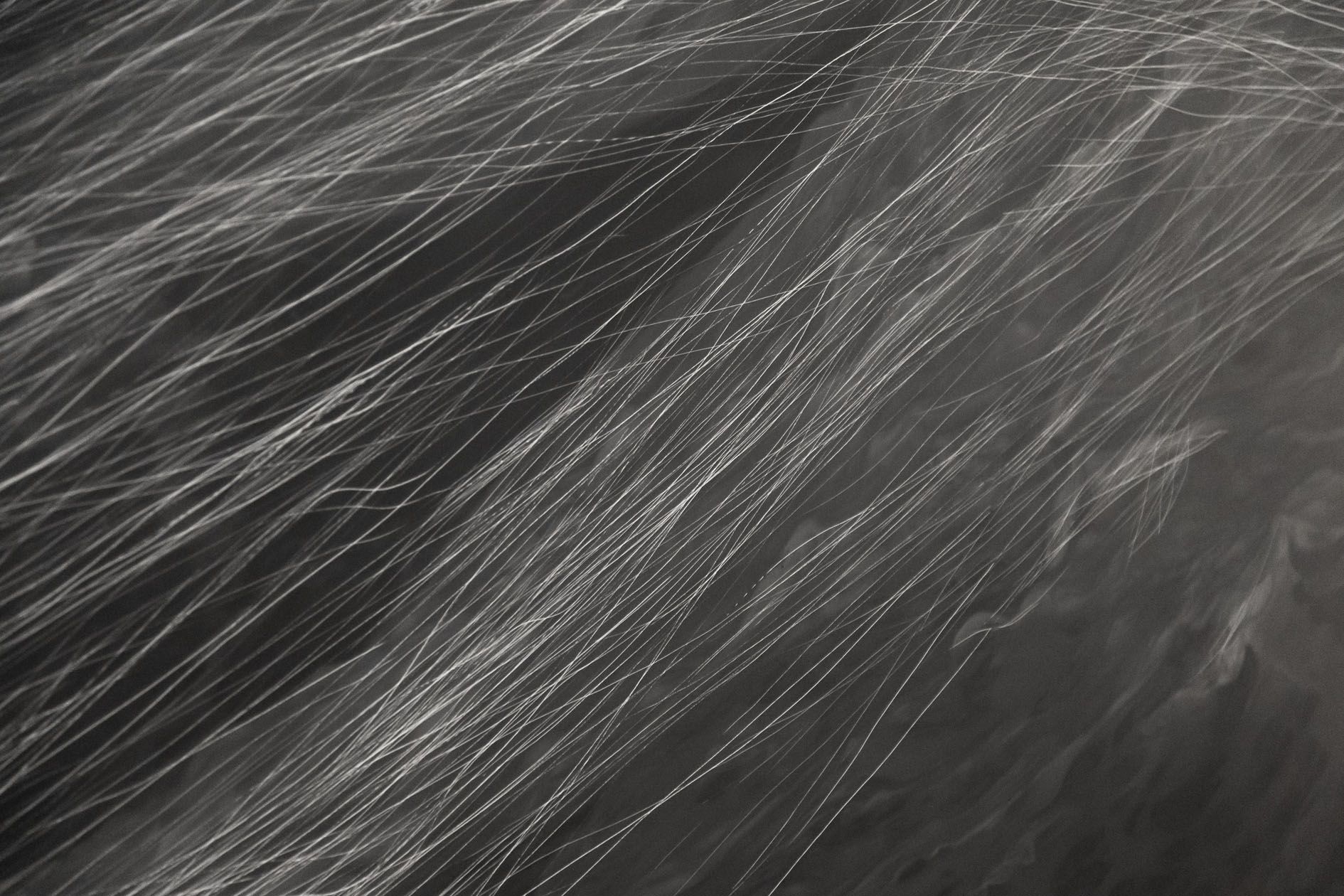


Anne Imhof’s practice moves across performance, sculpture, painting, and film, yet returns always to the same insistent subject: the body—how it moves through space, how it is observed, what it can and cannot occupy, and how fleeting experience might be translated into enduring form. Grey Wave I (2025) belongs to a series of wave paintings first presented at Serralves Museum in Porto, a city shaped by its proximity to the Atlantic. The large-scale painting is monochromatic in palette, rendered entirely in shades of gray. It depicts a hyper-realistic wave, which is in fact constructed: the image originates digitally before being realized, laboriously, in oil paint, layer upon layer applied across the canvas. Imhof scratches directly onto the canvas, releasing fine, urgent white lines that arc and scatter, preserving the trace of a hand and the ephemeral movement of the wave. While scratching has long been part of her practice on aluminum works, its application to canvas marks a new development.
Anne Imhof’s solo exhibition Citizen is on view at Sprüth Magers, London, through August 1, 2026.
Anne Imhof (*1978, Gießen, Germany) lives and works in Berlin and New York. Selected solo exhibitions include Serralves Museum, Porto (2026), Park Avenue Armory, New York (2025), Kunsthaus Bregenz (2024), Stedelijk Museum, Amsterdam (2022), Palais de Tokyo, Paris (2021), Tate Modern, London (2019), Hamburger Bahnhof, Berlin (2016), Kunsthalle Basel (2016), MoMA PS1, New York (2015), Carré d’Art – Musée d’Art Contemporain de Nîmes (2014), and Portikus, Frankfurt (2013). Her work has also been featured in numerous group exhibitions, including at Aichi Triennale, Aichi Prefecture (2022), Kunstmuseum Winterthur (2022), Tai Kwun, Hong Kong (2019), La Biennale di Venezia (2017), where she was awarded the Golden Lion, La Biennale de Montréal (2016), Palais de Tokyo, Paris (2015), Centre Pompidou, Paris (2015), and Museum MMK für Moderne Kunst, Frankfurt (2014).
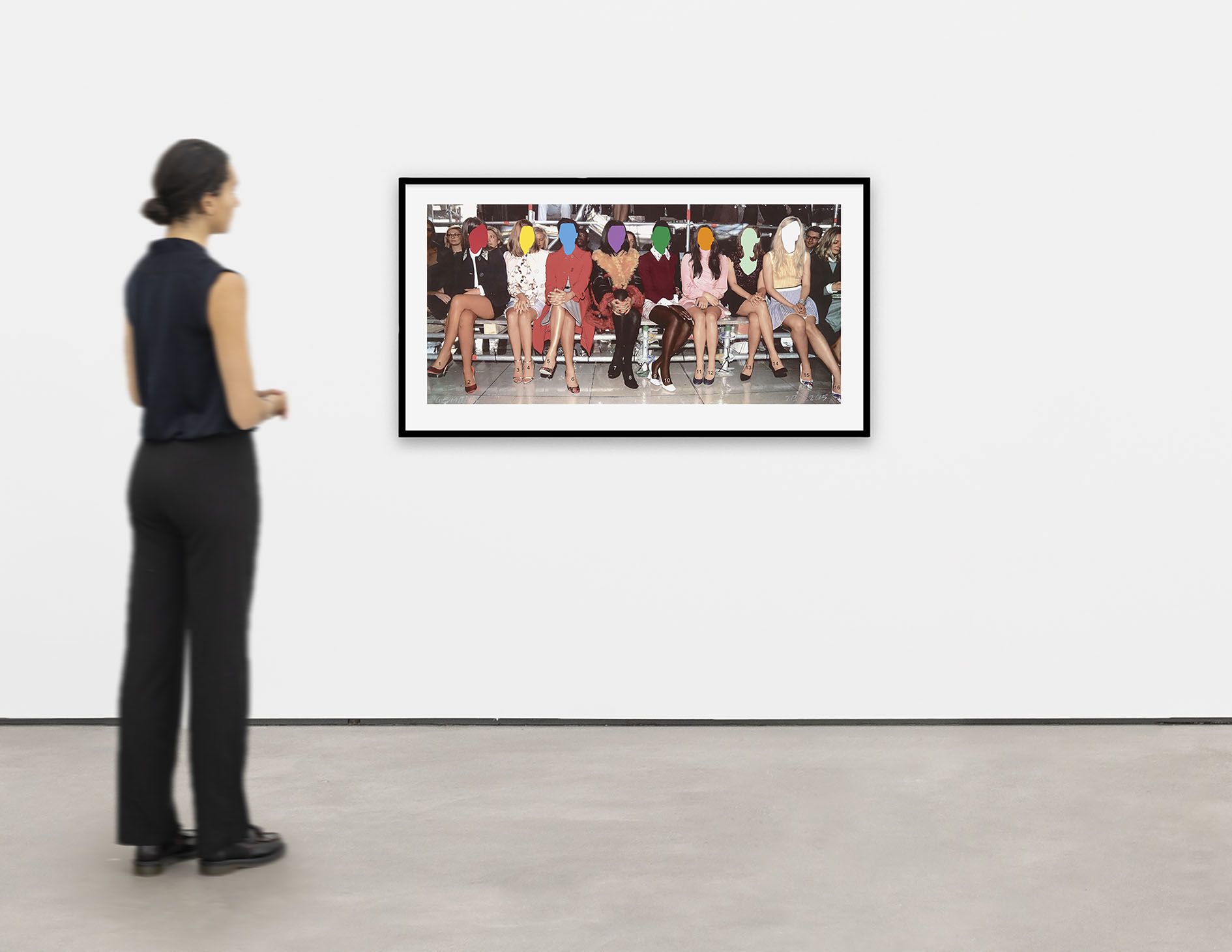

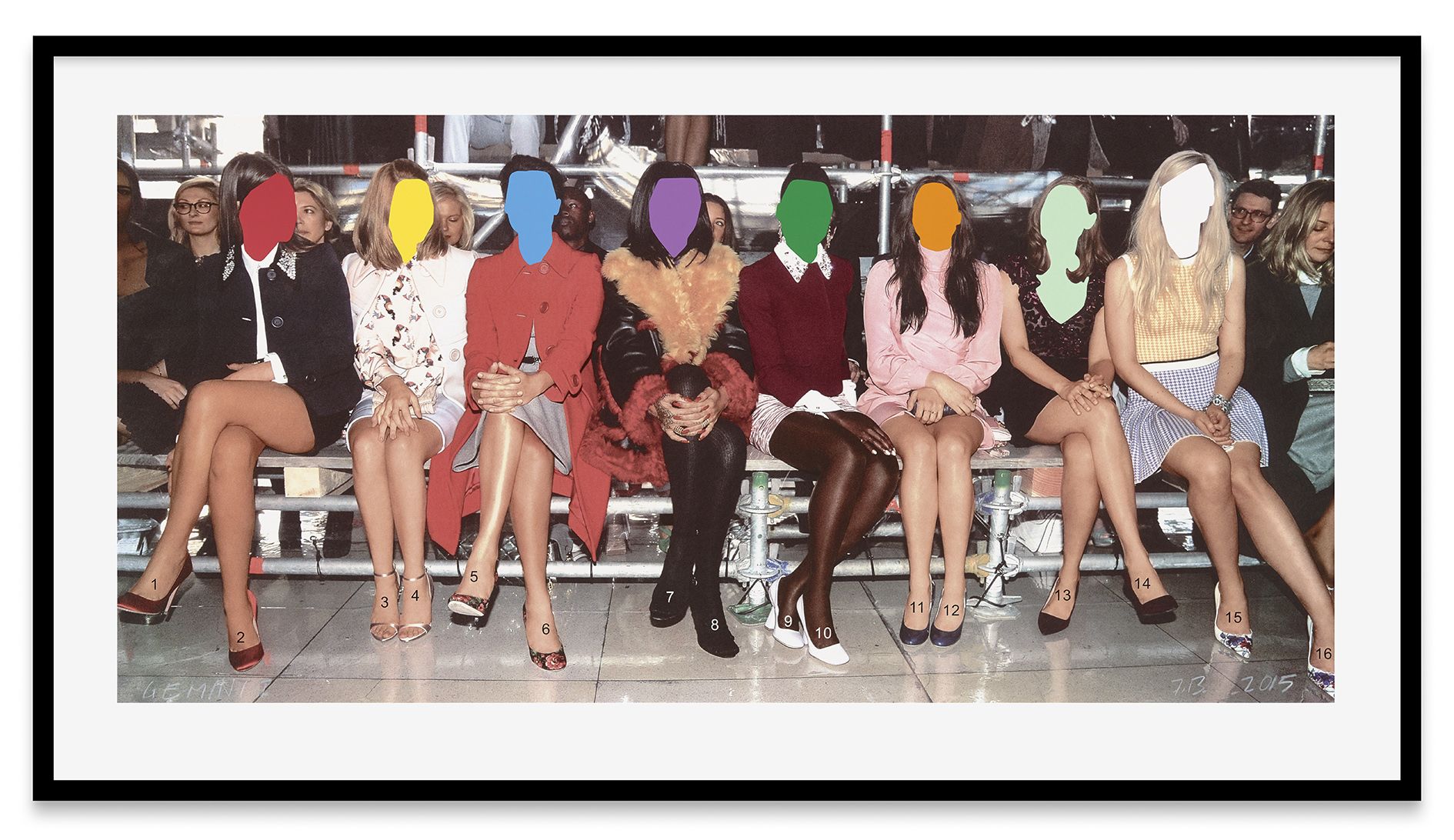
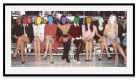
An example of John Baldessari’s extensive work in editions, Front Row: Numbered Legs (2015) stems from a suite of works using appropriated photographs of runway shows and fashion icons. In this twenty-color screenprint, Baldessari applies the gesture for which he is best known, covering the faces of the figures in his appropriated photographs with brightly colored shapes and overlays. In this case, by obscuring their identities, the artist subverts the goal of appearing in the “front row,” where one is best placed to see and be seen. Baldessari instead draws his viewers’ attention to other areas of the image, including the figures’ shoes, outfits and camera-ready poses, and thus offers a playful, Technicolor critique of contemporary culture’s obsession with image and identity.
John Baldessari (1931–2020) lived and worked in Venice, California. Selected solo exhibitions include Bozar Centre for Fine Arts, Brussels (2025–26), Fondazione Querini Stampalia, Venice, Italy (2025), Museo de Arte Latinoamericano de Buenos Aires (2024), Moderna Museet, Stockholm (2020), Laguna Art Museum, Laguna Beach (2019), Museo Jumex, Mexico City (2017), Städel Museum, Frankfurt (2015), Garage Center for Contemporary Culture, Moscow (2013), Stedelijk Museum, Amsterdam (2011), Fondazione Prada, Milan (2010), Metropolitan Museum of Art, New York (2010–11), Museum of Contemporary Art, Barcelona (2010), Los Angeles County Museum of Art (2010), Tate Modern, London (2009). Selected group exhibitions include the 53rd La Biennale di Venezia (2009), at which he was honored with the Golden Lion for Lifetime Achievement, Whitney Biennial (2009, 1983), Documenta V and VII (1972, 1982), and the Carnegie International (1985–86).


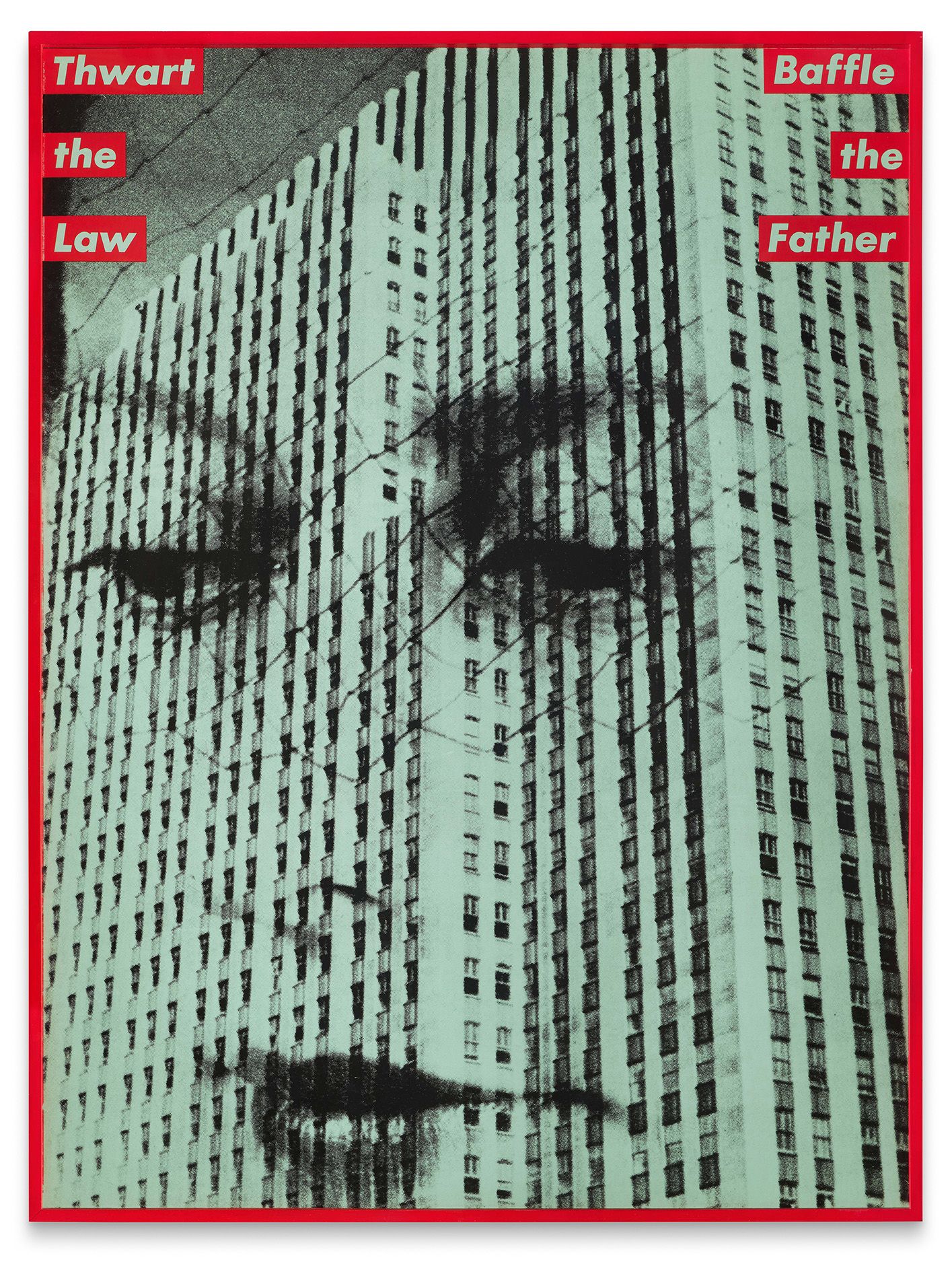
Barbara Kruger’s iconic artistic practice explores the power of image and word, touching on the dynamics of control, corruption, and consumerism. For over four decades, her voice and aesthetic have transcended the insularity of the art world, influencing everyday visual culture. Untitled (Thwart the Law) (1987) especially manifests Kruger’s stylized politicality: the downcast face of a woman is superimposed over a heavily windowed commercial building, a monochrome of opaline green. In the top corners of the image, Kruger’s signature red-bordered Futura typeface instructs the viewer to “thwart the law” and “baffle the father.” Read in conversation with one another and the selected imagery, Kruger is advocating the resistance of institutionalized patriarchy through the authoritative visual syntax of advertising.
Barbara Kruger (*1945, Newark, NJ) lives and works in Los Angeles and New York. Recent solo shows include Museo Guggenheim Bilbao (2025), ARoS Art Museum, Aarhus, Serpentine Galleries, London (both 2024), Museum of Modern Art, New York, Los Angeles County Museum of Art, Neue Nationalgalerie, Berlin (all 2022), Art Institute of Chicago (2021), Amorepacific Museum of Art, Seoul (2019) and National Gallery of Art, Washington, DC (2016). Recent group exhibitions include Langen Foundation, Neuss, Germany (2025), The Broad, Los Angeles (2023), La Biennale di Venezia (2022), Isabella Stewart Gardner Museum, Boston (2021), Museum of Modern Art, Warsaw (2021), The Metropolitan Museum of Art, New York (2020), Walker Art Center, Minneapolis (2020), Nationalmuseum, Stockholm (2019) and Hamburger Bahnhof, Berlin (2018).
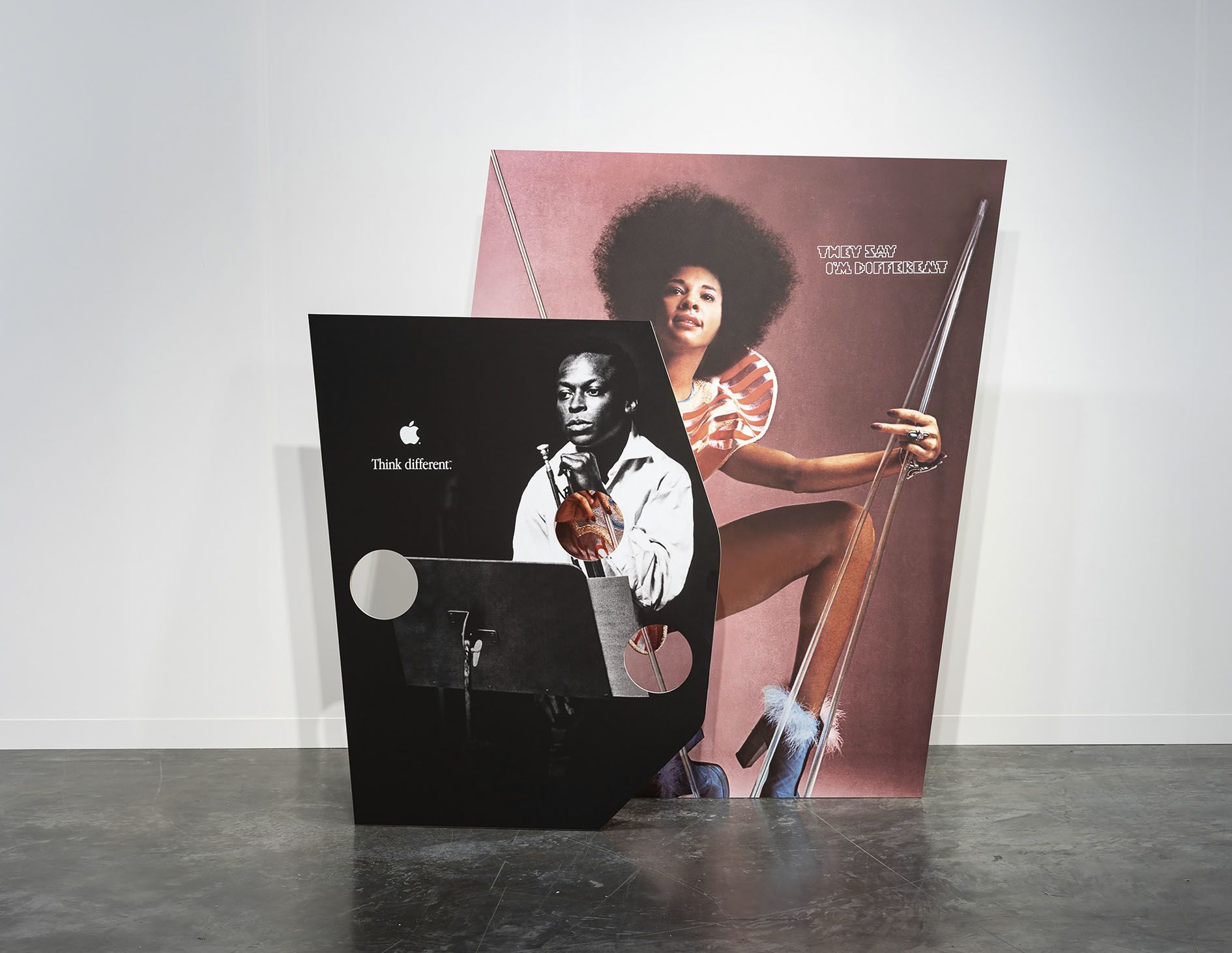

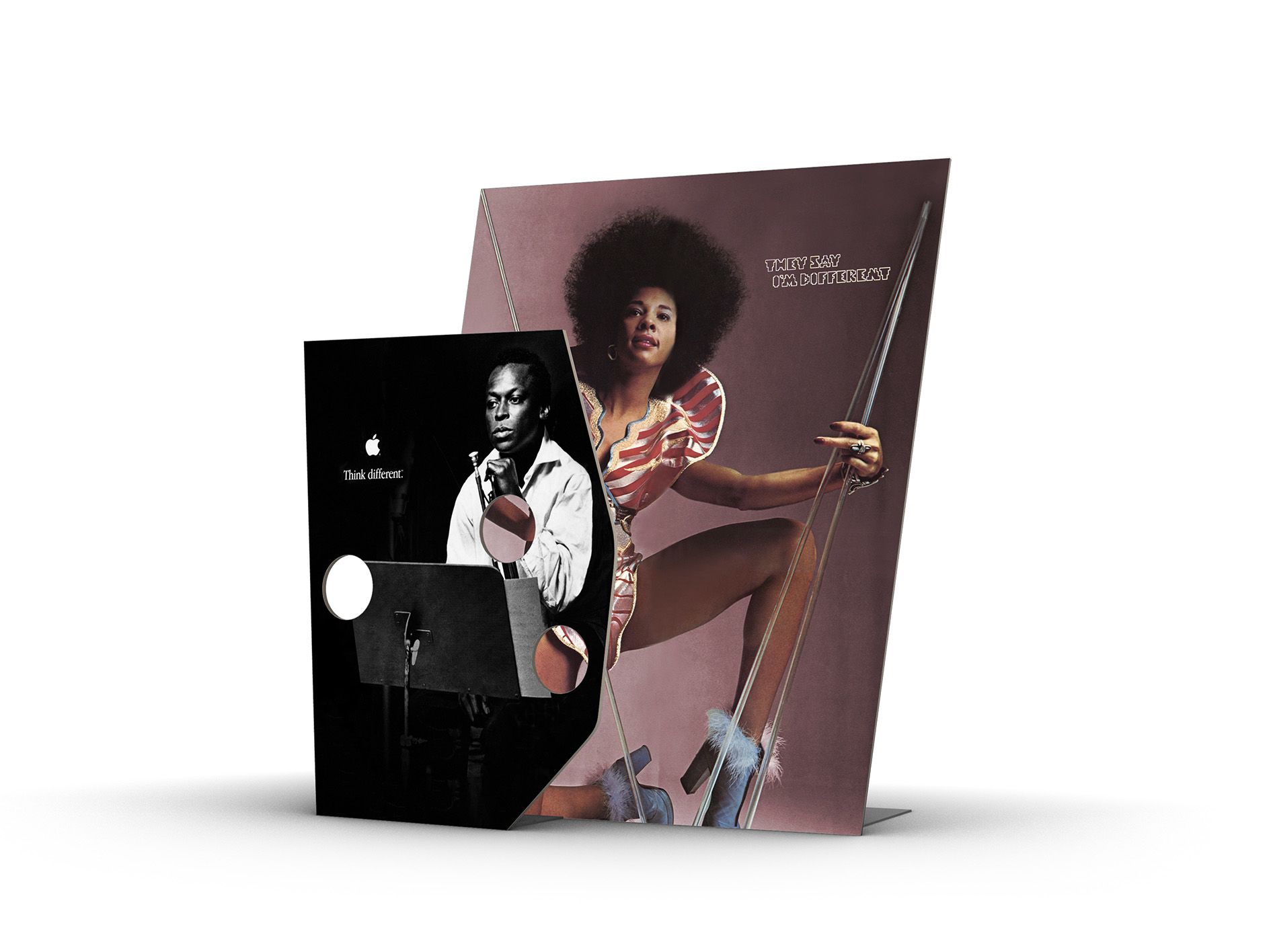
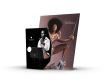
For over three decades, Arthur Jafa has produced imagery that dissects the realities, constructions, and influence of Blackness in contemporary culture. Through strategies of appropriation, as well as lyrical manipulations of industrial materials, his works reveal poignant gaps and connections between different sources through the power of juxtaposition. Black Différance, Miles and Betty (2024) is one of Jafa’s aluminum “cutout” sculptures, which take their format from the work of Cady Noland (an artistic touchstone for Jafa) and their content from music history. The front panel features Miles Davis, pulled from an Apple advertisement using his image. Three prominent holes in the aluminum give views onto the back panel, depicting Betty Davis—Miles Davis’ second wife, and a performer and songwriter in her own right—on the cover of her album They Say I’m Different. Compared to her album title, Apple’s appeal to “Think Different” rings hollow, laying bare the frequent commercialization of Black culture by capitalist societies that still treat their Black citizens unequally.
Arthur Jafa (*1960, Tupelo, Mississippi) lives and works in Los Angeles. Recent solo exhibitions include Museum of Contemporary Art, Chicago (2024), LUMA Foundation, Arles (2023), Louisiana Museum, Humlebæk (2021), Serralves Museum, Porto and Musée d’art contemporain de Montreal (both 2020), Moderna Museet, Stockholm (2019), Museum of Contemporary Art, Denver (2018), and Serpentine Galleries, London (2017). Recent group exhibitions include Modern Art Museum, Fort Worth and Schirn Kunsthalle, Frankfurt (both 2024), Smithsonian American Art Museum, Pinakothek der Moderne, Munich, and 14th Gwangju Biennale (all 2023), Aspen Art Museum and Bangkok Art Bienniale (both 2022), and Art Gallery of New South Wales, Sydney, Los Angeles County Museum of Art, Brooklyn Museum, New York, and Institute of Contemporary Art, Boston (all 2021). In 2019, he received the Golden Lion at the 58th La Biennale di Venezia.


Over a prolific two decades, the late Kaari Upson created a groundbreaking body of work that delved into the deep-seeded motivations and urges that characterize the human experience. In works that range from intimate objects to room-sized installations, the artist explored the nature of our relationships with ourselves and others as well as with the domestic spaces we inhabit. 98 (2013) is a stunning work from her celebrated series of domestic sculptures, which she began to produce in 2012 using mattresses, sofas and other objects found discarded near her studio in Los Angeles. Upson cast these forms in silicone and urethane, fascinated with the possibility of lifting and replicating not only their physical surfaces, but also the emotional and psychological impressions of those who had used them. This sculpture, with its gestural sprays of color, perfectly illustrates Upson’s painterly style and her vivid exploration of both the beauty and grotesqueness, the fragility and excesses, of capitalist Western society.
Kaari Upson (1970–2021) lived and worked in Los Angeles and New York. Solo exhibitions include a major retrospective at Louisiana Museum of Modern Art, Humlebæk, Denmark (2025), which traveled to Kunsthalle Mannheim (2026) and MASI Lugano (forthcoming 2026–27), Hammer Museum, Los Angeles (2023, 2007), Deste Foundation, Athens (2022), Kunsthalle Basel (2019), Kunstverein Hannover (2019), and New Museum, New York (2017). Group exhibitions include Kunstmuseum Basel (2025), Hessel Museum of Art, Annandale-On-Hudson, NY (2024), Centre d’Art Contemporain Genève (2023), San Francisco Museum of Modern Art (2022), Cleveland Museum of Art (2021), Walker Art Center, Minneapolis (2020), Aspen Art Museum (2019), Marta Herford Museum, Herford, Germany (2018), 15th Istanbul Biennial (2017) and 2017 Whitney Biennial. In 2019 and 2022, her work was featured in the 58th and 59th La Biennale di Venezia.


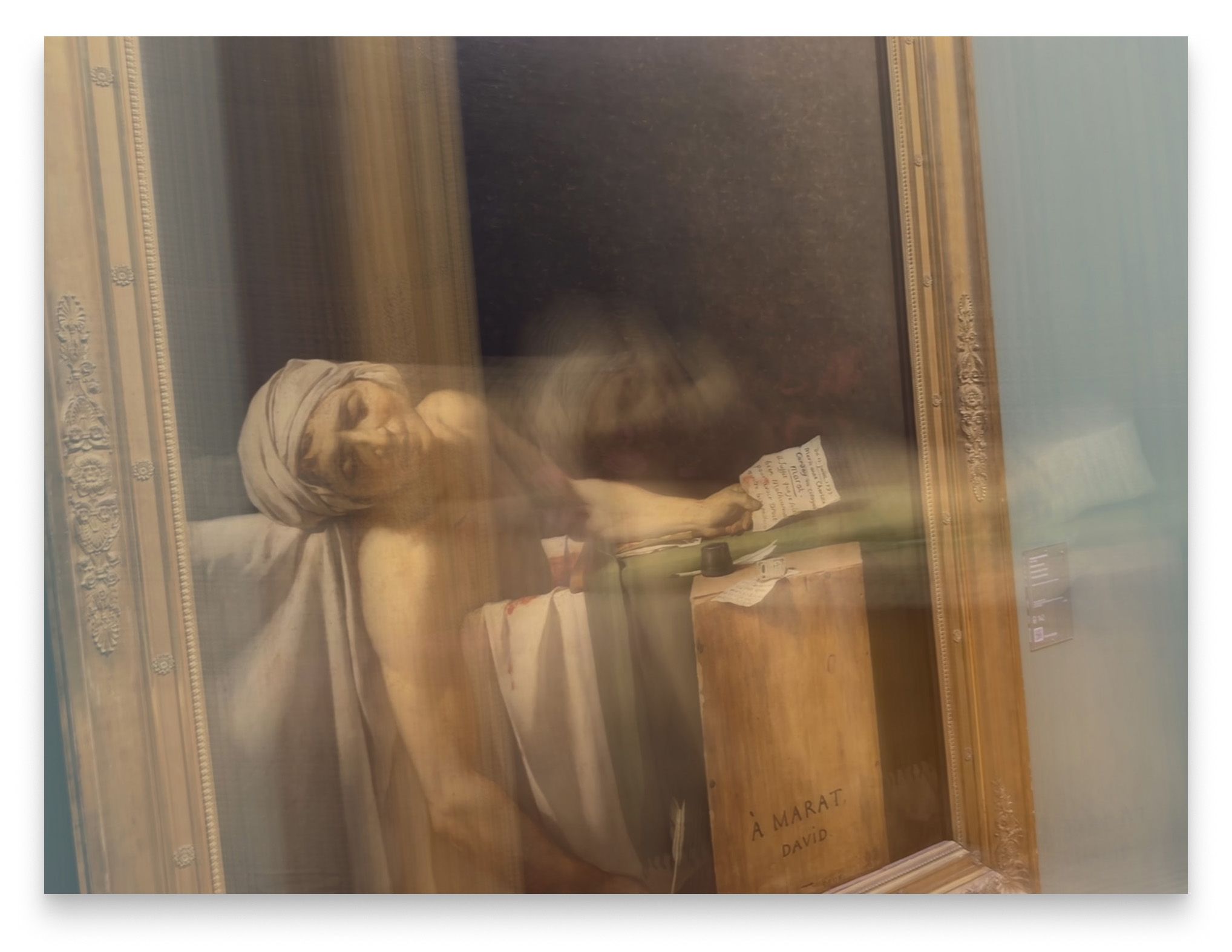
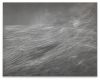
Louise Lawler is a steadfast investigator of picture-making. Since the late 1970s, her practice has centered on photographing the works of other artists—finding them in the overlooked corners of museums, the private interiors of collections, the transactional spaces of auction houses and storage depots. Through these complex photographic investigations, Lawler analyzes the conditions of exhibiting and the fate of objects, finding meaning in the incidental or unacknowledged aesthetics that surround art. Before/During/After (Green) (2024/2025) is a blurred photograph Lawler took at the Royal Museums of Fine Arts of Belgium in 2024 of Neoclassical painter Jacques-Louis David’s painting The Death of Marat (1793), one of the most politically charged images in the history of French art. Lawler’s camera captures the painting mid-movement, the swiped motion of the lens introducing a temporal blur that seems entirely fitting: the title’s sequence—before, during, after—gestures toward how images accumulate meaning over time, caught between their making, their history, and their present encounter.
Louise Lawler (*1947, New York) lives and works in New York. Solo exhibitions include Collection Lambert, Avignon (2023), Art Institute of Chicago (2019), Sammlung Verbund, Vienna (2018), The Museum of Modern Art, New York (2017), and Museum Ludwig, Cologne (2013). Selected group exhibitions include Fondazione Prada, Venice, The Metropolitan Museum of Art, New York, Museum Brandhorst, Munich, Walker Art Center, Minneapolis, Institute of Contemporary Art, Boston, The Museum of Modern Art, New York, MoMA PS1, New York, MUMOK, Vienna, Hammer Museum, Los Angeles, and the Whitney Museum, New York, which additionally featured the artist in its 1991, 2000 and 2008 biennials. Her work was also included in the 59th La Biennale di Venezia (2022).

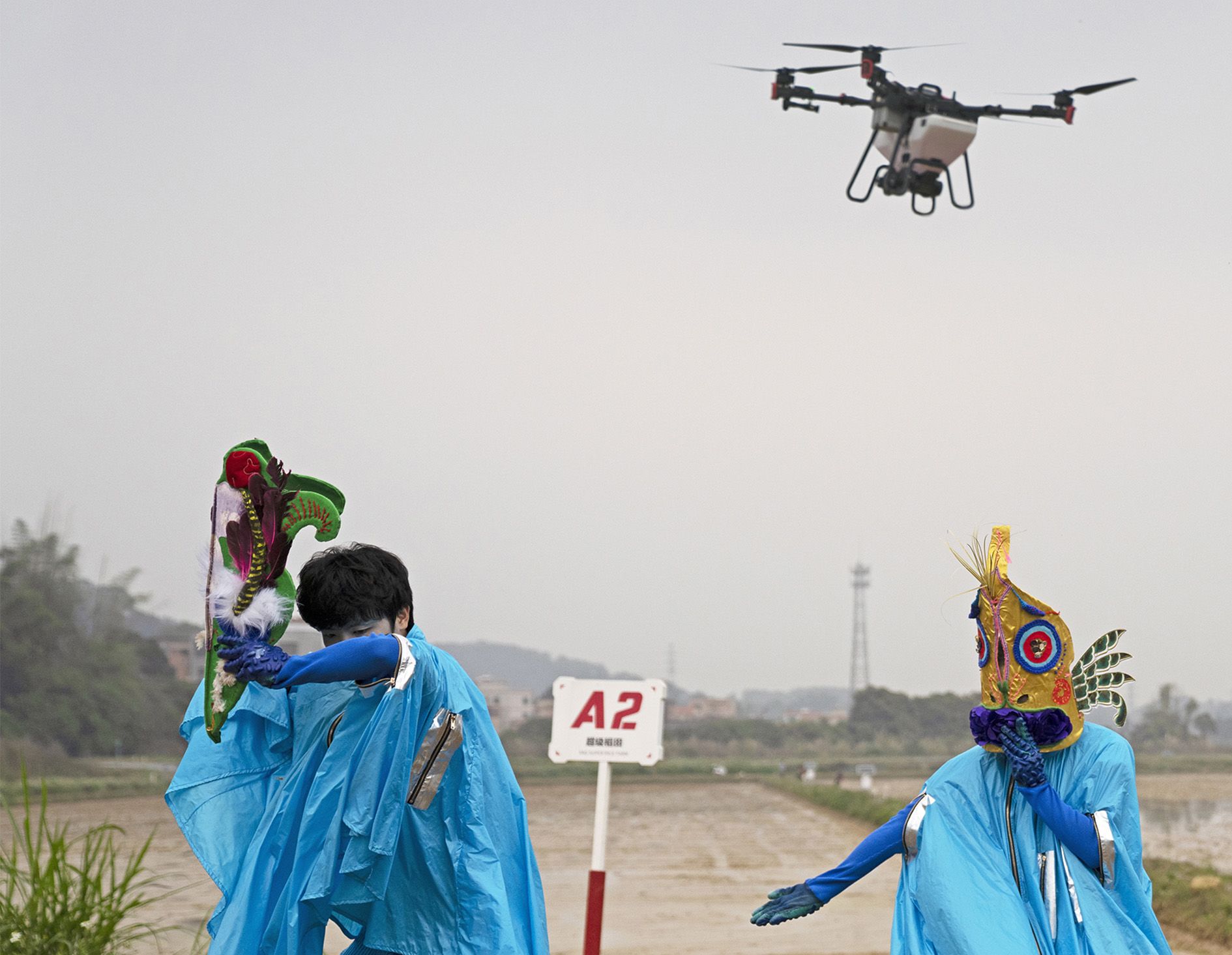



Celebrated internationally for her wide-ranging multimedia work, Cao Fei regularly explores the intersections between humanity, technology, capital and the digital age. The photograph Dash 01 relates to Cao Fei’s newest video work Dash (both 2026), a culmination of three years of research that follows the crop cycle from sowing to harvest as fields become laboratories of smart agriculture. Four figures, wearing a mixture of worker uniforms and ceremonial garb, dance together in ritualistic fashion; their bright blue attire and colorful masks radiate amid the muted, muddy landscape behind them. Hovering above the group is a high-tech farming drone—a fifth character in the action Cao Fei has orchestrated. Like the film, Dash 01 considers how technological progress weaves itself into rituals, music and traditional knowledge, which have long shaped the rhythms of rural communities, and it raises questions about sustainability and cultural continuity.
Cao Fei (*1978, Guangzhou) lives and works in Beijing. Selected solo exhibitions include Fondazione Prada, Milan, Kunstmuseum Basel (both 2026), Sydney Modern / Art Gallery of New South Wales, Museum of Art Pudong, Shanghai, Lenbachhaus, Munich (all 2024), Pinacoteca de São Paulo (2023), MAXXI, the National Museum of 21st Century Arts, Rome and UCCA Center for Contemporary Art, Beijing (both 2021), Serpentine Galleries, London (2020), Centre Pompidou, Paris (2019), Tai Kwun Contemporary, Hong Kong and K21, Düsseldorf (all 2018), MoMA PS1 (2016), Secession, Vienna and Bonnefantenmuseum, Maastricht (both 2015) and Tate Modern, London (2013). Cao Fei’s work has been featured in group exhibitions and major biennial and triennial exhibitions worldwide since the early 2000s. In 2021, she was awarded the Deutsche Börse Photography Foundation Prize.


Reinhard Mucha is a leading German sculptor and conceptual artist known for combining formal rigor and conceptual clarity with painterly and sculptural detail, often infused with subtle irony. Golzen (2025) is a wall-mounted glass vitrine in which four footstools—a primary element in Mucha’s practice—are stacked one upon another. The vitrine references his free-standing display cases, here fixed to the wall, with its legs repeated and inverted atop the case. The stools are upholstered in muted floral and golden green fabrics, the uppermost in a deep crimson velvet, each one bearing the accumulated history of everyday use. Turned legs, braided piping, heavy fabric: ordinary objects that, through their presentation here, acquire something approaching the sacred. Between each stool, a rectangle of aluminum folding rulers holds the composition in tension—balancing and mediating. Their repeating lines echo the rigid geometry of the vitrine’s wooden frame, drawing the eye upward through an architecture of layered horizontals and verticals.
Mucha’s interest in the vitrine, the pedestal, the display, and how they function as instruments of auratic exaltation finds its concentrated expression in Golzen.
Reinhard Mucha (*1950, Düsseldorf) lives in Düsseldorf. The comprehensive survey exhibition Der Mucha – An Initial Suspicion was on view at Kunstsammlung Nordrhein-Westfalen’s two locations K20 and K21 in Düsseldorf (2022–23). Other solo exhibitions include Kunstmuseum Basel (2016), ifa – Galerie Friedrichstraße, Berlin (1996), Museum Haus Esters, Krefeld (1990), Kunsthalle Basel (1987), Kunsthalle Bern (1987), Centre Georges Pompidou, Paris (1986), Württembergischer Kunstverein, Stuttgart (1985), and Kabinett für aktuelle Kunst, Bremerhaven (1983). He participated in Documenta X (1997), and Documenta IX (1992) and represented Germany at the 44th Venice Biennale (1990).

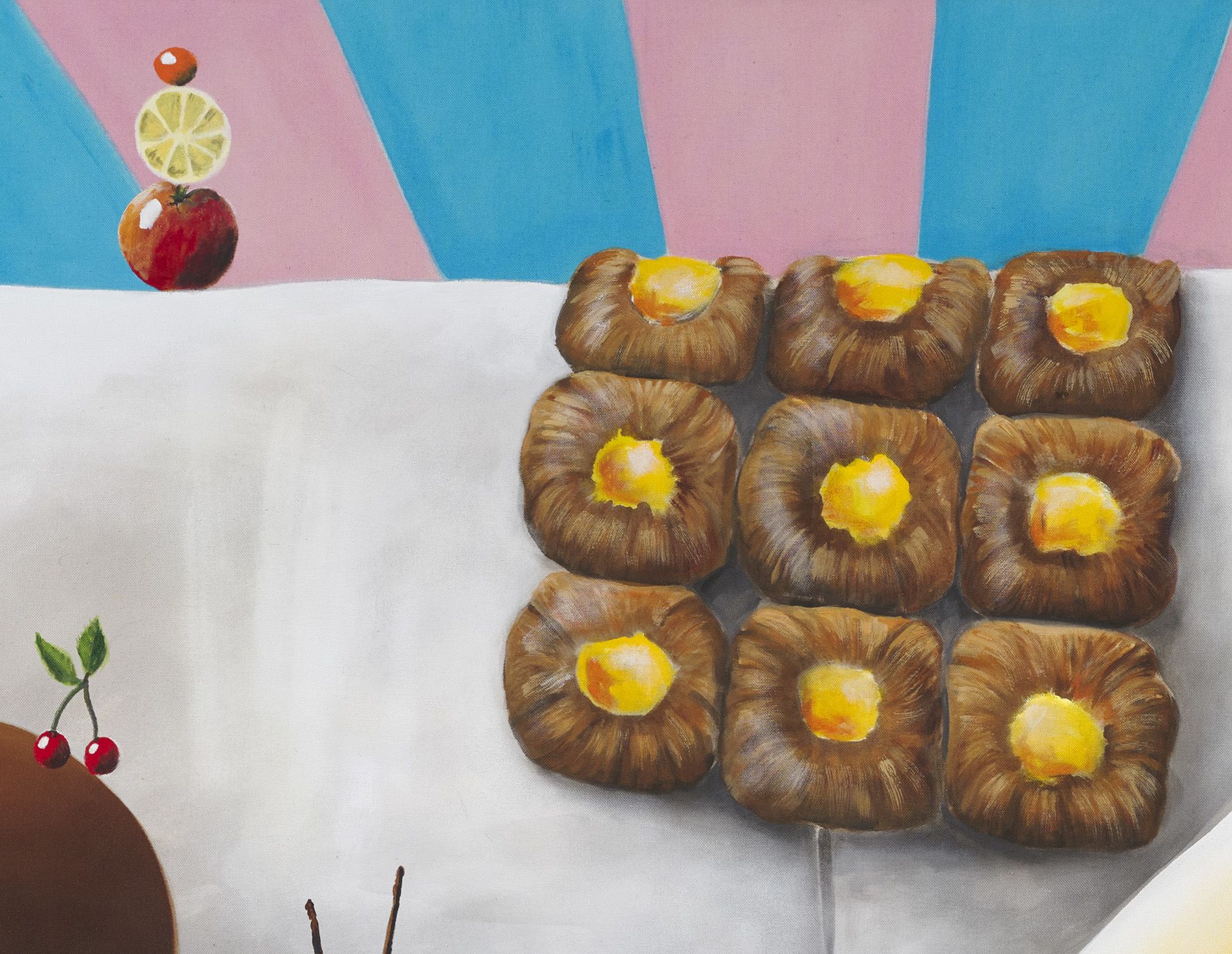
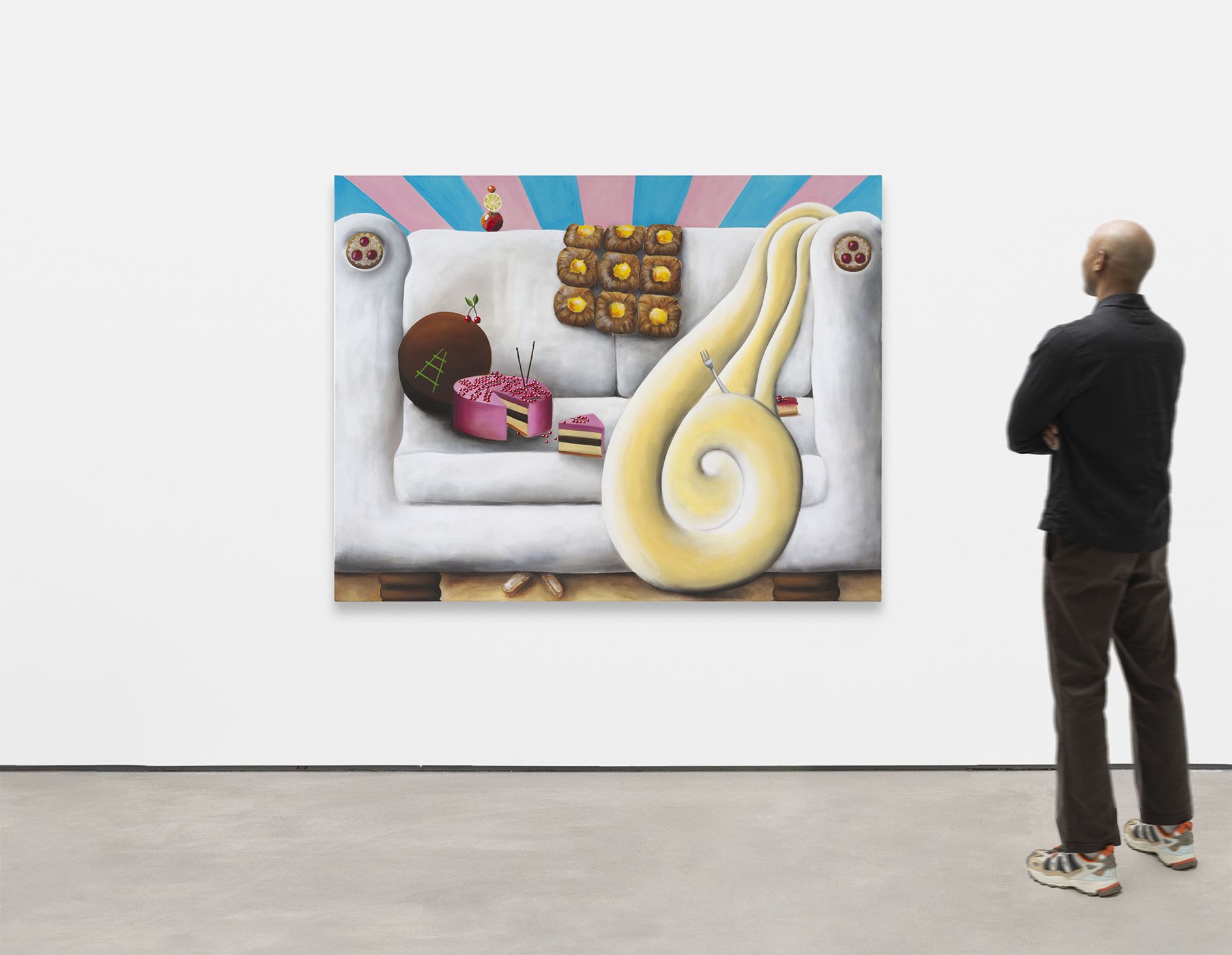


Andreas Schulze is one of the great individualists of German contemporary painting. His unique, vividly visual worlds, depict domestic spaces, urban scenes and lush landscape views—all in gleefully distorted forms that challenge the social and cultural norms of middle-class existence. Untitled (Weekend) (2026) is a statement work that perfectly encapsulates the artist’s painterly approach, in which he freely adopts styles derived from Surrealism, Naive Art and Pop Art but also merges different themes and motifs into one. The work depicts a sofa, a recurring motif in Schulze’s work. Here it is made of cream, which spills across the canvas in wonderfully soft cushions and swirls, and is dotted with other delicious confections. Schulze thus transforms the scene into cake, another of the artist’s commonplace motifs, and the subject—for the first time ever—of his current exhibition at Sprüth Magers, New York.
Andreas Schulze (*1955, Hanover) lives and works in Cologne. Selected solo exhibitions include Institute of Contemporary Art, Miami (2025–26), Le Consortium, Dijon (2025), Kunsthalle Nürnberg, which traveled to The Perimeter, London (2022–23), Fuhrwerkswaage, Cologne (2021), Kunsthalle Bielefeld (2018), Villa Merkel, Esslingen, which traveled to Kunstmuseum St. Gallen and Kunstmuseum Bonn (2014–15), Schirn Kunsthalle Frankfurt (2014), Falckenberg Collection, Hamburg and Leopold-Hoesch-Museum, Dueren (both 2010), Sprengel Museum, Hanover (1997) and Monika Sprüth Galerie, Cologne (1983). His work is part of numerous institutional and public collections including ICA, Miami, Museum Ludwig, Cologne, Musee d’Art Moderne, Paris, Kunstmuseum Bonn, Kunstmuseum St. Gallen, Städel Museum, Frankfurt, The Perimeter, London.

Icons of German postwar photography, Bernd and Hilla Becher meticulously documented industrial architecture across Europe and North America, challenging the perceived gap between documentary and fine art photography. Water Tower, Liévin, F (2012) is characteristic of the Bechers’ formal arrangements: a black-and-white frontal view of a tall water tower in Liévin, a municipality in northern France. The photograph’s location is revealed not just in the title of the work, which is customary within the Bechers’ practice, but also, unusually, in the sign above the structure. Text is rare within the Bechers’ œuvre, especially of such large type. In photographing so many utilitarian structures, their practice simultaneously distils each construction into a taxonomy of visually and functionally homogeneous structures, whilst emphasizing the particular and eccentric character of each.
Bernd (1931–2007) and Hilla Becher (1934–2015) lived in Düsseldorf and worked together since 1959. A major solo show of their work is on view at Fondazione MAST, Bologna (through September 27, 2026), which traveled from Die Photographische Sammlung/SK Stiftung Kultur, Cologne (2025–26). Other selected solo exhibitions include The Metropolitan Museum of Art, New York (2022), which travelled to San Francisco Museum of Modern Art (2022), National Museum Cardiff, Wales (2019), Josef Albers Museum Quadrat Bottrop (2018), Die Photographische Sammlung/SK Stiftung Kultur, Cologne (2016, 2013, 2010, 2006), Hamburger Bahnhof, Berlin (2005), Centre Pompidou, Paris (2004), K21 Kunstsammlung Nordrhein-Westfalen, Düsseldorf (2003) and 44th Venice Biennale (1990). Group exhibitions include Barbican Art Gallery, London (2014), Pinakothek der Moderne, Munich (2014, 2004), The Museum of Modern Art, New York (2013), Solomon R. Guggenheim Museum, New York (2010), Hamburger Bahnhof, Berlin (2008), The National Museum of Modern Art, Tokyo (2005), Hammer Museum, Los Angeles (2004), Tate Modern, London (2004, 2003) and Documenta XI, VII, VI and V, Kassel (2002, 1982, 1977, 1972).
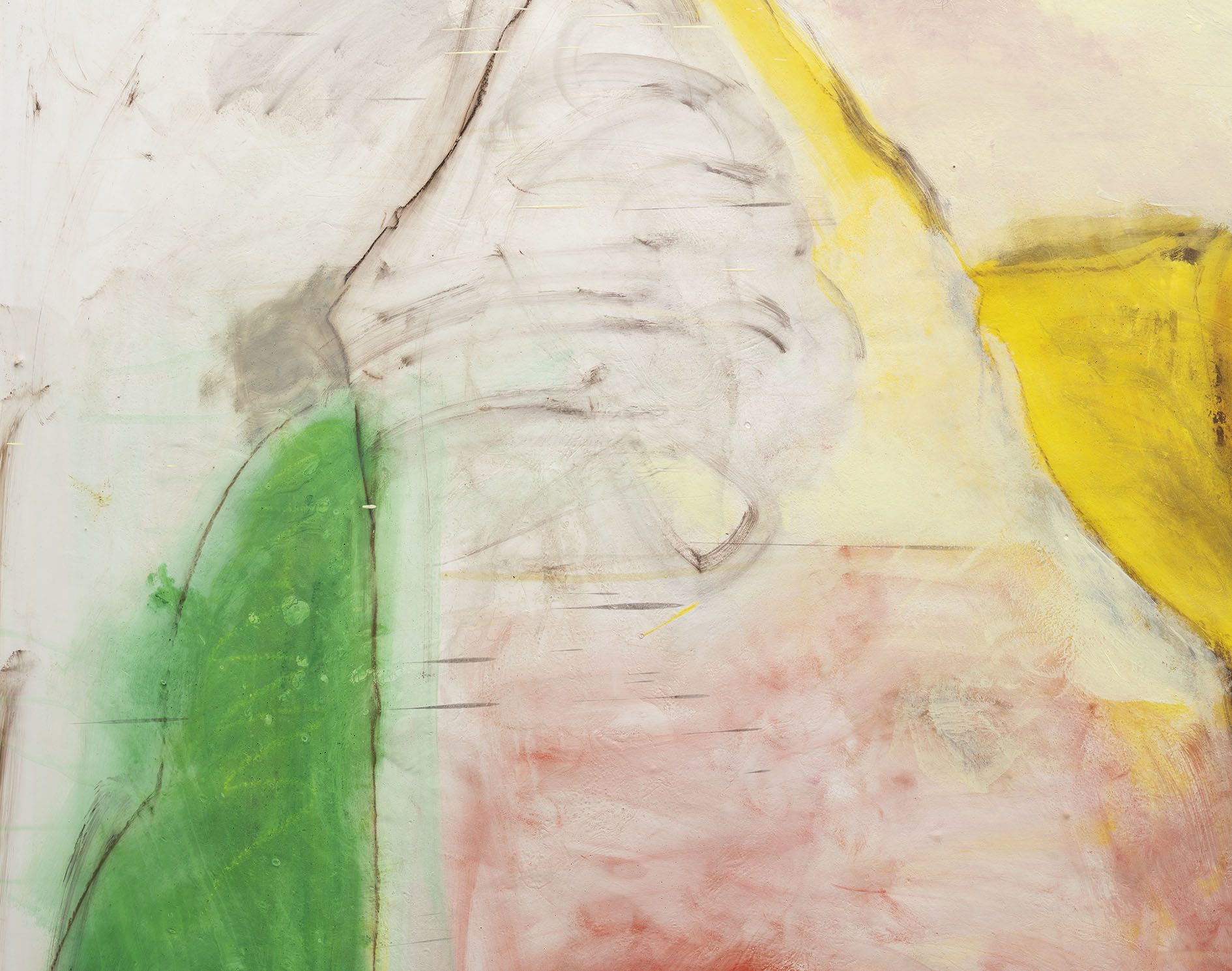


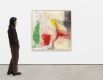
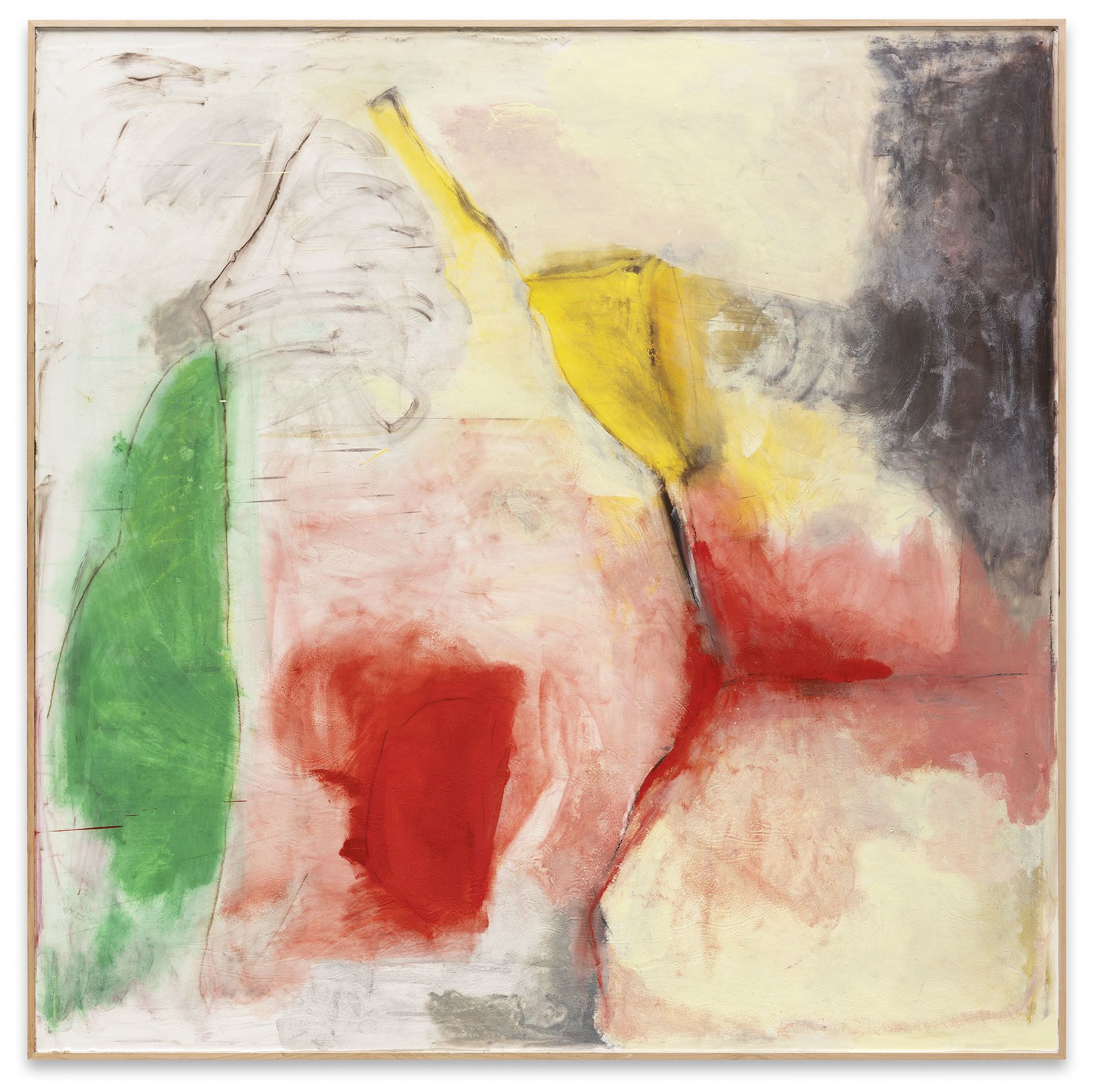
Thea Djordjadze’s distinctive paintings exemplify an embodied practice that investigates the poetics and particularities of space, alongside the inherent characteristics of her chosen materials. Her ongoing series of plaster-filled wooden frames with pigment both embedded within and layered upon their porous surfaces occupies a hybrid territory between painting and relief, fusing painterly gestures with sculptural presence. In Untitled (2026), a broad field of blush pink meets bold patches of deep red and a luminous wedge of yellow that cuts diagonally through the upper center of the composition. A vivid green form anchors the left edge, while a mass of cool gray and charcoal in the upper right dissolves into a churning spiral. Hints of cream and white emerge through the layered ground, which is extensively marked with gestural sweeps, scratched lines and grooves—asserting the work’s identity as what Djordjadze terms a “relief painting” rather than a flat surface. These textured layers, along with paint splashes and translucent washes, invest the work with a tangible sense of immediacy and gestural energy, revealing painting as a site of physical negotiation between artist, medium and space.
Thea Djordjadze (*1971, Tbilisi) lives and works in Berlin. Solo shows include Hamburger Kunsthalle (2025), WIELS, Centre d’Art Contemporain, Brussels (2023), Musée d’Art Moderne et Contemporain (MAMC), Saint-Étienne (2022), Martin-Gropius-Bau, Berlin (2021), Kunst Museum Winterthur (2019), Portikus, Frankfurt (2018), Pinakothek der Moderne, Staatliche Graphische Sammlung, Munich (2017), Secession, Vienna (2016), MoMA PS1, New York (2016), South London Gallery (2015), MIT List Visual Arts Center, Cambridge (2014), Aspen Art Museum (2013), Malmö Konsthall (2012), and Kunsthalle Basel (2009). Recent group exhibitions include Kölnischer Kunstverein (2025), Fondation Beyeler, Riehen/Basel (2023), Hamburger Bahnhof, Berlin (2022), Tai Kwun – Centre for Heritage and Arts, Hong Kong (2020), and Deichtorhallen Hamburg (2019).

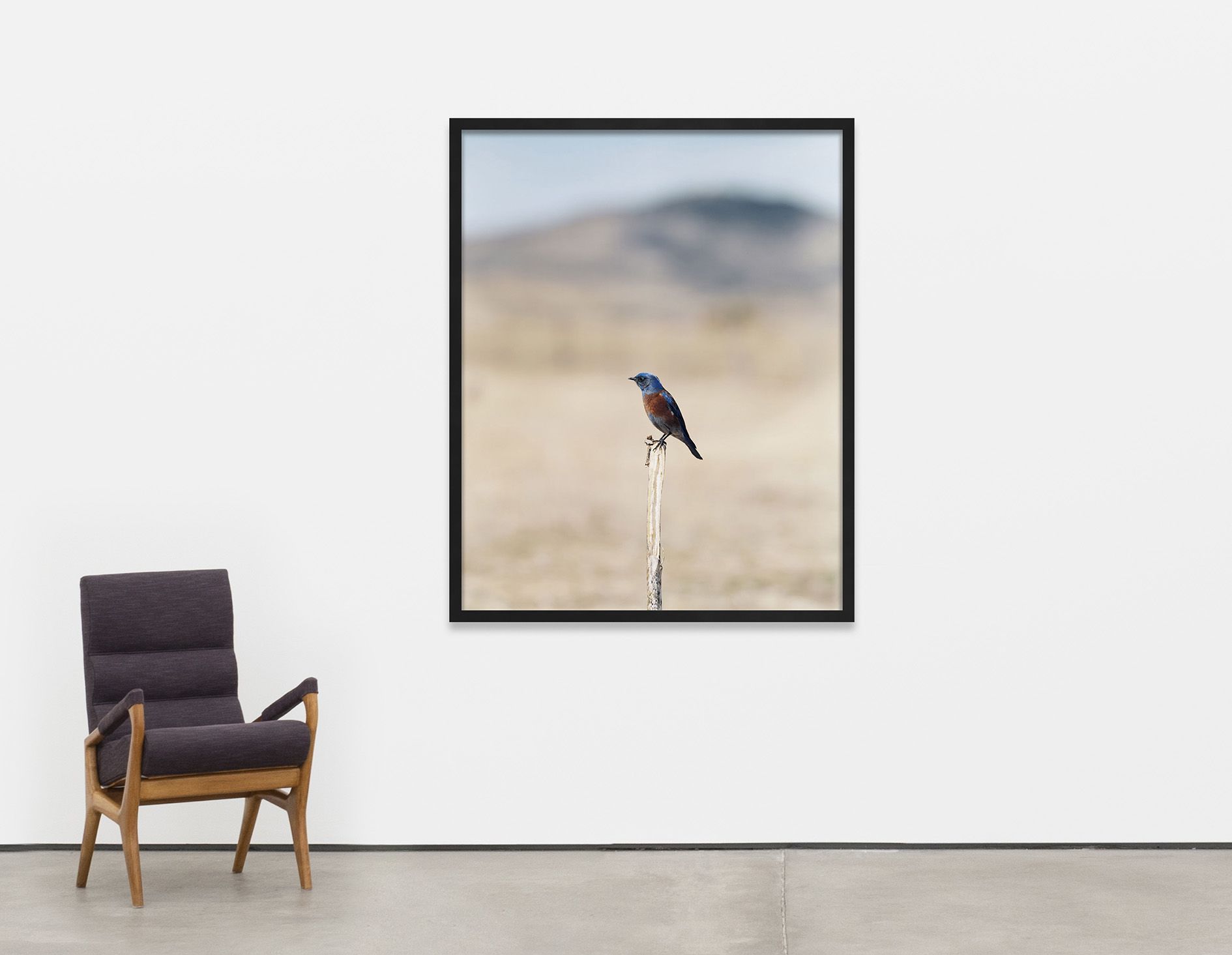


For over four decades, Jean-Luc Mylayne has captured birds in their natural habitats, creating formally surprising images at the center of which lie poetry and existential philosophical questions. Every photograph is carefully orchestrated and the product of exceptional amounts of commitment, time and technical ingenuity. Requiring lengthy periods of preparation that stand in stark contrast to his subjects’ ceaseless anxious movement, Mylayne composes tableaux that possess the astounding ability to decelerate time. Mylayne’s titles convey his method and theoretical concerns: numbered chronologically and stating the year and months of production, they reveal time as the fundamental aspect of his work. The “A” in A 7, Novembre 2006 – Mars 2007 (2006/07) stands for ami. The “friend” is a sharp Western bluebird with shiny feathers that sits at the center of a uniformly blurred background. A reflection on our present age of the Anthropocene, the work tells of the implicit trust between photographer and subject and leaves viewers with much to consider about our time and impact on Earth.
A solo exhibition of Mylayne’s work opens at the Berlin gallery on September 9, 2026.
Jean-Luc Mylayne (*1946, Marquise, France) lives and works in the world. Selected solo exhibitions include Kestnergesellschaft, Hanover (2020), Fondation Vincent Van Gogh, Arles, France, Aargauer Kunsthaus, Aarau, Switzerland, Long Museum, Shanghai (all 2018–19), The Art Institute of Chicago, The Arts Club of Chicago, Lurie Garden, Millennium Park, Chicago (all 2015), Museo Nacional Centro de Arte Reina Sofía, Madrid (2010), Musée d’Art Contemporain de Lyon (2009), Parrish Art Museum, Southampton, New York (2007–09), Lannan Foundation, Santa Fe, New Mexico (2010, 2005, 2004), Musée des Arts contemporains, Grand-Hornu (2004), Musée d’Art Moderne de la Ville de Paris (1995), Musée d’Art Moderne et Contemporain, Saint-Étienne (1991). Significant group exhibitions include Hayward Gallery, Southbank Centre, London (2020), S.M.A.K., Ghent (2017), 54th La Biennale di Venezia (2011), Neues Museum Weserburg, Bremen (1998), 10th Biennale of Sydney (1996), Kunsthaus Zürich, Zurich (1995).
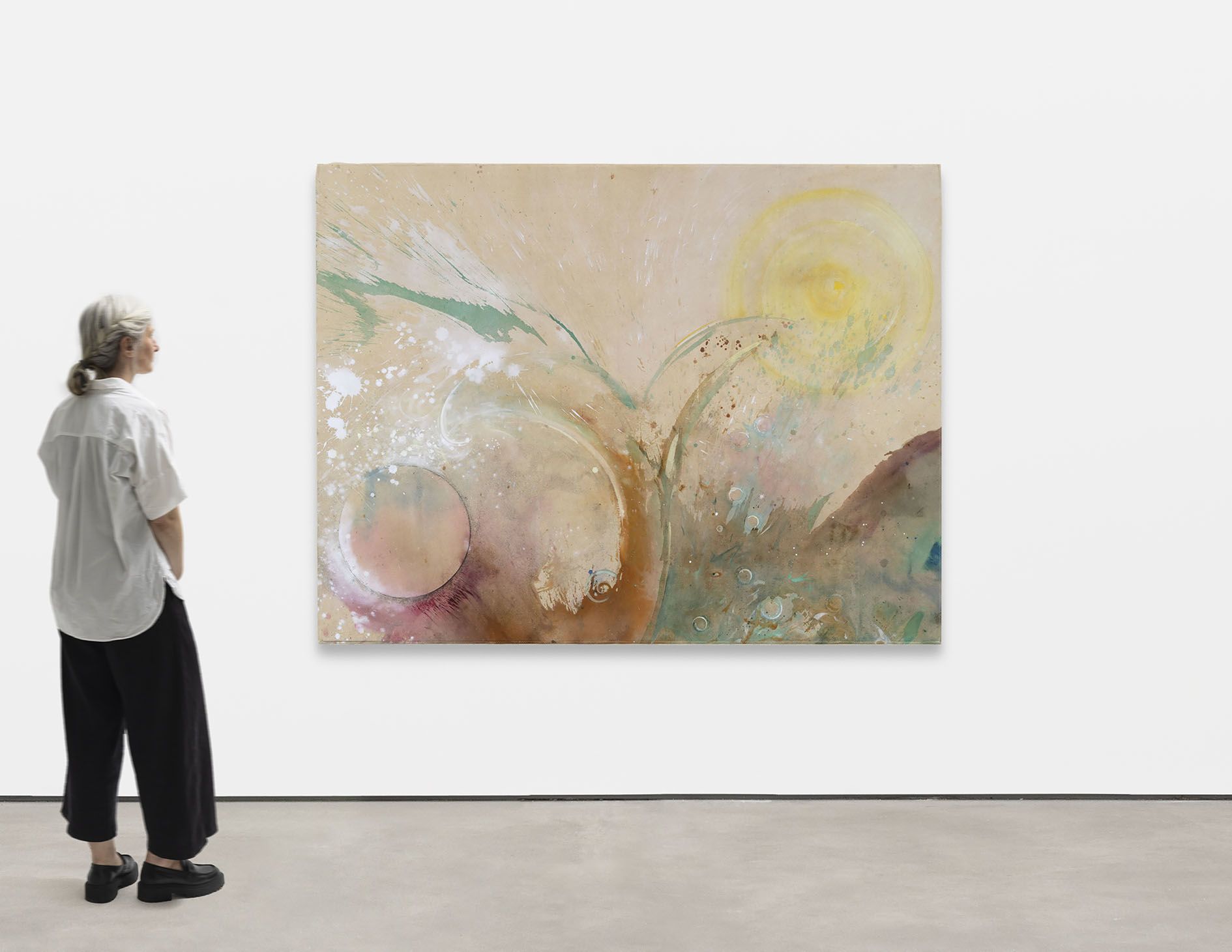


Using mostly unconventional pigments derived from nature and her immediate surroundings, Lucy Dodd’s dynamic paintings create vibrant compositions of spills, drops, stains, and surprising chemical reactions from the biota she deftly manipulates. After spending much of her life in upstate New York, Dodd recently moved to the United Kingdom, specifically to the Scottish coast on the North Sea. Reflecting her changed environment, Sun, Moon and Mermaid (2026) has an oceanic quality with its tempestuous brushwork, aquatic colorants, and reference to mythological creatures of the sea in the painting’s title. Although Dodd’s paintings are lyrical abstractions that evoke allusive cosmological and spiritual landscapes, by reading this oceanic theme into the painting, it becomes possible to see a mermaid fluke forcefully erupt from the water, splashing saltwater at two orbs, one bright yellow and the other deep purple, possibly Dodd’s sun and moon.
Lucy Dodd (*1981, New York) lives and works in Scotland. She completed studies at Art Center College of Design, CA (2004), and Bard College, New York (2011). Selected solo shows include Sprüth Magers, Berlin (2025), The Ranch, Montauk, New York (2024), Sprüth Magers, Los Angeles (2022), Whitney Museum of American Art, New York (2016), Power Station, Dallas (2016), Rubell Family Collection, Miami (2014) and Pro Choice, Vienna (2010). Recent group shows and performances include those at San Francisco Museum of Modern Art (2022), Museum of Fine Arts, Boston (2019), Frankfurter Kunstverein (2018), Armada, Milan (2015), The Kitchen, New York (2015) with Sergei Tcherepnin, and Church of Saint Luke and Saint Matthew, New York (2012).


Gary Hume rose to prominence as one of the most important voices in the Young British Artists (YBA) movement, an ambitious generation of artists who graduated from London’s Goldsmiths College in the late 1980s. He is best known for work that plays with the precarious boundary between figuration and abstraction, which his charcoal drawings of swans masterfully do. In this series, the elongated necks and beaks of Cygnus birds intersect and interact across the picture plane, transforming the composition’s negative spaces into geometries of abstraction. Oscillating between dense charcoal marks and raw canvas, Hume reduces the complexity of the creatures’ natural form to elegant, swirling lines, revealing a sensitivity to the natural world and its cycles of life.
Gary Hume (*1962, Tenterden) lives in London and New York. Selected solo exhibitions include Museum Dhondt-Dhaenens (2020), Aspen Art Museum (2016), Tate Britain (2013), Modern Art Oxford (2008), Kestnergesellschaft, Hanover (2004), Kunsthaus Bregenz (2004), Irish Museum of Modern Art, Dublin (2003), ICA, London (1999), Fundação La Caixa, Barcelona (2000) and The National Galleries of Scotland, Edinburgh (1999). Selected group exhibitions include National Portrait Gallery, London (2018), Birmingham Museum and Art Gallery (2017), Astrup Fearnley Museet, Oslo (2016), Kunstmuseum Wolfsburg (2014), Pinchuk Art Centre, Kiev (2011), Museum of Modern Art, New York (2006), Tate Britain, London (2004), Louisiana Museum (2004), Kunsthalle Basel (2002) and Museum of Contemporary Art, Los Angeles (2001), Venice Biennale (1999) and São Paulo Biennial (1996).
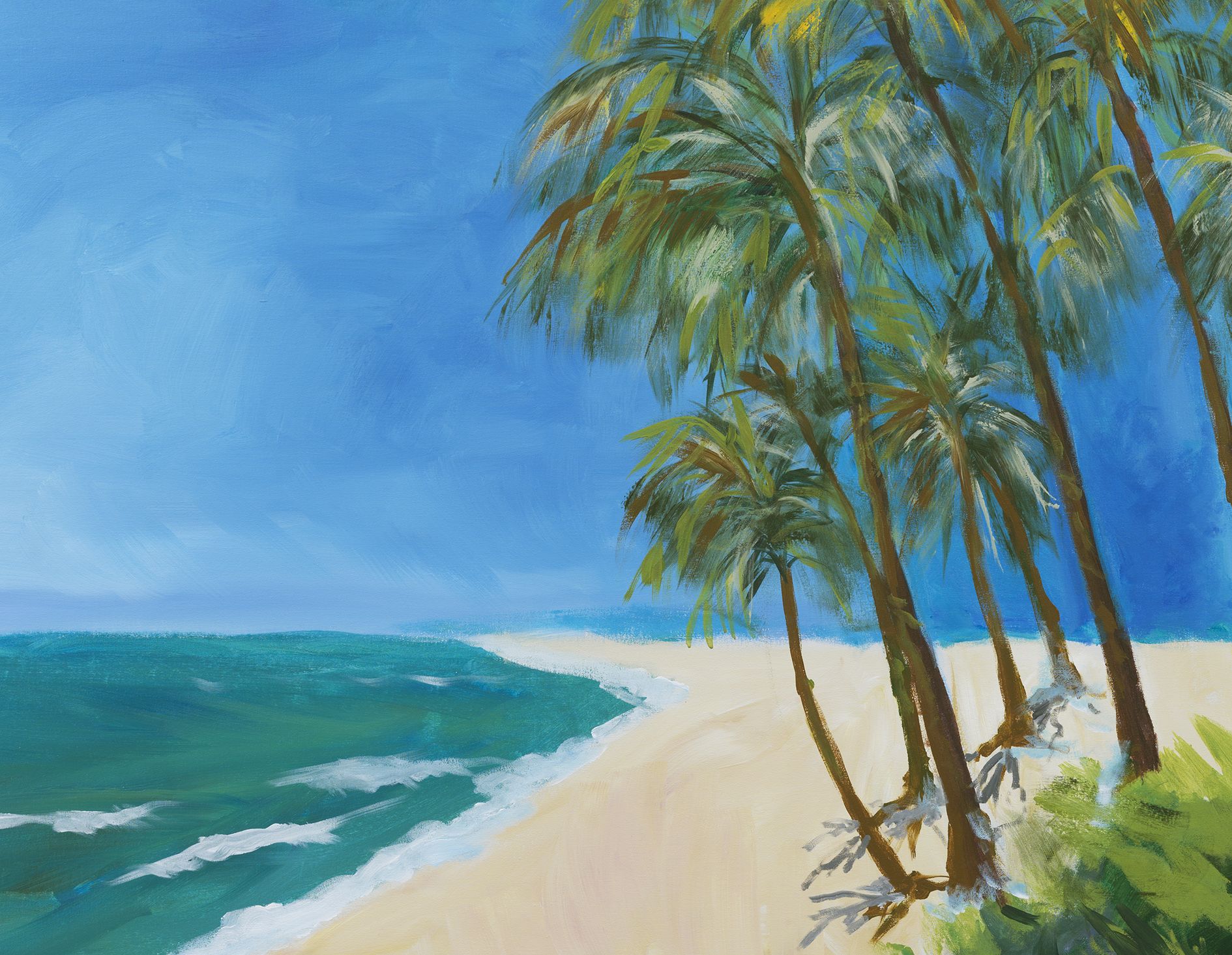


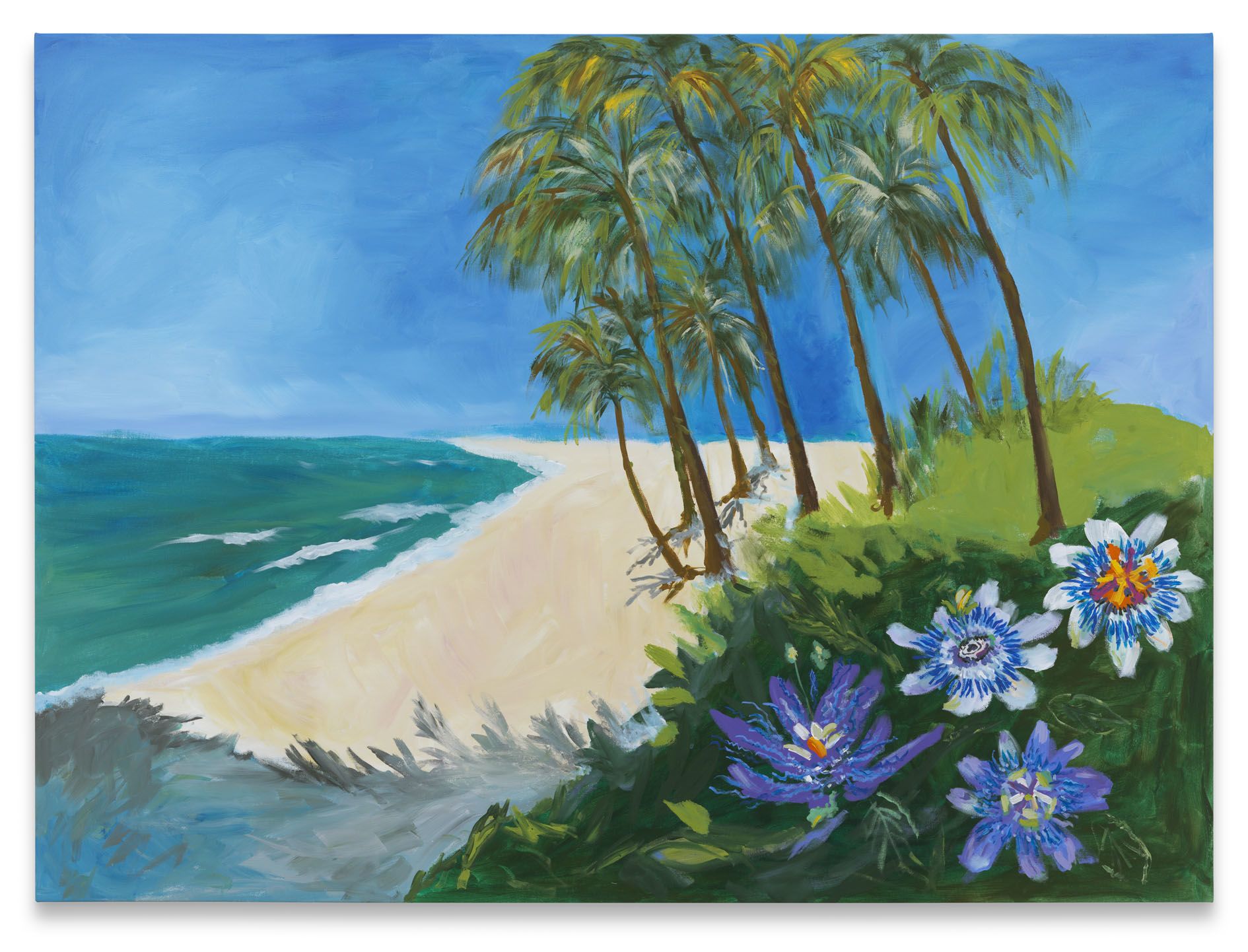
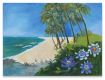
One of the most important representatives of figurative painting, sculpture, video and installation art over the last four decades, Karen Kilimnik continues to produce groundbreaking work, creating fantastical visual domains that are enveloped in delight. Kilimnik’s slumber island of passiflora, passion flower grove (2025) belongs to a series of serene beach paintings markedly devoid of human presence. In this painting, purple and blue tropical flowers rest atop verdant vegetation. Majestic palm trees sway in the distance, rooted in soft yellow sand. With vibrantly-hued turquoise water and blue coastal sky, the artist’s lush style of painting, a result of her bold coloring and velvety brushwork, creates a simple and serene composition that is simultaneously richly imaginative.
Kilimnik will present a major solo exhibition at Centro Pecci in Prato, Italy, which opens this fall.
Solo exhibitions include Art Chosun, Seoul (2024), Kunsthaus Glarus (2023), Le Consortium, Dijon (2013, 2007), the Museum of Contemporary Art, Denver (2013), The Brant Foundation, Greenwich (2012), the Belvedere Museum, Vienna (2010), Museum of Contemporary Art, Chicago (2008), Serpentine Galleries, London (2007), Museum of Contemporary Art, Miami (2007), Musée d’Art Moderne de la Ville de Paris (2006), Fondazione Bevilacqua La Masa, Venice (2005), Irish Museum of Modern Art, Dublin (2002) and Institute of Contemporary Art, Philadelphia (1992). Recent group exhibitions include Fondation Vincent van Gogh Arles, Arles (2024), Renaissance Society, Chicago (2023), Fondazione Prada, Milano (2021), 57th Carnegie International, Pittsburgh (2018), Whitney Museum of American Art, New York (2016, 2008, 1993), Tate Modern, London and Metropolitan Museum of Art, New York (both 2012), and Museum of Modern Art, New York (2005, 2001, 1999).

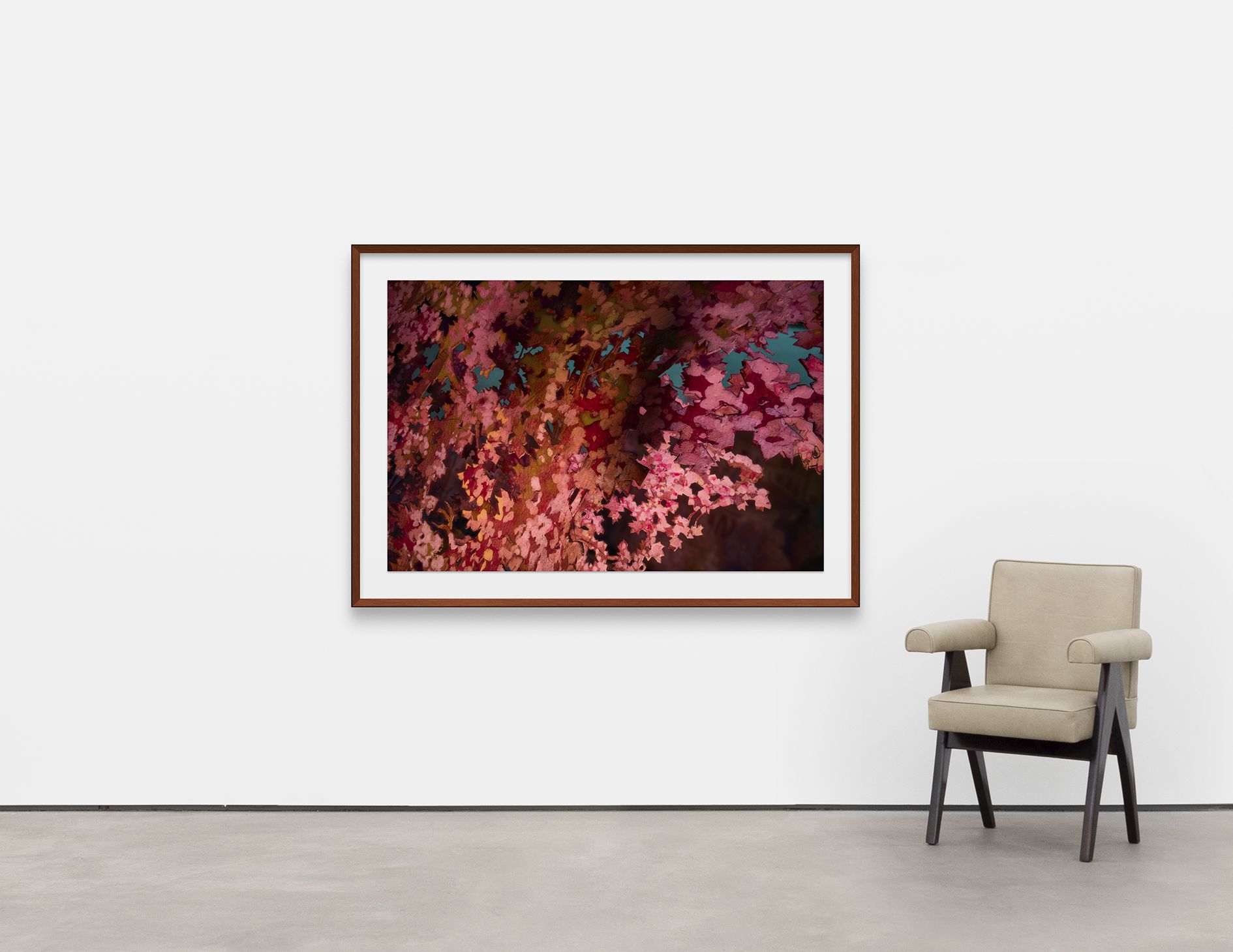


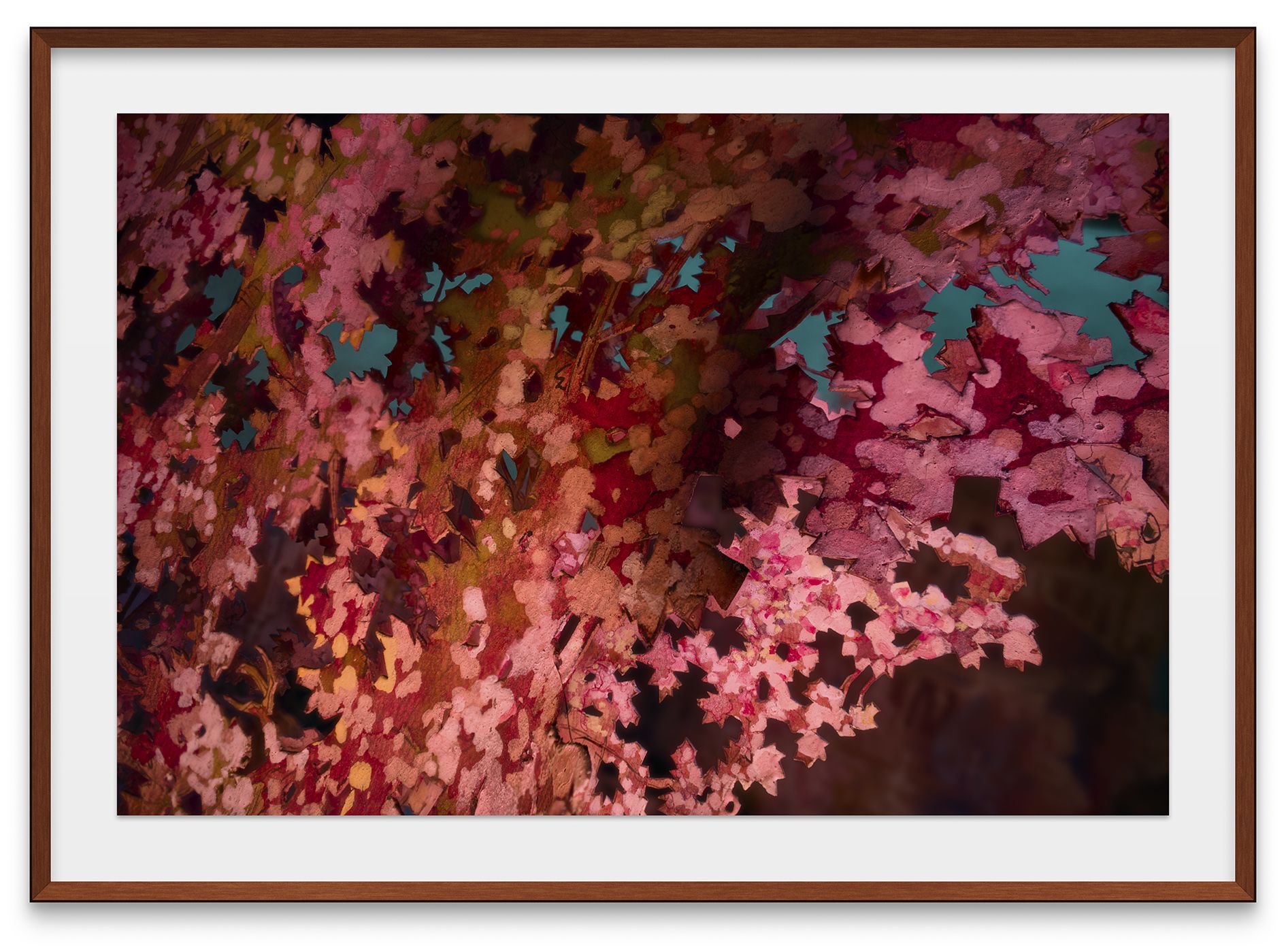
In the latest installment of his ongoing Model Studies series, Demand unites the visual power of theater and opera with his artistic practice. Having selected scenographic models from the archives of the Theatermuseum, Vienna, and the Nouveau Musée National de Monaco—ranging from Baroque backdrops to those of the turn of the century—Demand transposes them into his primary medium: photography. In Parsifal V (2026), titled after Wagner’s final opera, a painterly canopy of blossoms in pinks and crimsons, with hints of olive green, tumbles across the frame. Yet Demand’s tight crop and enlargement betray the artifice: the cut edges of layered paper or card, the slight roughness of pigment, the trace of pencil marks. Demand lays bare the handmade origins of theatrical spectacle, while turning them into something entirely new.
A solo exhibition of Demand’s latest work is currently on view at the Berlin gallery through August 1, 2026.
Thomas Demand (*1964, Munich) lives and works in Berlin. A solo exhibition of new Model Studies by Demand is currently on view at MAK, Vienna, through January 24, 2027. He is the subject of a major touring retrospective, which opens at Fundación PROA, Buenos Aires, on August 21, 2026, having previously been exhibited at Taipei Fine Arts Museum (2025), Museum of Fine Arts, Houston (2024), Jeu de Paume, Paris (2023), Israel Museum, Jerusalem (2023–24), and UCCA Edge, Shanghai (2022). Other selected solo exhibitions include Museum of Contemporary Art, Toronto (2022), Centro Botín, Santander, Garage Museum of Contemporary Art, Moscow (both 2021), Fondazione Prada, Venice (2017, 2007), Modern Art Museum of Fort Worth (2016), Los Angeles County Museum of Art (2015), Museum of Contemporary Art, Tokyo (2012), Neue Nationalgalerie, Berlin (2009), Hamburger Kunsthalle, Hamburg (2008), Serpentine Galleries, London (2006), Museum of Modern Art, New York (2005), Kunsthaus Bregenz (2004), Louisiana Museum of Modern Art, Humlebæk (2003), and Castello di Rivoli, Turin (2002). He represented Germany at the 26th São Paulo Biennial in Brazil in 2004.

Henni Alftan’s paintings transform ordinary scenes of modern life into mysterious visual delights. Her works initially appear intimately familiar, yet, as a result of her economy of means and careful cropping, become increasingly elusive upon extended engagement. In Steps (2025), Alftan paints an unembellished spiral staircase in which a partially visible figure ascends its sharp steps, casting a long, pale blue shadow behind them. Alftan’s choice to only show the enigmatic figure just above their ankles obscures their identity in favor of focusing upon the fleeting impression their body casts upon the world around them. In Steps and throughout her œuvre, Alftan thwarts her viewers’ natural urge to make sense of what they are seeing without the context of what they aren’t, creating an alluring dichotomy of familiarity and mystery.
Henni Alftan (*1979, Helsinki) lives and works in Paris. Institutional group exhibitions include those at Centre Pompidou-Metz, France (2025), Longlati Foundation, Shanghai (2024), Amos Rex Art Museum, Helsinki (2024), Kemper Museum of Contemporary Art, Kansas City (2024), EMMA – Espoo Museum of Modern Art, Espoo, Museum of Contemporary Art Kiasma, Finland (both 2023), LACMA, Los Angeles (2022), ENSA Limoges, École Nationale Supérieure d’Art (2020), Musée des Beaux-Arts de Brest (2017). Alftan’s works are included in the collections of the Buffalo AKG Art Museum, New York, Dallas Museum of Art, Hammer Museum, Los Angeles, Helsinki Art Museum, High Museum of Art, Atlanta, Institute of Contemporary Art, Miami, Kuntsi Museum of Modern Art, Vaasa, Finland, Los Angeles County Museum of Art and the UBS Art Collection.
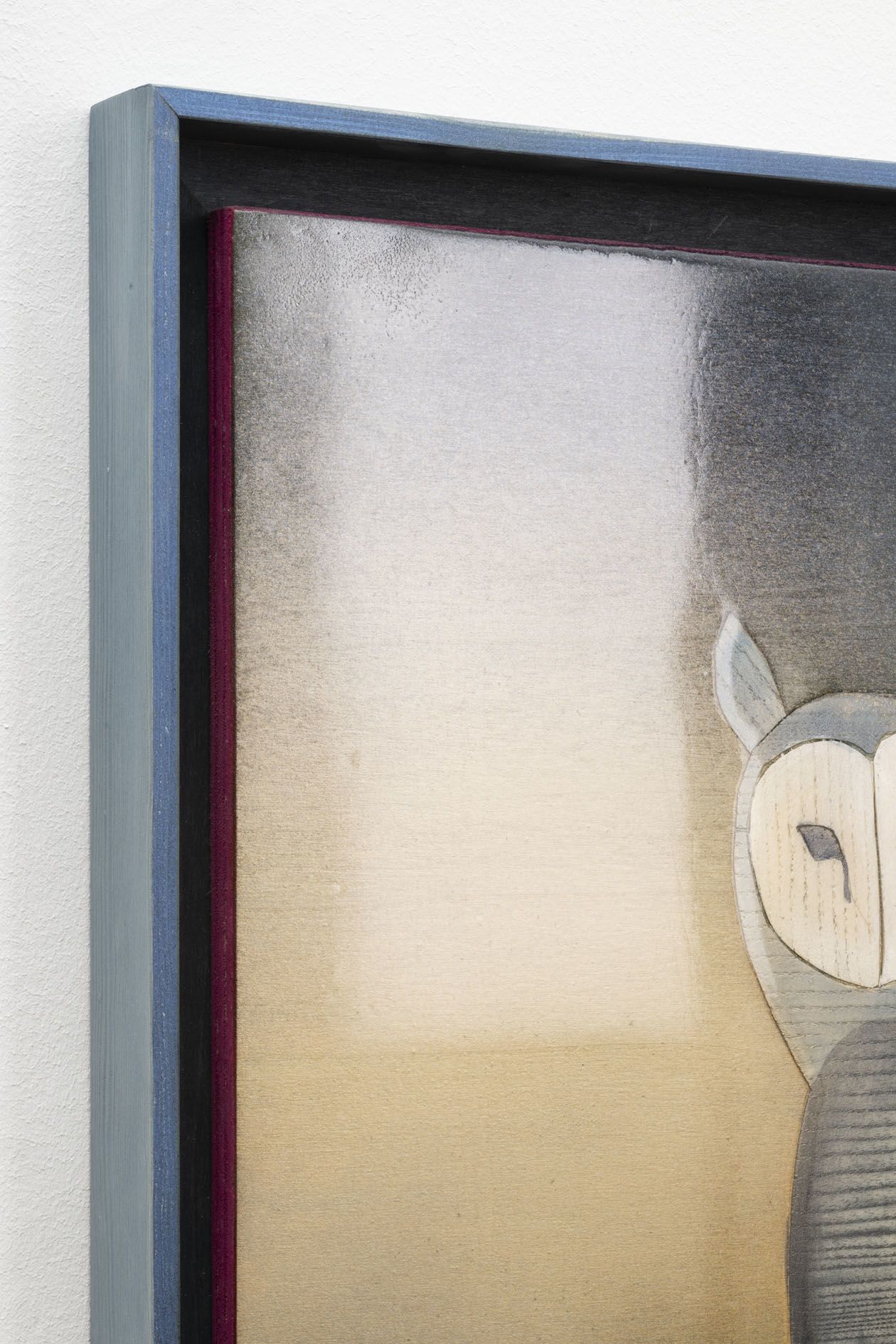

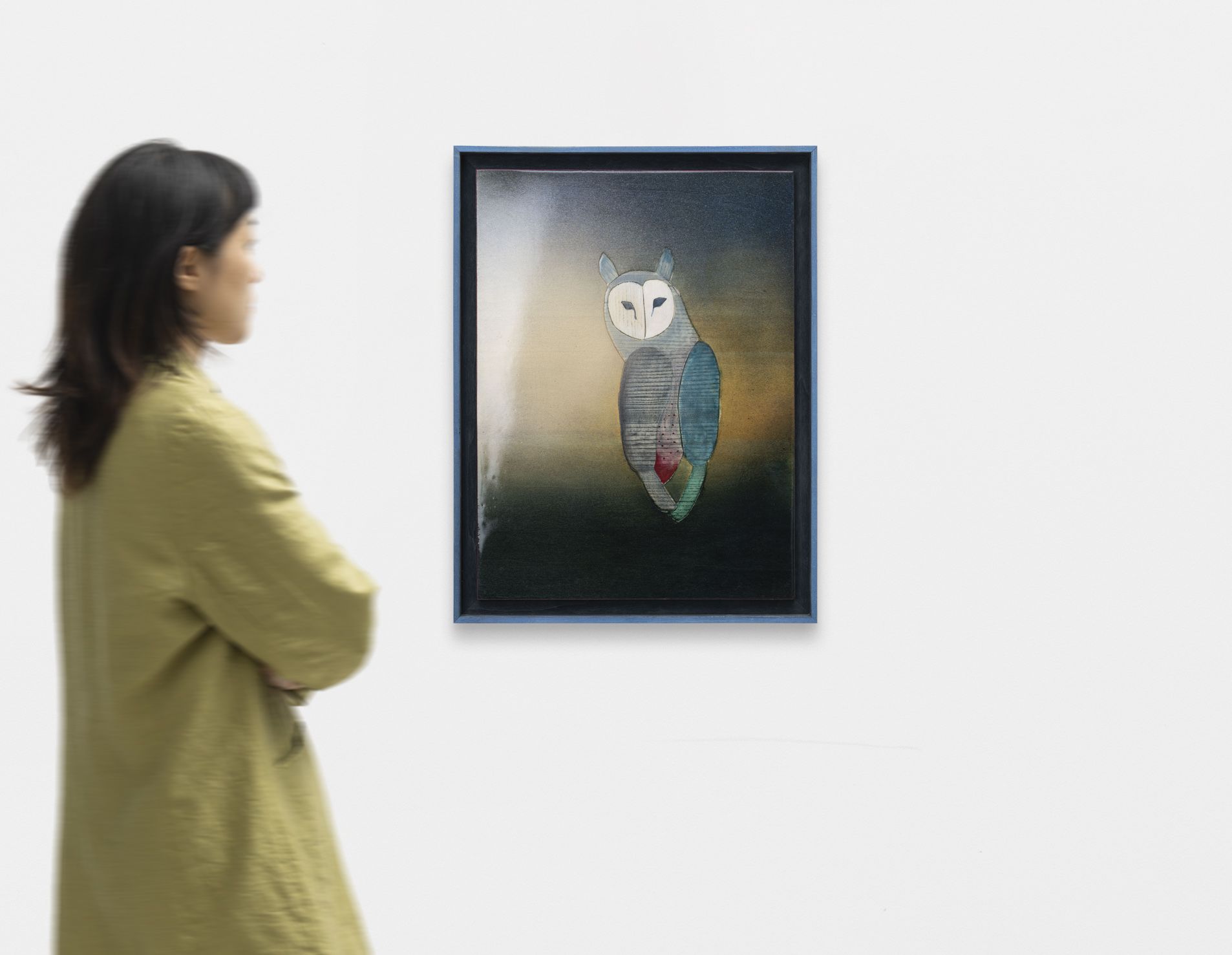


Robert Elfgen’s works thrive on narrative and symbolic density, drawing on biography, everyday observation, and a sensibility for the subliminal poetry of myths and rituals. Landscapes, fauna, figurative scenes and depictions of animals, especially birds, dominate his symbol-laden pictorial world. Loana (2026) is one of his latest paintings on wood, in which he layers wood stain, ink, and metallic spray paint onto wooden supports, then sands back certain areas to reveal the grain. This natural pattern becomes integral to the image, turning into a warm, atmospheric dusk. The visible grain lends the painting a tactile quality, while Elfgen’s controlled use of color and light imbues the work with a subtle romanticism. Like the owl that inhabits the scene, the viewer is invited to adopt a non-anthropocentric perspective: one of watching rather than controlling.
A solo exhibition of Elfgen’s latest work is currently on view at the Berlin gallery through August 1, 2026.
Robert Elfgen (*1972, Wesseling, Germany) lives and works in Cologne and Brittany, France. From 1997 to 2001, Elfgen studied under John M. Armleder at the Braunschweig University of Art (HBK). He studied under Rosemarie Trockel at the Kunstakademie Düsseldorf from 2001, becoming her Meisterschüler in 2004. Selected solo exhibitions include Fuhrwerkswaage, Cologne (2025), PIBI Gallery, Seoul (2022 with An Gyungsu), Sprüth Magers, Berlin (2021), Leopold-Hoesch-Museum, Düren, Germany (2016), Oldenburger Kunstverein, Oldenburg, Germany (2015), Sprüth Magers, Cologne (2008), westlondonprojects, London (2006), and Bonner Kunstverein, Bonn (2005). Selected group exhibitions include Langen Foundation, Neuss, Germany (2025), Villa Stuck, Munich (2017), me Collectors Room Berlin / Stiftung Olbricht (2014), Zentrum für Kunst und Medien, Karlsruhe, Germany, and Sammlung Falckenberg, Hamburg (both 2007–08).


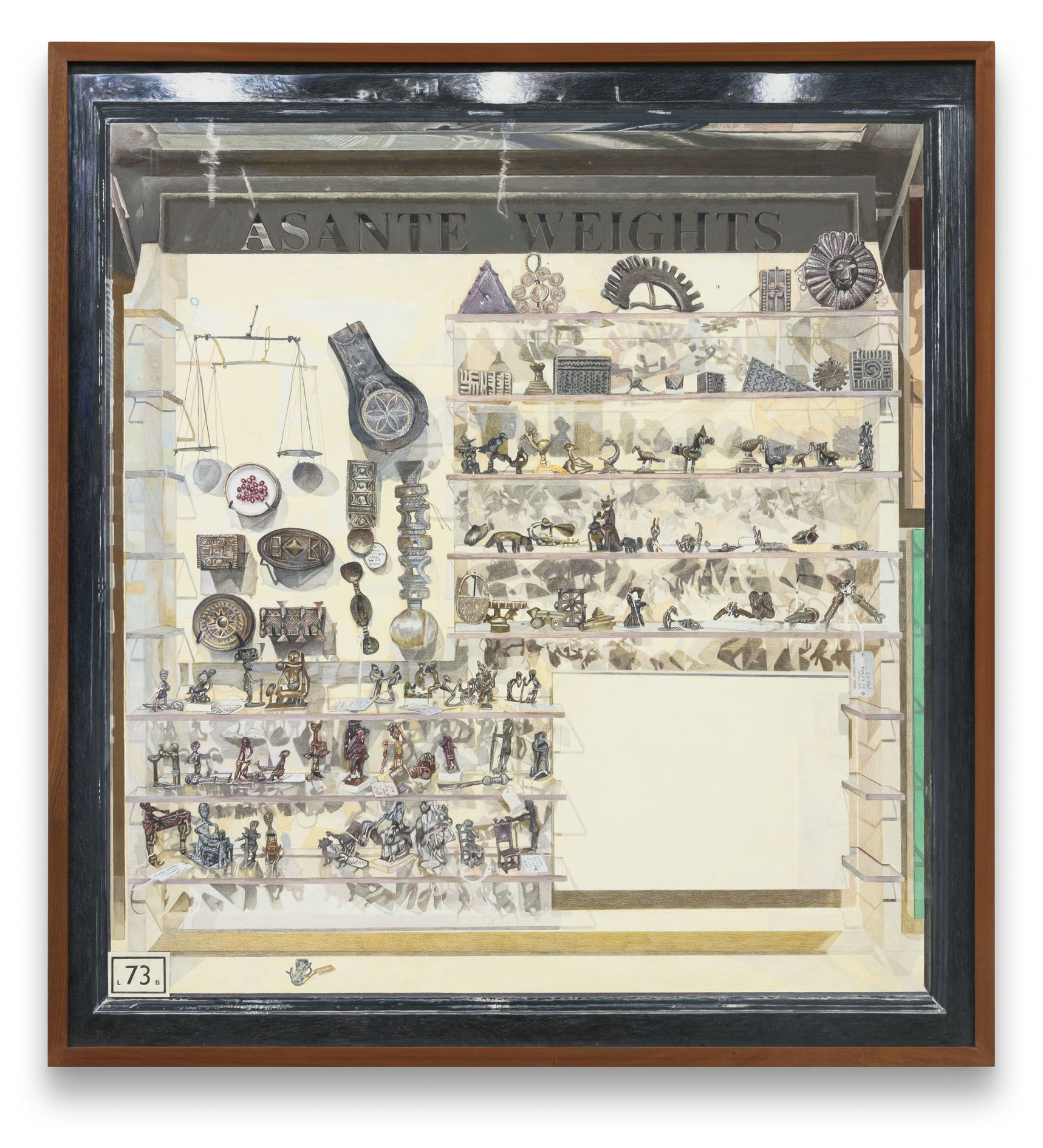
Gala Porras-Kim’s research-driven practice examines how our understanding of cultural artifacts is shaped by the museological and epistemological conventions that dictate their acquisition, preservation, and display. Central to her practice is the act of drawing, intricately detailed images that consider art objects in relation to their historical and contemporary contexts. In 1 Case L.73.B Asante weights at Pitt Rivers Museum (2026), she reproduces a vertical vitrine of Asante weights, Ghanaian objects used for weighing gold, in Oxford University’s Pitt Rivers Museum, which uniquely categorizes its collection based on perceived formal or functional similarities, rather than by geographical or cultural provenance. A refreshing approach to institutional critique, the drawing reveals the tension between the artifacts’ original utilitarian purpose and the decorative nature of exhibition, prompting an intellectual interrogation of the colonial ideology behind encyclopedic museum practices.
Gala Porras-Kim presents a featured installation at the Pavilion of Applied Arts, located in the Arsenale at the 61st La Biennale di Venezia (2026), developed with the late curator Koyo Kouoh, in collaboration with the Victoria and Albert Museum, London.
Gala Porras-Kim (*1984, Bogotá) lives and works in Los Angeles and London. The Colombian-Korean-American artist received her Master of Fine Arts from CalArts, Valencia, CA (2009). She was a Fellow at the Radcliffe Institute for Advanced Study at Harvard University, Cambridge (2019), an Artist in Residence at the Getty Research Institute, Los Angeles (2020–22) and a Fellow at the Museo delle Civiltà, Rome in collaboration with MAO – Museo d’Arte Orientale, Turin (2023–25). Her work has been exhibited at the Carnegie Museum of Art, Pittsburgh (2025), Museum of Contemporary Art Denver (2024), The Museum of Modern Art, New York (2023), Leeum Museum of Art, Seoul (2023), MMCA, Seoul (2023), MUAC, Mexico City (2023), Liverpool Biennial (2023), Gwangju Biennial (2021), São Paulo Art Biennial (2021), and Whitney Museum of American Art, New York (2019, 2017).
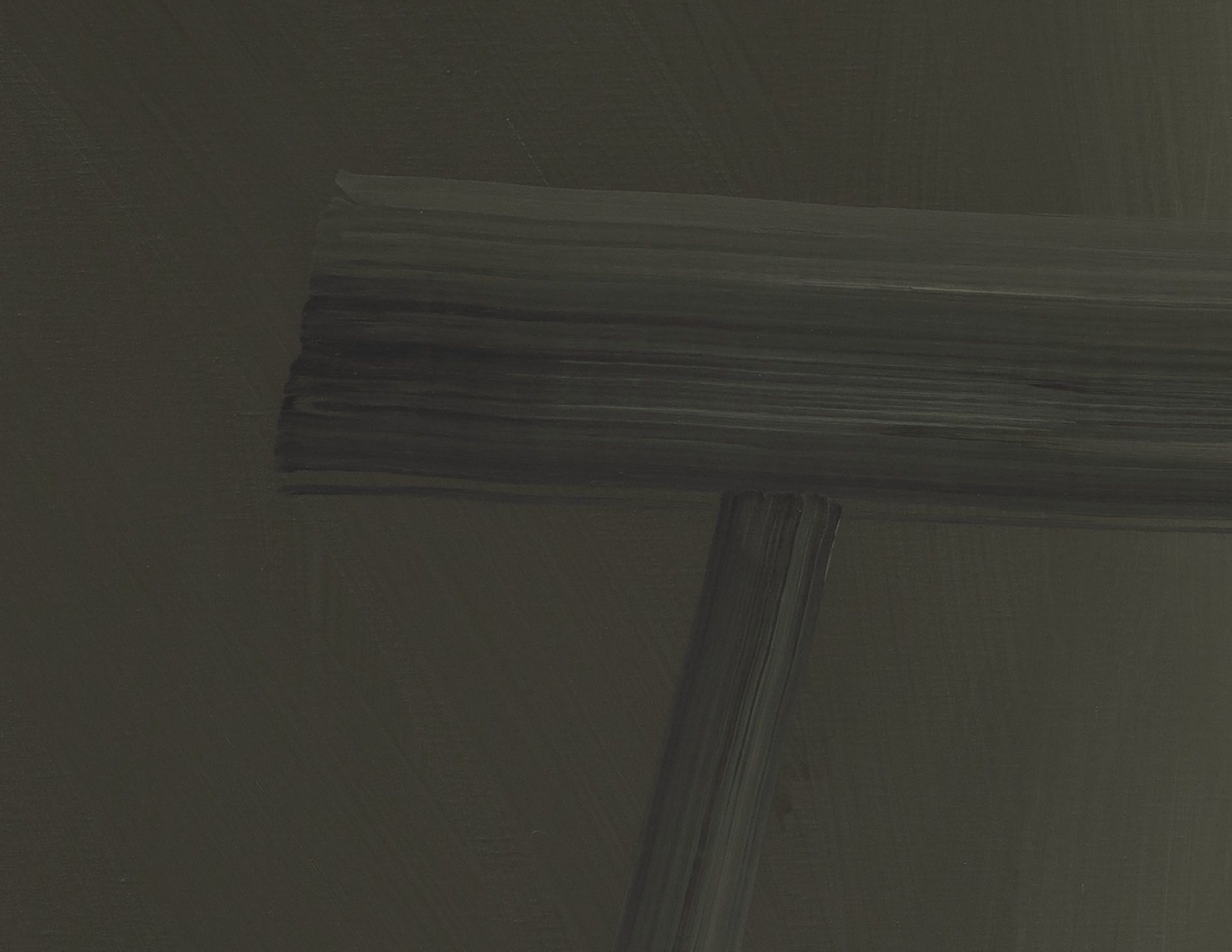


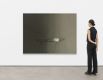
Hyun-Sook Song understands painting to be an act of concentrated meditation that visually records the artist’s state of mind. Her decades-long practice has been defined by a distinctive style: simple compositions of deliberate linework, which are reminiscent of East Asian calligraphy, rendered in egg tempera. In 6 Brushstrokes (2023), Song paints a simple table-like wooden structure with a band of white fabric against a neutral-toned gradient background. The painting is emblematic of the artist’s economy of gesture, naming the number of brushstrokes needed to complete the work. In doing so, Song prompts viewers to identify and trace each measured line, to understand its enigmatic balance of abstraction and figuration by tracking her meticulous movements in its creation.
Hyun-Sook Song (*1952, Damyang, Jeollanam-do, South Korea) lives and works in Hamburg. Her work is currently prominently featured in the group exhibition Isa Mona Lisa at the Hamburger Kunsthalle. The exhibition will run through October 18, 2026. Selected solo and group exhibitions include Hamburger Kunsthalle, National Museum of Contemporary Art, Seoul, Gwangju Museum of Art, Poznan Biennale, Leeum Samsung Museum of Art, Seoul, Mori Art Museum, Tokyo, Asian Art Museum, San Francisco, Berkeley Art Museum, San Francisco, Deichtorhallen, Hamburg. Hyun-Sook Song’s work is included in the collections of institutions, such as Kunstmuseum Bern, Kunstmuseum Bonn, Hamburger Kunsthalle, Kunstmuseum Düsseldorf, Leeum Samsung Museum of Modern Art, Seoul, Mori Art Museum, Tokyo, Fukuoka Asian Art Museum, Seoul Museum of Art, Gwangju Art Museum, and Gyeonggido Museum of Art.

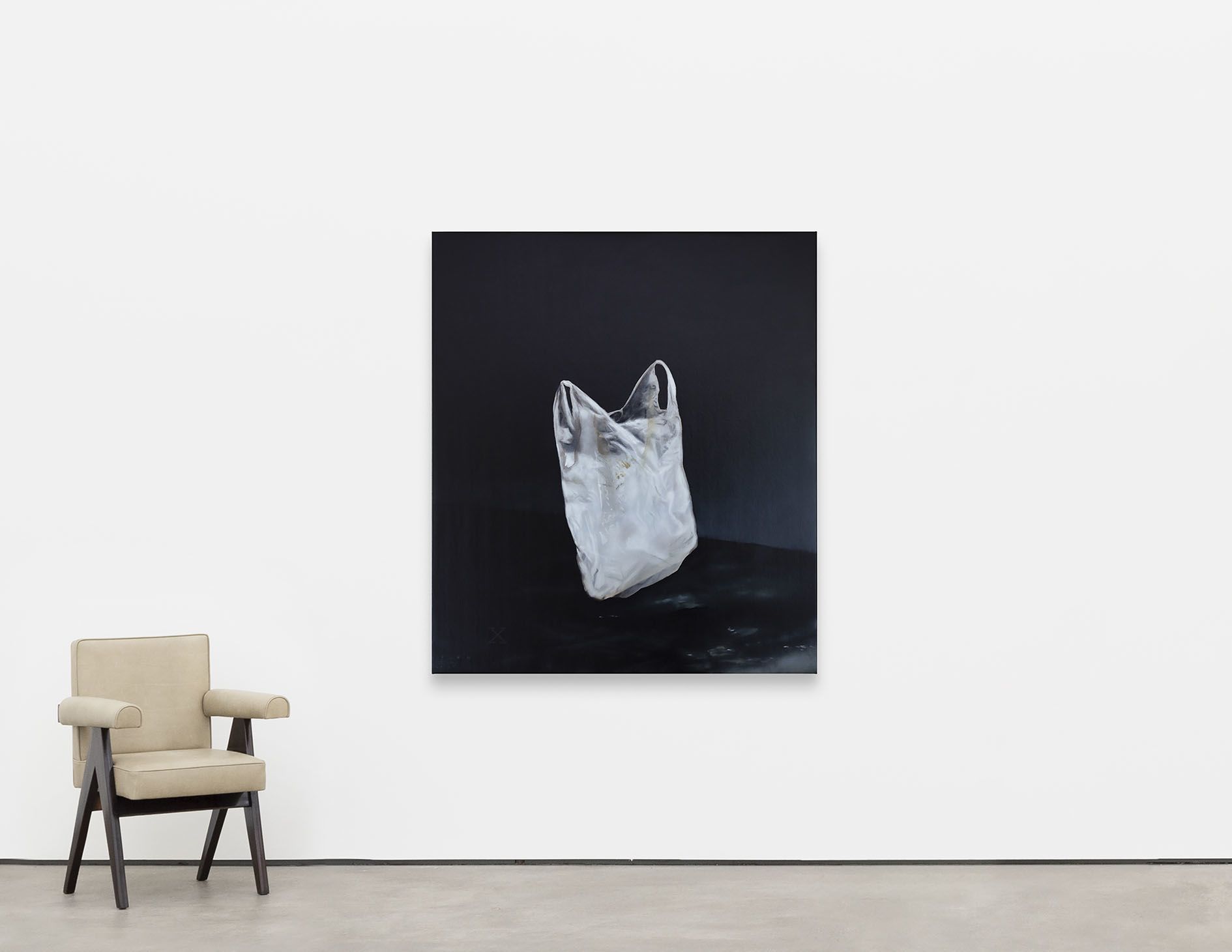


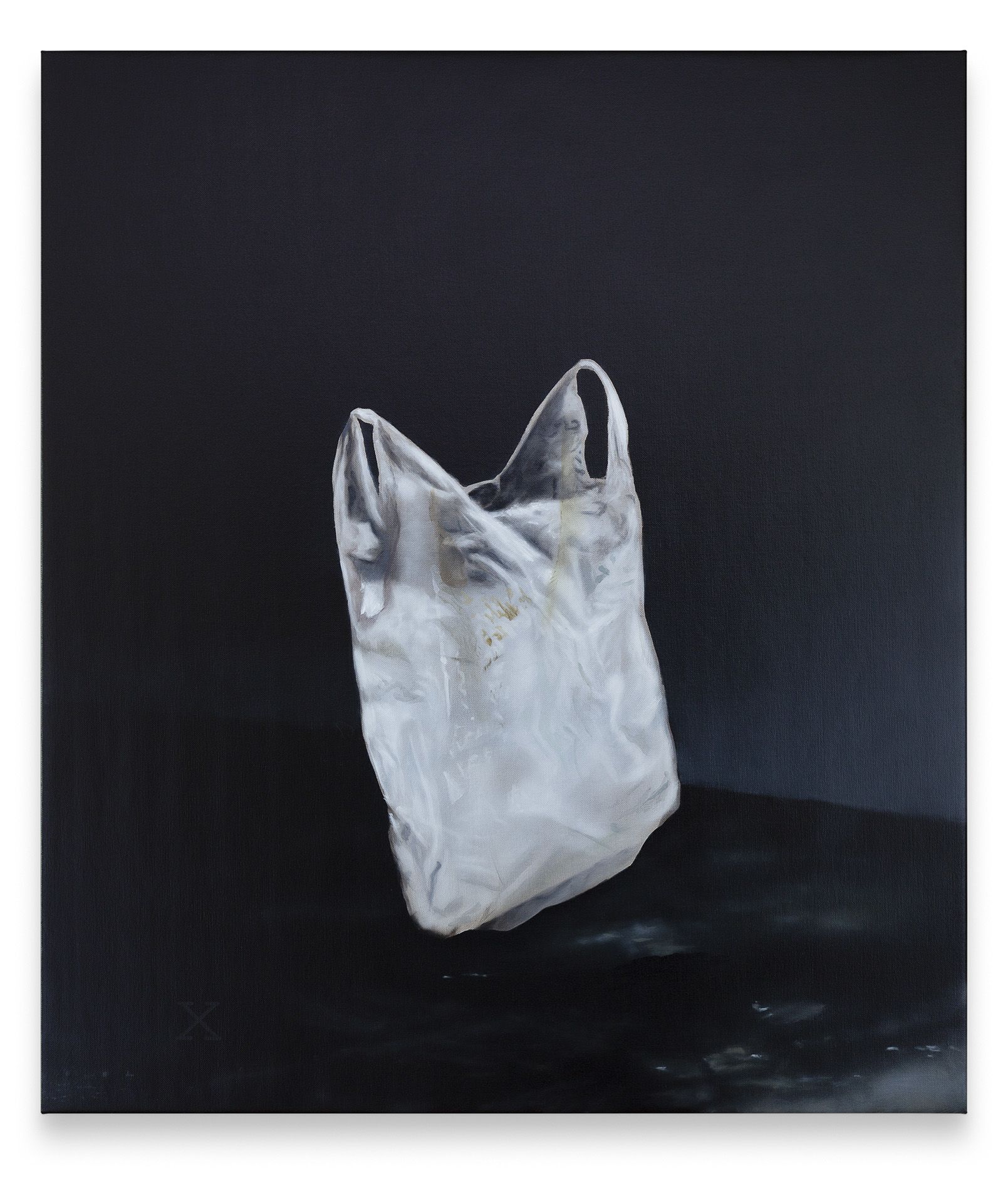
Astrid Klein is one of Germany’s most distinguished conceptual artists. Since the late 1970s, she has played a key role as a European counterpart to the American Pictures Generation, questioning, deconstructing and renewing the relationship between image and text. In Untitled (2025), Klein turns to the still life tradition, inviting a dialogue with Édouard Manet. Like the nineteenth-century master who elevated a solitary asparagus or peonies to objects deserving serious pictorial attention, Klein isolates a castoff remnant of consumer culture, a plastic bag, luminous against a black ground. The compositional logic is strikingly familiar: a single object, frontally placed, its light dissolving into a dark surface below. Yet where Manet’s late works carry a quiet melancholy, Klein’s work imbues the vanitas genre with a contemporary charge. Her object does not fade; it persists, at once discarded and indestructible, in a severe painterly beauty.
Astrid Klein (*1951, Cologne) lives and works in Cologne and Italy. Selected solo exhibitions include Fuhrwerkswaage, Cologne (2024), Odyssey, Cologne (2021), Pinakothek der Moderne, Munich (2020), Falckenberg Collection at Deichtorhallen, Hamburg (2018), The Renaissance Society, Chicago (2017), KW Institute for Contemporary Art, Berlin (2005), Contemporary Art Center, Vilnius (2003), Hamburger Bahnhof, Berlin (2002), Neues Museum/Staatliches Museum für Kunst und Design, Nürnberg (2001), Kunsthalle Bielefeld (1989), traveling exhibition by the Kestnergesellschaft, Hannover, ICA, London, Vienna Secession and Forum Stadtpark, Graz (1989), and the Museum of Contemporary Art, Seoul (1981). Recent group exhibitions include The National Museum of Art, Osaka (2024), Galeria Studio, Warsaw (2022), Kunstmuseum Stuttgart, Vancouver Art Gallery and Sharjah Art Foundation (all 2021), and Ludwig Forum für Internationale Kunst, Aachen (2020). Klein participated in the 14th Sharjah Biennial (2019), Documenta 8 (1987), and the 42nd Venice Biennale (1986).

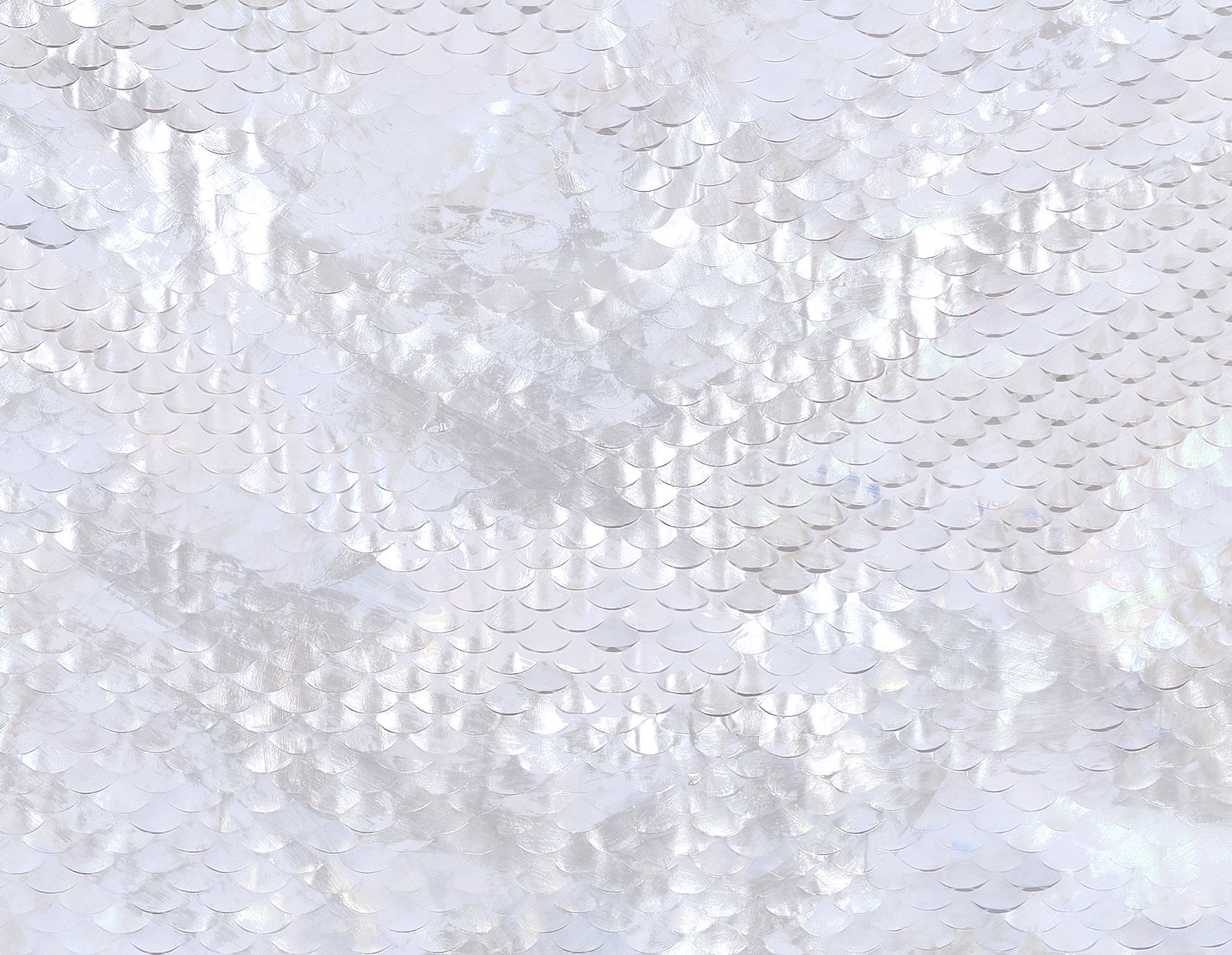


Pamela Rosenkranz’s artistic practice visually explores the profound scientific and sociocultural systems that affect humanity. Her interdisciplinary approach incorporates elements from neurology, art history, biorobotics and literature, a conscious blend of nature and culture. In Rosenkranz’s Healer Scrolls (2021–ongoing), the artist focuses specifically on the simultaneously archaic and contemporary image of the serpent, using ancient kirigami cuts and folds to evoke a pattern that resembles the scales of a snake. Healer Scrolls (Timing Falls) (2026) continues the artist’s negotiation with this squamate form, its scales now rounder and more fish-like, shimmering in a lustrous pearl white. The title of this series references both the historic rolls of paper used to store information and the continuous unrolling movement of scrolling through the internet’s vast wealth of modern knowledge.
Pamela Rosenkranz (*1979, Uri, Switzerland) lives and works in Zurich. Selected solo exhibitions and large scale presentations include Fondazione Sandretto Re Rebaudengo, Venice (2026), Stedelijk Museum, Amsterdam (2025), Neuer Berliner Kunstverein (2024), the High Line, New York (2023–24), Kunsthaus Bregenz (2021), GAMeC, Bergamo (2017), Fondazione Prada, Milan (2017), Kunsthalle Basel (2012), Centre d’Art Contemporain, Geneva (2010). Rosenkranz’s project Our Product was selected for the Swiss Pavilion at the 56th Venice Biennale in 2015. Recent group shows include ARoS, Aarhus, New Museum, New York (both 2026) Kunstmuseum Basel (2025), Deste Foundation, Hydra (2023), Kunstmuseum Winterthur and MIT List Visual Arts Center, Cambridge (both 2022), Schinkel Pavillon, Berlin, and Institute of Contemporary Art, Los Angeles (both 2021), Sharjah Art Foundation, Sharjah (2020), Museum MMK für Moderne Kunst, Frankfurt, Centre Georges Pompidou, Paris, Okayama Art Summit, and the 15th Biennale de Lyon (all 2019).

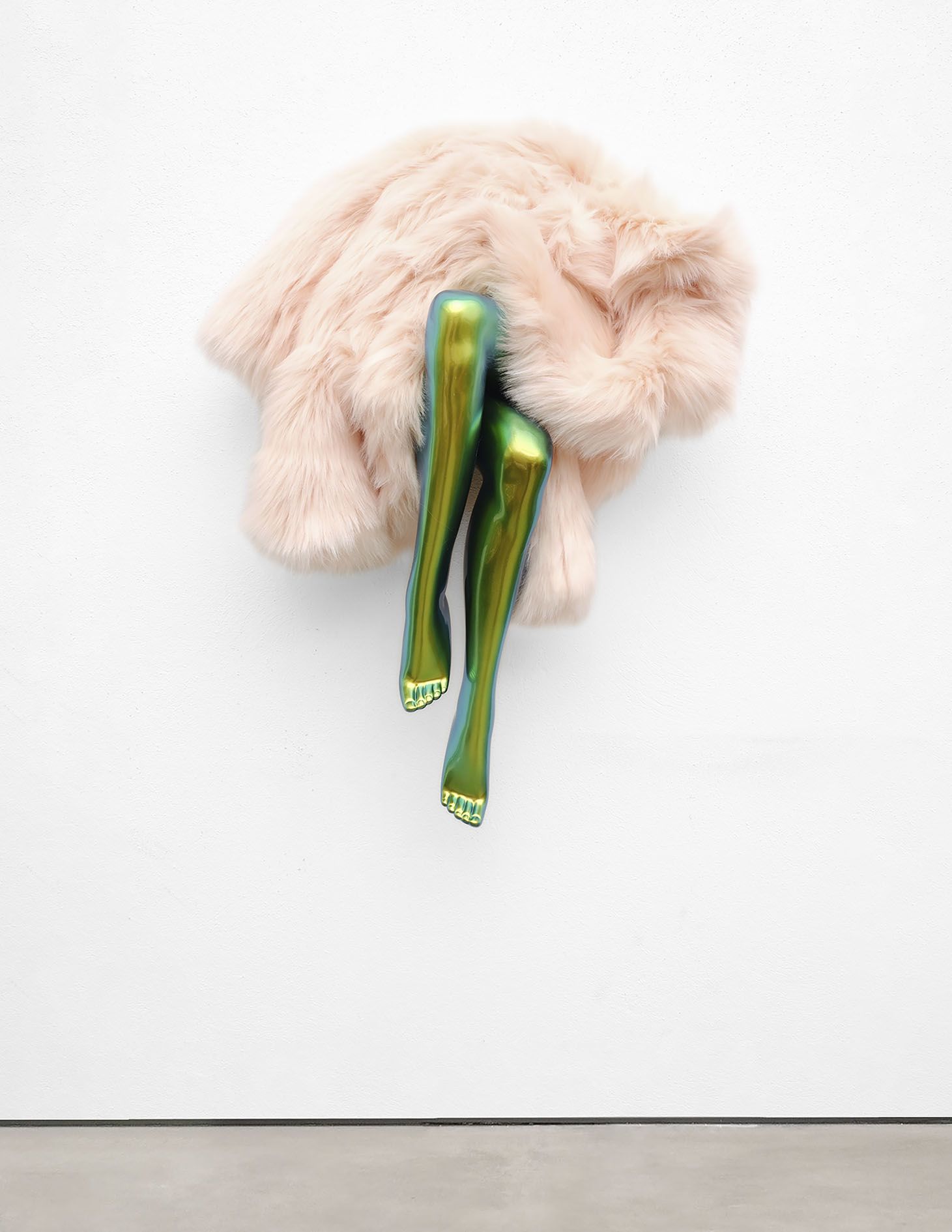


Sylvie Fleury’s multimedia practice explores the interplay between fashion and art, interrogating the politics of consumerism and fetishism. This interrogation is as playful as it is provocative, radically questioning the paradigms of desire and artistic disciplines. Such discourses are evoked by Fleury’s series of mannequin sculptures, which feature the lower half of a fiberglass model coated in sleek car paint, legs crossed, and draped in clothing. In Come and Stay with Me (2025), Fleury’s protruding legs, lacquered in synthetic green and adorned with kitschy pink faux fur, are unsettling. They appear to disquietingly emerge from the wall and stay afloat there, disrupting normative relations between bodies in a mode that recalls Robert Gober’s eerie wax wall sculptures of legs. Yet, Fleury’s legs are simultaneously visually alluring, a precarious position that both invokes and disrupts the aesthetics of materialism.
Sylvie Fleury (*1961, Geneva) lives and works in Geneva. Selected solo exhibitions include Mrac Occitanie, Sérignan (2025), Kunsthal Rotterdam (2024), Kunstmuseum Winterthur (2023), Pinacoteca Agnelli, Aranya Art Center and Bechtler Stiftung (all 2022), Kunstraum Dornbirn, the Instituto Svizzero, Rome (both 2019), Villa Stuck, Munich (2016), Centro de Arte Contemporaneo, Malaga (2011), MAMCO, Musée d’art moderne et contemporain, Geneva (2008–2009), the Mozarteum, Salzburg (2005), ZKM, Museum für Neue Kunst, Karlsruhe, Le Magasin-Centre National d’Art Contemporain, Grenoble (both 2001), The Museum of Contemporary Art Chicago (1995). Selected group exhibitions include Migros Museum für Gegenwartskunst, Zurich (2022/2013), Jeu de Paume, Paris (2020), Grand Palais, Paris (2019), Kunsthaus Zurich (2018), Museum für angewandte Kunst, Frankfurt (2017), Museum Haus Konstruktiv, Zurich (2016), Belvedere, Vienna (2012), Städtische Galerie im Lenbachhaus, Munich (2010), Chelsea Art Museum, New York (2007), MoMA PS1, New York (2006), Collection Lambert, Avignon (2003) and Museum Ludwig, Cologne (2000).


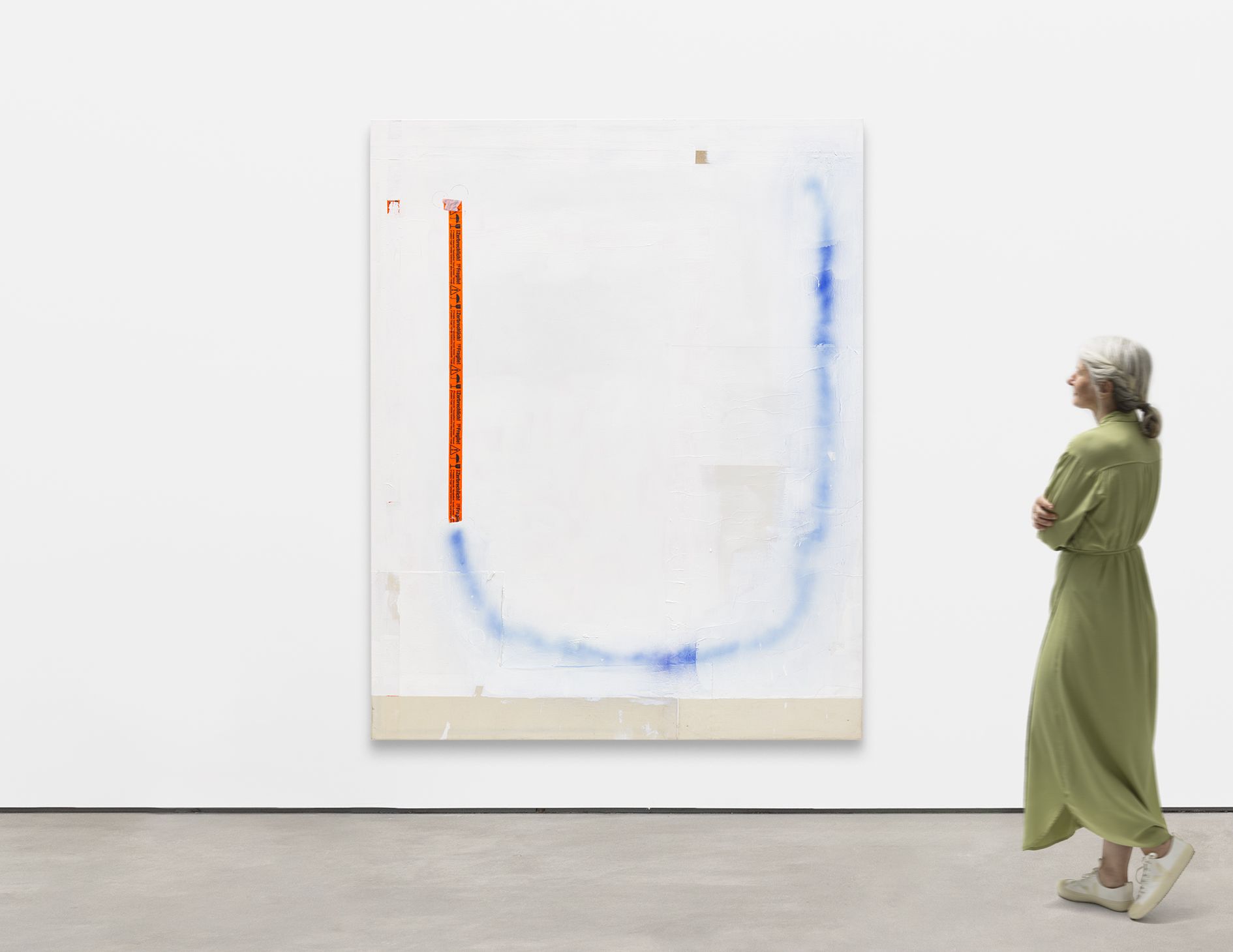


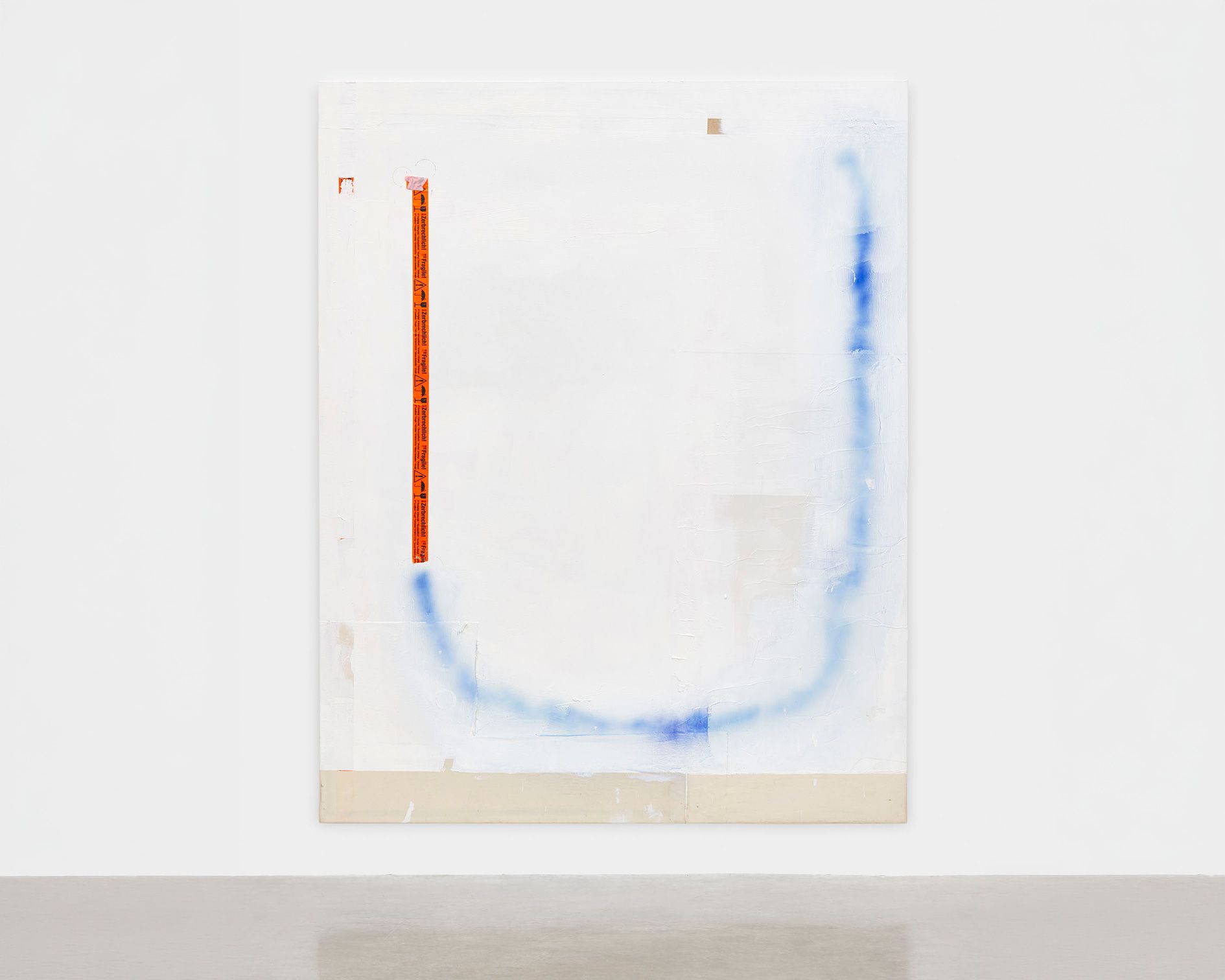
David Ostrowski’s practice continuously engages the concept of total reduction in painting, a conscious rejection of painterly codes and traditions. His recent work directly explores the ontology of painting and its semantics. In Untitled (Letters) (2025), Ostrowski paints an approximation of the letter “U” with a gentle, curved line of blue spray paint and a vertical strip of fluorescent orange packing tape. At first, this elusive symbol seems to be contained within a terrain of white emptiness, but upon closer inspection, the various layers within the painting’s surface reveal a wealth of complexity and sophistication. By painting over collaged remnants from his studio, he creates an elaborately textured field of monochrome. Untitled (Letters) is thus a prime example of how Ostrowski’s practice visualizes notions of the void and absence.
David Ostrowski (*1981, Cologne) lives and works in Cologne. Solo exhibitions include The Perimeter, London (2026), Aranya Art Center, Beidaihe (2025), Fig., Tokyo and Ramiken, New York (both 2023), Lady Helen, London (2020, with Angharad Williams) Avant-Garde Institute, Warsaw (2020, with Tobias Spichtig), Jir Sandel, Copenhagen and Leeahn Gallery, Seoul (both 2020), Sundogs, Paris and Piece Unique, Cologne (both 2019), Wschód, Warsaw (2018); Halle 9 Kirowwerk, Leipzig and Blueproject Foundation, Barcelona (both 2017), Leopold Hoesch Museum, Düren (2016, with Michail Pirgelis), Arken Museum of Modern Art, Copenhagen and Kunstraum Innsbruck (both 2015), Rubell Family Collection, Miami and Fondazione Sandretto Re Rebaudengo, Turin (both 2014). Recent group exhibitions include Standard Oslo and Weiss Falk at XYZcollective, Tokyo (both 2023), Catherine Zeta, Cologne (2022), and Akademie der Künste, Berlin and Fuhrwerkswaage, Cologne (both 2021).
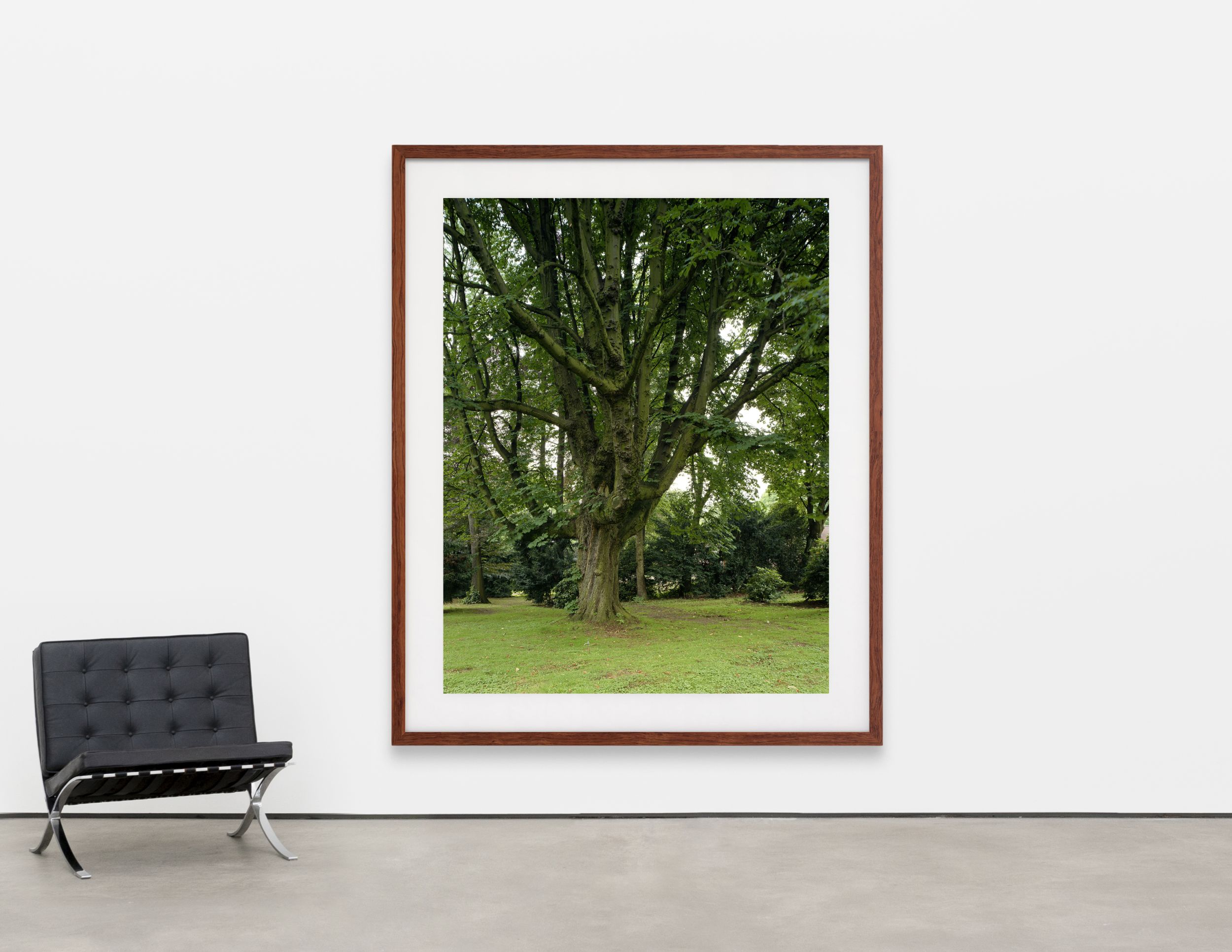

For over four decades, Thomas Ruff has created photographs about photography. His methodical, research-driven approach investigates the norms and practices of the medium and the complex relationship between perception and reality. In his series l.m.v.d.r. (1999–2001), titled after the initials of the architect Ludwig Mies van der Rohe, Ruff photographed van der Rohe’s renovated Haus Lange and Haus Esters in Krefeld, Germany. Beginning as a commission by the Kunstmuseen Krefeld, Ruff sought to find new ways to capture and visually manipulate the two well-documented sites. Instead of directly recording van der Rohe’s constructions, in h.e.k.03 (2000), Ruff focuses on its surrounding greenery—the only instance in the series where a tree takes center stage. The balanced composition of verdant grass and stoic trees appears to have no connection to modernist architecture, reminding the viewer of the inherent exclusionary limitation of photography: the medium cannot capture everything, only what is within its frame.
Thomas Ruff (*1958, Zell am Harmersbach, Germany) lives and works in Düsseldorf. Selected solo exhibitions include Lishui Photography Museum, China (2025), Künstlerverein Malkasten, Düsseldorf (2024), National Taiwan Museum of Fine Arts, Taichung (2021), K20, Kunstsammlung Nordrhein-Westfalen, Düsseldorf (2020–21), National Portrait Gallery Whitechapel Gallery, London (2017), National Museum of Modern Art, Tokyo (2016), S.M.A.K., Ghent, traveled to Kunsthalle Düsseldorf (both 2014) and Haus der Kunst, Munich (2012). In 2022, Thomas Ruff’s solo exhibition d.o.pe. was presented at Sprüth Magers, Berlin. Recent group shows include San Francisco Museum of Modern Art (2022–23), Museo Guggenheim Bilbao (2021), Museum of Modern Art, New York (2019), Tate Modern, London, and Victoria and Albert Museum, London (both 2018).
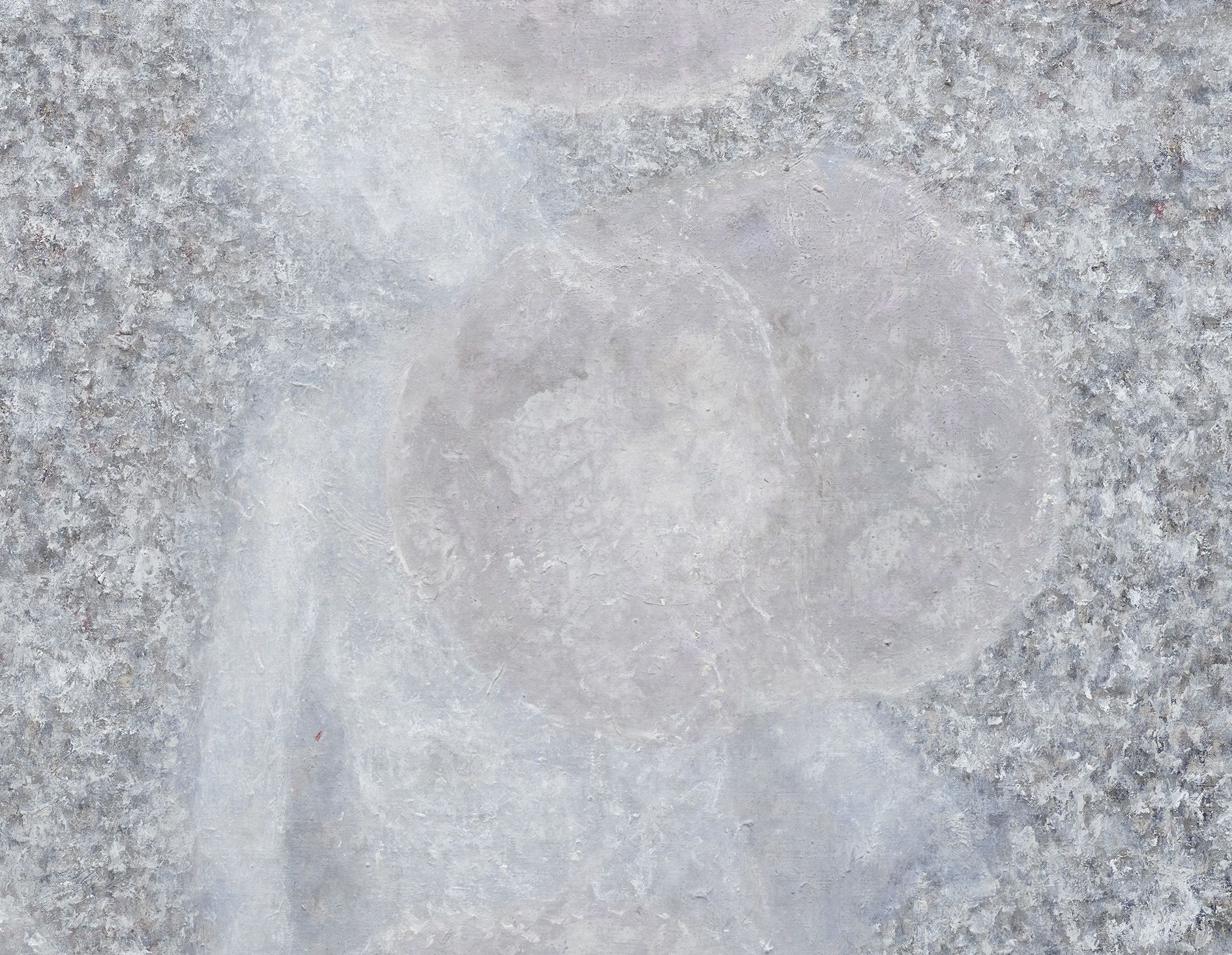


Oliver Bak has become known for his historically inspired, vibrant painterly topographies, which stem from a deep engagement with the materials, procedures and influences of painting. Bak’s textured surfaces evolve by applying thick coats of oil paint mixed with wax and reworking them in a prolonged process of addition and subtraction until his motifs flicker in degrees of opacity. His mottled brushwork and magnetic use of color thus evoke the dreamlike works of Symbolist, Surrealist and Nabi painters. Bak’s newest work, Sleepwalker (2026), conjures a pale spectral figure emerging through large diaphanous forms that drift across the surface like creatures of the deep sea, or petals shed from some impossible flower, scattered across a frozen field of small frost-bleached blooms. Bak’s figures often inhabit such liminal spaces: existing somewhere between stillness and action, between life and death, they unfurl from their backgrounds, as seen in Sleepwalker, to evoke the states of dreaming.
Bak’s works are currently on view as part of the new presentation at Boros Collection, Berlin.
Oliver Bak (*1992, Copenhagen) lives and works in Copenhagen. Recent solo exhibitions include Ghost Driver, or The Crowned Anarchist, Sprüth Magers, Berlin (2024), Caves in the Sky, Cassius & Co, London (2023) and Sick with Bloom, ADZ Gallery, Lisbon (2022). From December 2024 to May 2025, Oliver Bak was part of the group exhibition The Flowers of Evil at the Sammlung Scharf-Gerstenberg, Nationalgalerie – Staatliche Museen zu Berlin.


Engaging histories and practices of post-minimalism, the readymade, and conceptual art, Michail Pirgelis transforms industrial remnants into contemplative art objects, repurposing decommissioned aircraft parts sourced from airplane “boneyards” in the American deserts. Recently, Pirgelis has incorporated stripes and flag-like elements into his sculptural practice. The vertical red and white bands in New Heaven (2025), which come from actual airline logos and branding, recall the work of Daniel Buren, while the industrial material is reminiscent of Donald Judd. Unlike Judd, however, the surface of Pirgelis’ work is marked by holes and rivets, some intentional and others the natural result of weather and time, scuffed surfaces that deliberately counter the pristine finish of canonical minimalism. Leaving traces of history and use intact, Pirgelis’ poignant sculptures evoke questions about historical memory embedded within industrial surfaces.
Michail Pirgelis (*1976, Essen) lives and works in Cologne. In 2026, his work will be featured in a solo exhibitions at Kunstraum Dornbirn. Other recent solo exhibitions include Kunstraum München (2026), Fuhrwerkswaage and Odyssey, both Cologne (both 2022), Braunsfelder, Cologne (2019, with Ruth Wolf-Rehfeldt), Leopold-Hoesch-Museum, Dueren (2016, with David Ostrowski), Autocenter Berlin (2015) and Artothek, Cologne (2011). Selected group exhibitions include Wilhelm Hallen, Berlin (2022), Villa Sarre, Potsdam and byvier, Cologne (both 2021), Ludwig Forum, Aachen and Gewölbe, Cologne (both 2020), DuMont Kunsthalle, Cologne, Kunsthalle Nuremberg; Haus N, Athens and Riot, Gent (all 2019), Athens Biennale; Kunstverein Reutlingen and Marta Herford (all 2018), Rubell Family Collection, Miami (2015), Istanbul Modern (2014), Bundeskunsthalle Bonn (2013), Museum Morsbroich, Leverkusen (2012), Thessaloniki Biennale (2011), Kunstmuseum Bonn (2010) and Stadtmuseum Düsseldorf (2005).


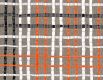

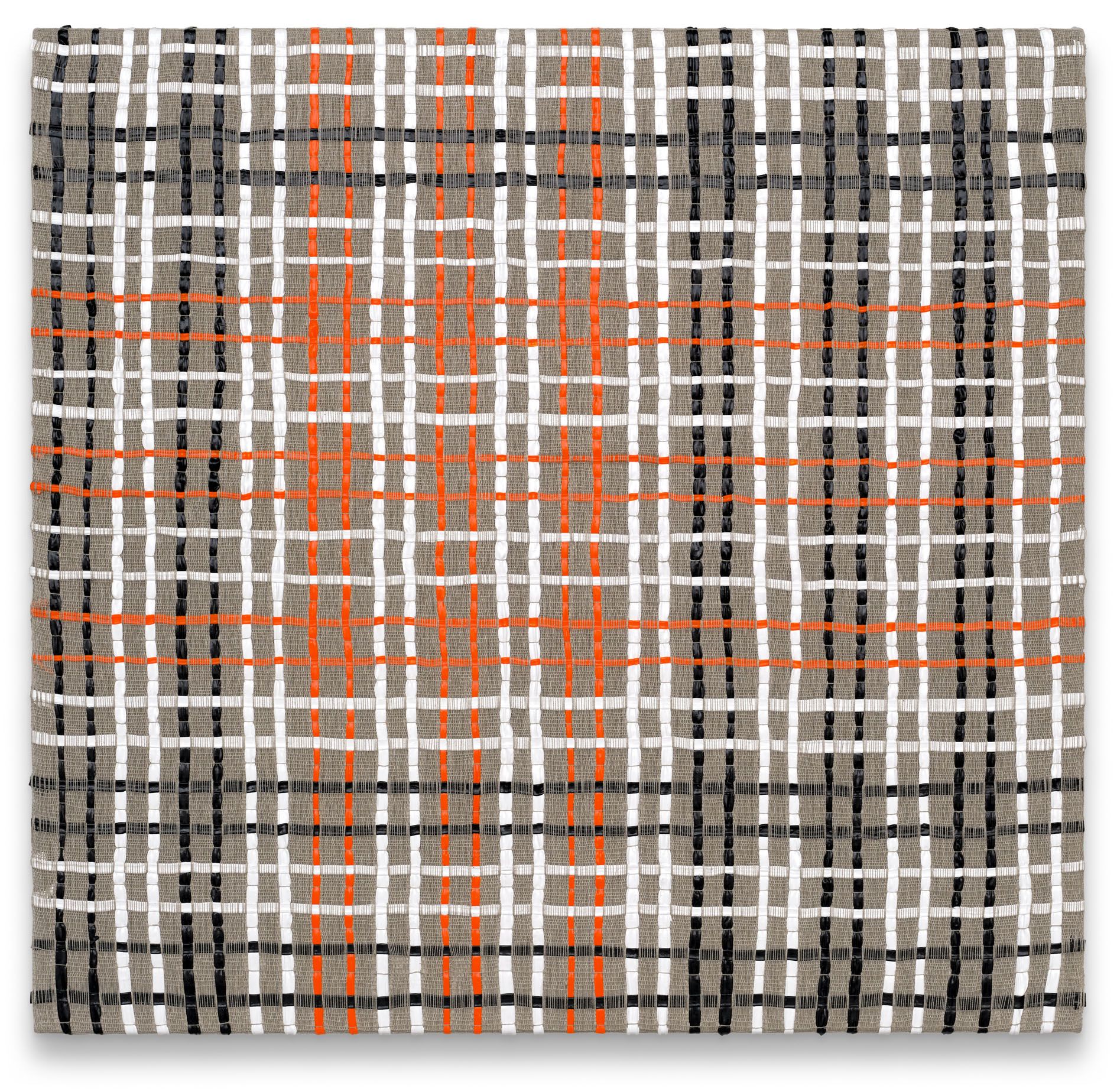
Analia Saban’s singular practice brings together opposing concepts into one work: two and three dimensions, painting and sculpture, digital and analog, industrial and handmade. Her series of woven paintings are no exception. To produce them, Saban weaves linen canvas with “threads” of paint, which she creates by drying thickly painted lines of acrylic into long, pliable strands. Using a Jacquard loom—half of which operates by computer, and half of which requires physical labor—she interlaces the paint with the linen into compositions that hover between representation and abstraction. Woven Plaid as Warp and Weft (Black, White, and Fluorescent Orange) (2026) develops this series yet further with a design reminiscent of plaid fabric, recognizable from centuries of fashion and cultural traditions.
Mesmerizing both in their symmetry and for their intricate process, Saban’s woven works remain in dialogue with the legacies of minimalist and monochromatic painting (including Agnes Martin, Robert Ryman and South American modernists, such as Hélio Oiticica and Mira Schendel), and at the same time reworks painterly conventions, incorporating elements of craft, design, and everyday materials and industries.
Analia Saban (*1980, Buenos Aires) lives and works in Los Angeles. In 2027, a major survey of her work will be on view at the Los Angeles County Museum of Art and the Kemper Museum of Art, University of Washington, St. Louis. Other solo exhibitions include Modern Art Museum Fort Worth (2019), Qiao Space, Shanghai (2017–18), Blaffer Art Museum, Houston (2016), and Armory Center for the Arts, Pasadena (2014). Recent group exhibitions include those at Massachusetts Museum of Contemporary Art (2026), Museum of Modern Art, New York (2025), Palacio Libertad, Buenos Aires (2025), National Gallery of Art, Washington (2024), Getty Research Institute, Los Angeles (2024), Los Angeles County Museum of Art (2023), Sheldon Museum of Art, Lincoln (2022), Clark Art Institute, Williamstown (2020), Hammer Museum, Los Angeles (2018), Aïshti Foundation, Beirut (2016), The National Museum, Oslo (2014), and Palais de Tokyo, Paris (2013).
Art Basel
June 18–21, 2026
Private View: June 16–17
Booth: B19

